 Chromatography
How HPLC Liquid Chromatography Works

The principle of HPLC is often summed up as "just run the sample through the column." In reality, separation hinges on dozens of details: mobile phase composition, temperature, flow rate, sorbent quality, and even sample preparation. If even one parameter drifts, peaks merge and results stop repeating.
Below we'll break down how an HPLC instrument is built, what happens inside the column, which components do what, and how to set parameters for reproducible analysis. This is useful both for those just implementing the method and for experienced operators who want to systematize their knowledge.
What HPLC Is: Where the Method Fits Among Chromatographic Techniques
High-performance liquid chromatography (HPLC) is a method for separating mixtures based on the different rates at which components travel through a sorbent bed in a liquid stream. The sample is dissolved in the mobile phase, pumped through the column under pressure, and separated into components that the detector records one after another.
Unlike gas chromatography, this method handles non-volatile and heat-sensitive compounds: pharmaceuticals, pesticides, vitamins, polymers, dyes. The gas variant won't work here—substances would decompose on evaporation. An HPLC system operates at room temperature or slightly elevated temperature, making it suitable for most organic and many inorganic compounds in solution.
Among liquid techniques, HPLC occupies the high-efficiency niche: fine sorbent (typically 1.5–5 µm) and high pressure (up to 400–1300 bar depending on instrument class) deliver narrow peaks and good resolution in a short time. Classic column chromatography on coarse sorbent can't achieve such results.
In Tashkent laboratories, HPLC is in demand in pharmaceuticals, water and food quality control, forensics, and research. For many methods it is the reference technique cited by industry standards.
The Physicochemical Basis of Separation: Sorption, Partitioning, and Retention
A mixture separates because each component distributes differently between the mobile and stationary phases (the sorbent). In normal-phase mode, the stationary phase is polar and the mobile phase is non-polar: polar molecules are retained more strongly on the surface and elute later. In reversed-phase mode, it's the opposite: the sorbent is non-polar (most often octadecylsilica, C18) and the mobile phase is polar (water with acetonitrile or methanol).
The key concept is the retention factor: the ratio of time a substance spends in the stationary phase to time in the mobile phase. The stronger the interaction with the sorbent, the longer the retention time. This is influenced by:
- molecular hydrophobicity (for reversed phase);
- mobile phase composition and pH;
- column temperature;
- particle size and sorbent porosity.
If two molecules have similar retention factors, they elute as a single peak—the method's selectivity is insufficient. Then you change the eluent composition, pH, or switch to a different sorbent type.
HPLC System Components: Pump, Injector, Column, Detector
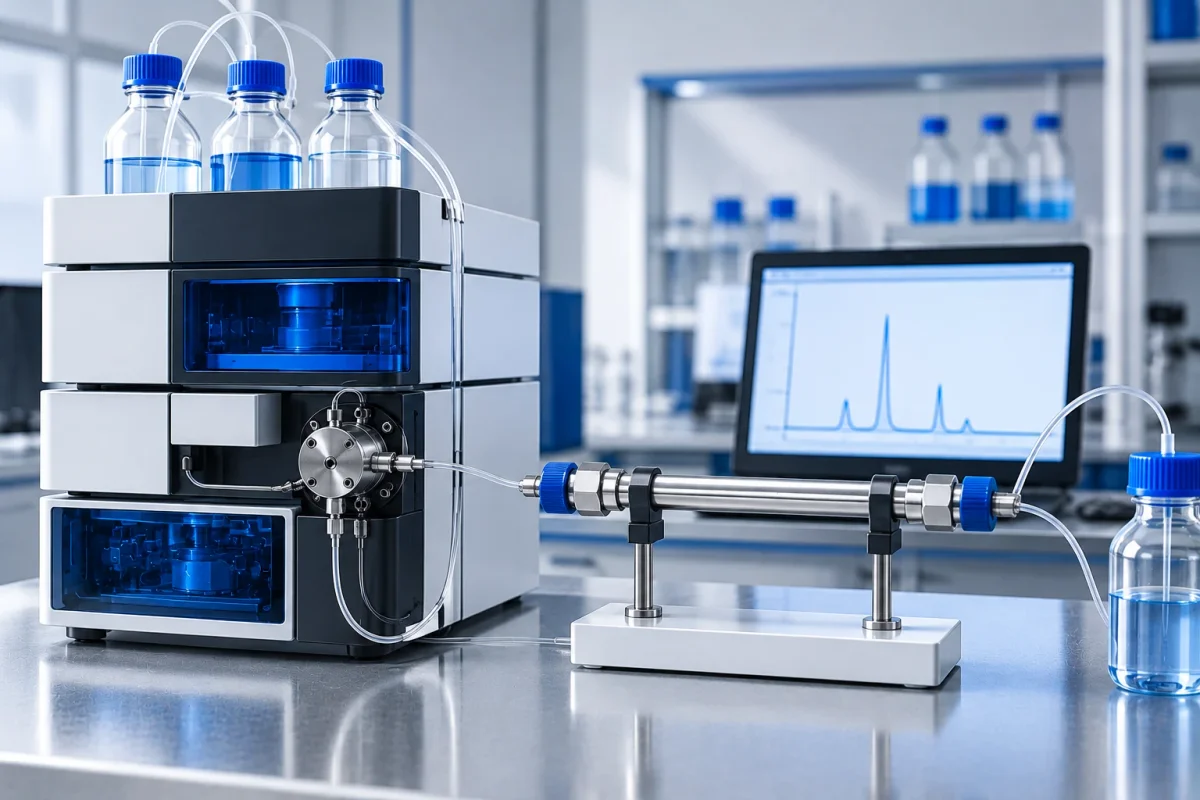
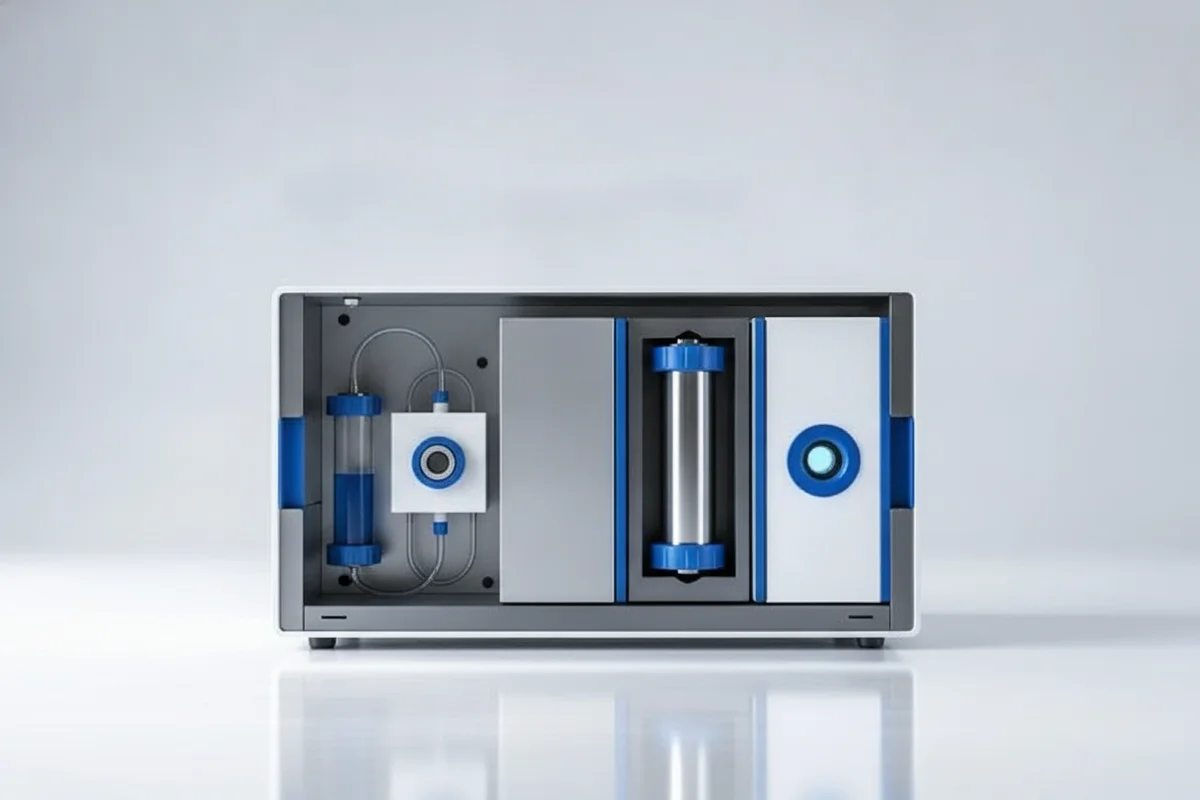
Every HPLC instrument follows the same scheme: eluent delivery → sample injection → separation → detection → data processing. Each component has its own job, and a failure in any of them distorts the result. HPLC system design is best understood component by component.
| Component | Function | What to Monitor |
|---|---|---|
| Pump (typically binary or quaternary) | Delivers mobile phase at a set flow rate and gradient | Flow stability, absence of bubbles, seal wear |
| Degasser | Removes dissolved gases | Vacuum line operation, baseline noise |
| Injector (autosampler) | Precise sample introduction into the flow | Loop volume, needle wash, carryover |
| Column thermostat | Maintains temperature | Stability within ±0.5 °C, no fluctuations |
| Detector (spectrophotometric, fluorometric, mass spectrometric) | Records component signals | Lamp, wavelength, flow cell cleanliness |
The column is the heart of the system—separation in the chromatographic column happens there. Columns are selected by particle size, length, internal diameter, and sorbent type. For routine methods, columns of 100–150 mm with 3–5 µm particles are typical; for fast analyses, shorter columns with smaller particles.
The HPLC schematic is simple but maintenance-intensive: pump seals are replaced on schedule, the detector flow cell is cleaned, the injector loop is checked for carryover. Skipping seal replacement causes flow pulsation, and peak resolution drops before you notice the fault.
Mobile and Stationary Phases: Choosing the Mode and Column
In practice, the choice of mode is dictated by sample chemistry. To separate non-polar and moderately polar compounds, reversed-phase mode is usually chosen: a C18 column and a water/acetonitrile eluent with acid additive. For polar substances, normal-phase or HILIC is the better fit.
Selecting an HPLC column comes down to three parameters:
- Sorbent type: C18, C8, phenyl, amino, silica, ion exchanger—matched to the compound class.
- Geometry: length and internal diameter affect analysis time and eluent consumption.
- Particle size: smaller particles give higher efficiency but also higher pressure.
The mobile phase is prepared from high-purity solvents, filtered through a 0.22–0.45 µm membrane, and degassed. Additives (formic acid, phosphoric acid, buffers) stabilize pH and peak shape. Never use unfiltered solvents: particulates settle on the sorbent and ruin the chromatogram.
Sample preparation and eluent preparation require reagents of appropriate grade. HPLC consumables, including filters and vials, are selected to match the method and sample volume; flow rate, eluent composition, and stationary phase type are documented in the SOP so the next shift prepares the eluent identically.
The Chromatogram and Key Parameters: Retention Time, Resolution, Efficiency
The result of an analysis is a chromatogram: detector signal over time. From it, you assess how well components separated. Key parameters:
- Retention time—the substance's characteristic under given conditions; used for identification.
- Resolution—the degree of separation between adjacent peaks; typically ≥1.5 for quantitative analysis.
- Efficiency—theoretical plate count; indicates how narrow the peaks are.
- Peak asymmetry—deviation from ideal shape; values of 0.8–1.5 are considered acceptable.
These parameters are interdependent. Increasing flow rate shortens analysis time but reduces efficiency. Changing wavelength alters detector sensitivity. Gradient operation improves separation of complex mixtures but demands stable pump and degasser performance.
You can verify system suitability in 20–30 minutes. Run a standard mixture chromatogram → compare peak resolution with the reference value → acceptable if the critical pair stays at ≥1.5. Inject three times: a relative standard deviation of peak area above 2% indicates flow or injector instability.
Regularly run a standard mixture chromatogram to check system health. If resolution drops and asymmetry increases, first check the column and eluent freshness.
How HPLC Works: A Step-by-Step Example with One Sample
Let's walk through what happens when the autosampler injects 10 µL of sample. The pump delivers eluent at 1.0 mL/min, the sample enters the flow and is carried onto the column. There, molecules partition between the mobile and stationary phases: some are retained more strongly on the sorbent, others pass through faster. Sorption and partitioning are the underlying mechanisms.
Separated components elute from the column one by one and are recorded by the detector. Each component produces a peak, and the time from injection to peak apex is the retention time. Peak resolution determines whether each substance's concentration can be quantified separately.
Example calculation: a 4.6 × 150 mm column with 0.65 porosity has a volume of about 1.6 mL. At 1.0 mL/min, eluent passes through the column in roughly 1.6 minutes, and the full analysis with equilibration takes 10–20 minutes. Reduce flow to 0.6 mL/min—analysis stretches to 25–35 minutes, but pressure drops and resolution improves.
The principle of HPLC comes down to one rule: control the partitioning between phases rather than randomly tweaking the instrument. Change eluent composition—check how it affected retention and resolution. Reproducibility rests on repeatability of every step.
Common Startup Mistakes and How to Fix Them
Most problems at the start are not instrument-related but sample preparation-related. Here are common situations and what to do.
| Mistake | Consequence | How to Avoid |
|---|---|---|
| Eluent not degassed | Bubbles in pump, pressure spikes, baseline noise | Use a degasser, prepare eluent in advance and let it settle |
| Sample not filtered | Column clogging, pressure rise, efficiency loss | Filter through 0.22–0.45 µm membrane before injection |
| Wrong eluent pH | Peak broadening, retention time drift | Prepare buffer per method, verify with pH meter |
| Column not equilibrated | Baseline drift, unstable retention | Wash and equilibrate column until signal is stable |
| Carryover from previous sample | False peaks, inflated results | Wash needle and loop, run a blank injection |
The "just run the sample and figure out the method later" approach is costly: a damaged column costs far more than the time spent on preparation. Start by verifying the system with a standard, then move to samples.
How HPLC Differs from Gas Chromatography and When to Choose It
Gas chromatography works with volatile compounds that can be vaporized without decomposition. HPLC requires no vaporization: the sample stays in solution. This determines the method choice.
Choose HPLC when:
- the substance is non-volatile or heat-sensitive;
- you need to analyze samples in water, biological fluids, or food matrices;
- gentle separation without heating is required;
- the method is explicitly specified in a regulatory document.
Gas chromatography remains the choice for volatile organic compounds, gases, and light solvents. For many laboratories, both techniques complement each other, and the choice is dictated by the analytical target.
What You Need to Set Up HPLC Analysis: Instrument, Columns, Consumables
Launching a method starts with choosing a system. The instrument is selected for the task: an isocratic pump suits simple routine methods; a binary gradient pump handles complex mixtures and methods with changing eluent composition. The detector is chosen by sensitivity: spectrophotometric is versatile, fluorometric offers greater selectivity for fluorescent compounds, mass spectrometric provides maximum information but requires skilled personnel.
The system requires:
- a set of chromatographic columns for your methods;
- guard columns to protect the main column;
- filters and membranes for eluents and samples;
- vials, caps, syringes, and needles;
- reagents for preparing eluents and standards;
- spare pump seals and maintenance parts.
It's convenient to purchase consumables as a kit for a specific method so work doesn't stop due to missing filters or vials. Columns and chromatography accessories should be selected with resource margin: column lifetime depends on sample and eluent purity, and with careful work it's noticeably longer. For storing eluents and solutions, borosilicate glass 3.3 with low leaching is suitable.
Frequently Asked Questions
Can one column be used for different methods?
Yes, if the methods use the same sorbent type and compatible eluents. Between switches, the column is washed and equilibrated. For methods with different pH and solvents, it's better to have separate columns: this reduces the risk of incompatible residues and carryover.
How often should the column be replaced?
There's no strict schedule: judge by the chromatogram. If resolution drops, asymmetry increases, and washing doesn't help, replace the column. With careful work using filtered samples and clean eluent, lifetime is noticeably longer.
Is a degasser needed if the eluent is prepared in advance?
A degasser is needed for stable pump operation and a flat baseline. Even pre-prepared eluent absorbs gases on contact with air. This is especially important for gradient methods.
How can I tell if the problem is the column and not the instrument?
Run a standard mixture chromatogram. If peak shape and resolution are reproducible and pressure is stable, the column is likely fine, and the cause lies in the sample or eluent. If the pattern repeats run after run and doesn't change after washing, check the column.
How to transfer an HPLC method to a different column without losing separation
Swapping the column is the most common reason a validated method goes off the rails: peaks shift, resolution drops, and the chromatogram no longer matches earlier results. The culprit is the sorbent geometry. Retention in HPLC is proportional to the volume of the stationary phase, which in turn depends on particle diameter, column internal diameter, and length.
The conversion is done by comparing column volumes. Pull the certificate data for both columns and calculate the retention-time transfer factor:
- column volume V = π × (d/2)² × L × porosity; for a rough estimate the ratio (d₁² × L₁) / (d₂² × L₂) is enough;
- example: a 4.6 × 150 mm column is replaced with a 2.1 × 100 mm one; the ratio is (4.6² × 150) / (2.1² × 100) = 3174 / 441 ≈ 7.2;
- retention time on the narrow column will drop roughly 7-fold, and the flow rate is lowered from 1.0 to 0.3 mL/min so pressure doesn't spike.
After the transfer, adjust the injection volume: on a 2.1 mm column it should be 4–5 times smaller than on a 4.6 mm one, otherwise the peak will broaden and resolution will suffer. Verify the result against a test mix: resolution between the critical pair of peaks must stay at or above 1.5.
If you switch to a column with 1.7 µm particles instead of 5 µm, efficiency triples, but pressure rises about 9-fold. For a standard HPLC with a 400 bar limit such a swap is a non-starter: you'll need a system rated for 1000 bar and above.
What documents and standards accompany HPLC analysis
An HPLC result only counts when it can be reproduced and backed up on paper. For internal reporting, a working logbook is enough, but product acceptance, raw-material testing, or handing data to a client requires a full document package.
| Document | What it records | Who prepares it |
|---|---|---|
| Test report | Method conditions, chromatograms, numerical result | Laboratory |
| SOP for the method | Step-by-step analysis procedure and acceptance criteria | Method developer |
| Verification/calibration log | Authorization of the instrument and balances for use | Metrologist |
| Column and eluent lot certificates | Traceability of consumables | Supplier |
Check three things before you accept a report from a contractor. The report must state the column number and its lot. The method conditions (eluent, flow rate, temperature, wavelength) must match what was agreed. The chromatogram must come with a table of numerical values, not just a picture.
If the lab operates under an accreditation scope, the report should reference the certificate. For internal work accreditation isn't mandatory, but the method must be validated at least for repeatability: three replicate injections, with a relative standard deviation of peak area no higher than 2%. Reagents and standards are prepared using Class A and B volumetric glassware so that volume error doesn't stack on top of method error.
Conclusion
HPLC is a technique where the result depends not only on the instrument but also on preparation: eluent purity, sample filtration, column stability, and a sound method. If you're just planning to start an analysis, begin by choosing a system, columns, and consumables to match your specific methods, then run a check against a standard. LPS UZ supplies analytical and general laboratory equipment, chromatography columns, and consumables; our specialists will help you select an instrument and a set tailored to your lab's needs and will prepare a quotation based on your list.