 Weighing
Sartorius Laboratory Balances for Every Task

You choose Sartorius laboratory balances when the weighing result affects the outcome of the analysis, not just gets logged in a journal. A 0.5 mg error when preparing a standard solution means recalculating the whole series and revalidating the method.
Making sense of the product lines is easy if you start from the task: how much you weigh, with what accuracy, and under what conditions the instrument will sit. Below is a breakdown of model classes, selection criteria, installation, and calibration so you can write a request without extra back-and-forth.
Sartorius Laboratory Balances: Why This Brand for the Lab
Sartorius makes weighing and biotech equipment. In lab practice, its models show up where reproducibility matters: pharmaceutical QC, standard preparation, food and chemical analysis, teaching and research labs.
The brand covers the full range: from Sartorius analytical-class balances with 0.1 mg readability to platform and technical models handling tens of kilograms. Within the lines there are common traits: overload protection, built-in weighing applications, stability filters, and PC data transfer. That's why Sartorius lab balances get picked for a variety of tasks, not just one method.
For the lab, that means predictability: accessories, consumables, and calibration procedures are documented by the manufacturer, and service support isn't limited to one city. If you're comparing options by accuracy class and price, it's worth looking at [alternative balance and equipment brands for comparison](/brands/263-dlab-scientificcoltd) and the [overview of brands supplied by LPS UZ](/brands) to see the full assortment.
Sartorius Analytical Balances: When 0.1 mg Readability Is Needed
Sartorius analytical balances are the class of instruments with 0.1 mg readability and a working range usually up to 100–320 g. They're chosen when the sample is in milligrams: reference standards, active ingredients, microsamples, calibration solutions.
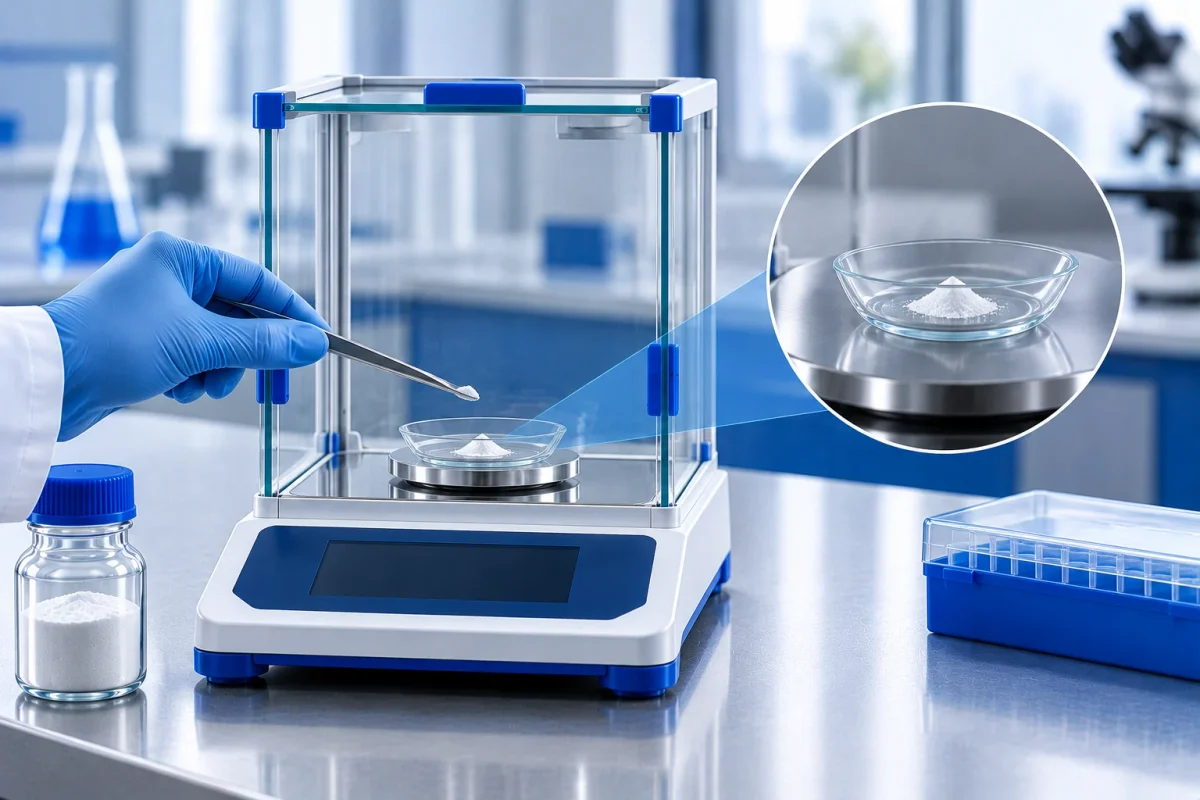
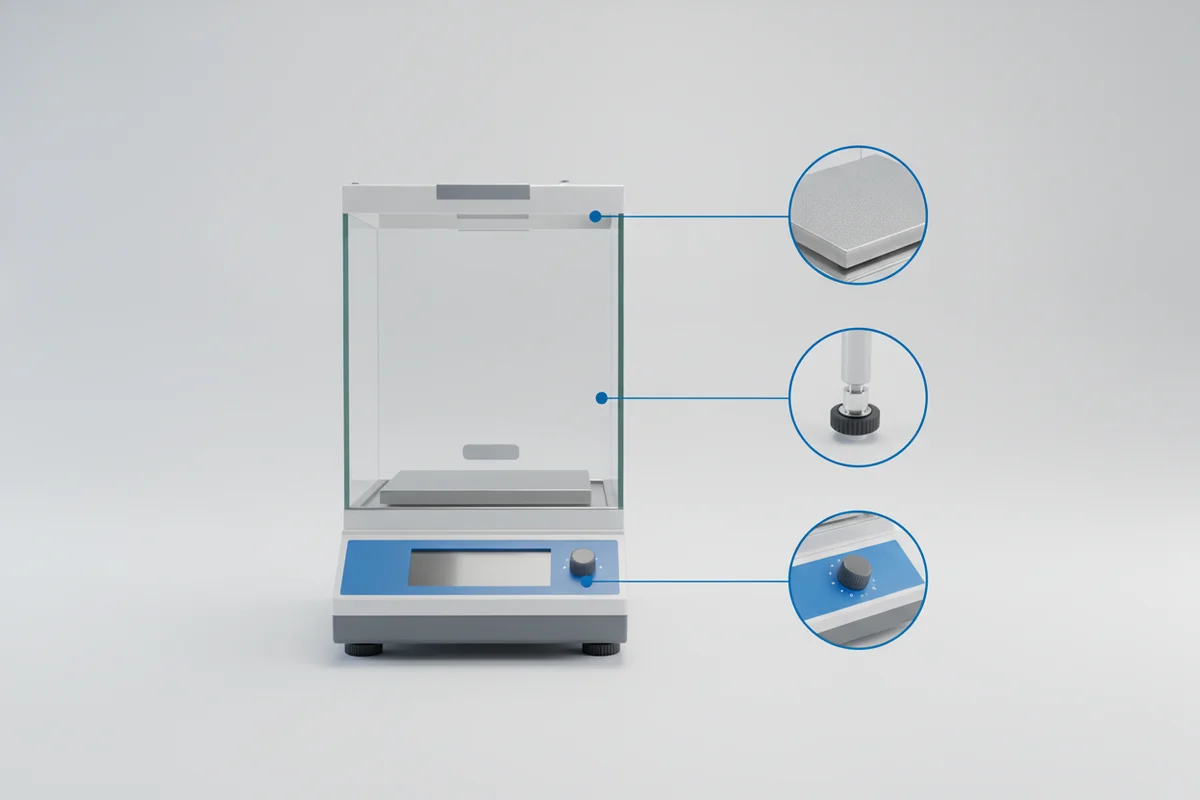
The key feature of such a model is the draft shield. Without it, air currents shift the reading more than the mass being measured. Inside the chamber you'll find the pan, shields, and a spill tray for collected powder.
Typical tasks where Sartorius analytical balances are justified:
- preparing standard solutions with 0.1 mg accuracy;
- weighing small reagent samples for methods with tight tolerances;
- checking the mass of filters and precipitates in gravimetry;
- verifying dosing in pharmaceutical production.
For these operations, readability matters more than range: a 120 g model with 0.1 mg steps covers most tasks, while the 320 g version is needed when you have to weigh larger containers together with the sample. Weighing milligram samples without draft protection almost always gives more scatter than the spec sheet. If you're looking for Sartorius 0.1 mg balances to meet standards, start with this line.
Precision and Technical Models: Weighing Samples, Reagents, Containers
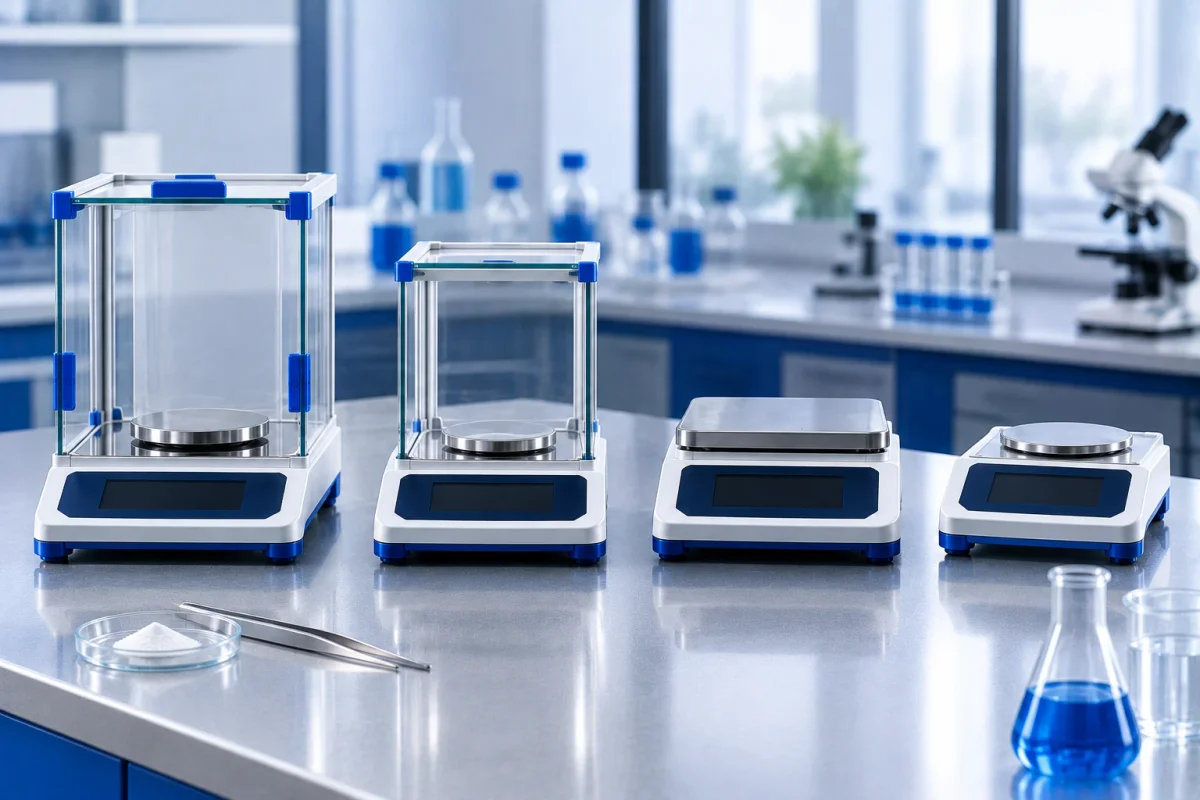
Sartorius precision models offer readability from 1 mg to 0.1 g and ranges up to several kilograms. This is a workhorse for weighing medium-mass samples, reagents, prepared mixes, and containers when microgram accuracy isn't needed but reading stability is.
Sartorius technical balances are platform and benchtop models with steps from 0.1 g and up. They're used for larger samples, preparing samples for drying or milling, and tracking consumables. A stainless steel platform and dust protection are handy in production areas.
The practical rule for selection is simple: first determine the smallest sample you weigh regularly, then choose a readability ten times smaller. If the smallest sample is 50 mg, 1 mg steps give a reasonable margin, and 0.1 mg steps give comfortable accuracy when working with standards.
| Class | Readability | Typical range | Task |
|---|---|---|---|
| Analytical | 0.1 mg | up to 100–320 g | standards, microsamples |
| Precision | 1–100 mg | up to 2–6 kg | samples, reagents, containers |
| Technical | 0.1–1 g | up to tens of kg | large samples, tracking |
Key Specifications When Choosing: Range, Readability, Calibration, Interfaces
Look at five parameters and your lab balance choice narrows to two or three models. First is maximum load: take it with a 10–20% margin over your heaviest container plus sample.
Second is readability, already covered above. Third is calibration method: internal automatic is more convenient for daily work, external with weights is cheaper to maintain and works if you already have a weight set.
Fourth is interfaces. To transfer data to LIMS or Excel you need an RS-232, USB, or Ethernet port; for label printing, a printer connector. Fifth is protection from external influences: level, draft shield, stability filters.
If you're planning to [buy laboratory balances](/categories/117-obshhelaboratornoe-oborudovanie) for a specific method, prepare a list: minimum and maximum sample, required readability, whether you have weights, and whether verification is needed. With that data, selection takes one conversation instead of a week of emails.
Where to Set Up the Balance: Anti-Vibration Plate, Draft and Static Protection
Analytical balances are sensitive to three things: vibration, drafts, and static charge. Put the instrument on a rigid anti-vibration plate or a massive table fixed to the wall, not to the shop floor. Nearby there should be no compressors, centrifuges, or doorways with active traffic.
Checks you can do yourself:
- Place a weight on the pan and lean your hand on the table: the reading should return to its original value within seconds without jitter.
- Turn on the fume hood or air conditioner at working speed: if the reading drifts, move the balance or install a shield.
- Wipe the pan with an antistatic cloth and repeat the weighing: a difference in the third digit indicates accumulated charge.
Keep room humidity in the 40–60% range and temperature stable. Sudden fluctuations cause zero drift that's easily mistaken for a fault. Balances for pharmaceuticals and balances for chemical labs are placed in separate rooms, away from the weighing area with large samples.
Calibration and Verification of Sartorius Balances: What to Order and How Often
Calibration of laboratory balances confirms that the instrument shows mass within the stated error. Verification is an official procedure with a document issued by accredited organizations. For labs following methods with specified accuracy, verification is often mandatory.
Internal calibration in Sartorius models runs automatically on a schedule or when temperature changes. This maintains stability between external procedures but doesn't replace official verification.
Approximate frequency: external calibration once a year, more often under intensive use or after repair. Schedule verification in advance so you don't stop the method mid-series. Requirements for non-automatic weighing instruments are described in OIML R 76, and the manufacturer provides installation and calibration recommendations.
Accessories and Consumables for Sartorius Balances
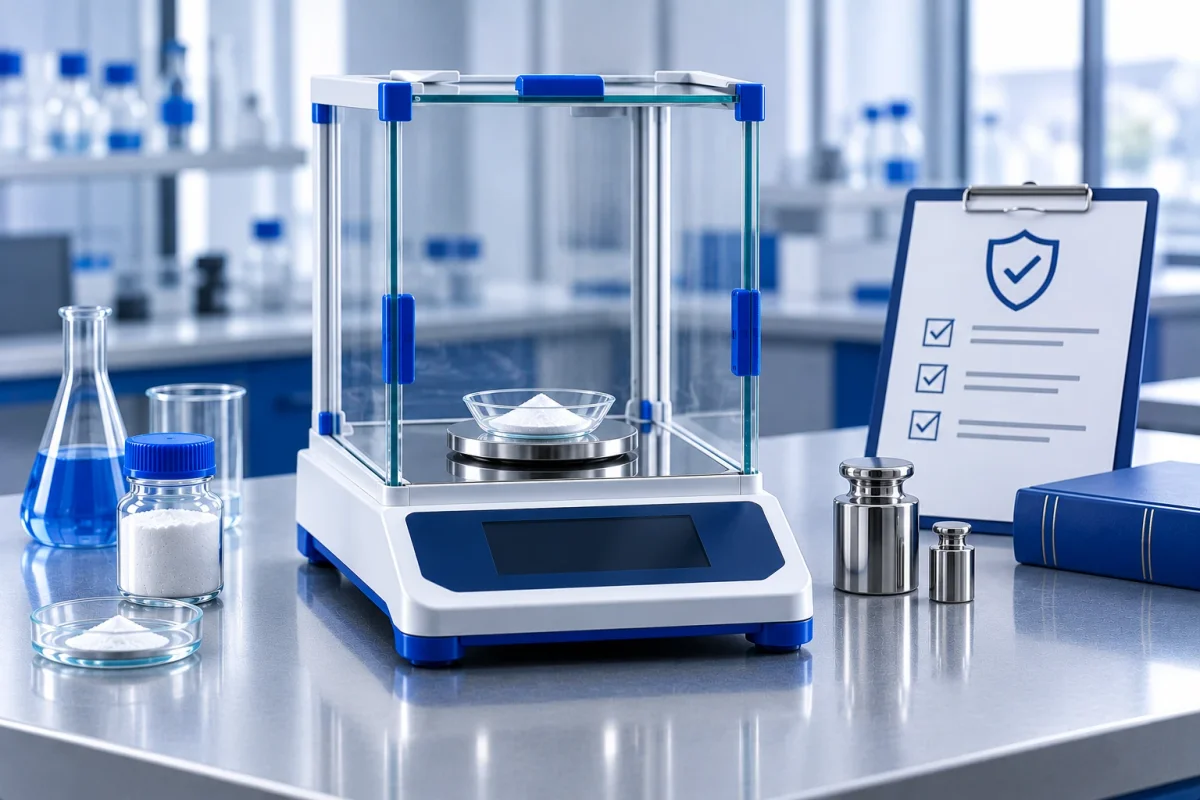
The accessory kit determines how smoothly the balance fits into your workflow. The minimum set for an analytical model: a weight set for external calibration, antistatic ionization or cloths, spare pans and draft shield panels.
For precision and technical models, you more often need platforms for specific containers, trays for weighing powders, and a label printer. If data goes to an information system, add a cable and adapter for the right port.
Consumables are replaced as they wear: pan, draft shield mesh, weights. Keep one spare weight and pan per lab so you don't wait for a delivery when they get contaminated. Choose glass chamber parts from [borosilicate glass 3.3](/blog/borosilikatnoe-steklo-3-3): it withstands temperature changes during washing.
How to Buy Sartorius Balances in Tashkent via LPS UZ: Supply, Installation, Service
A request starts with the task, not the model. Describe what you weigh, the minimum and maximum sample, the required readability, whether you already have weights, and whether verification is needed. Based on that, a model and accessory kit are selected.
Then supply, installation, and training are discussed. Sartorius balances in Tashkent are in demand in pharma, food control, and research institutions, so agree on the installation and calibration schedule for your method in advance.
| Stage | What to Prepare | Result |
|---|---|---|
| Request | samples, readability, method | model selection |
| Approval | installation site, power, PC | installation plan |
| Startup | weights, table, anti-vibration | reading check |
| Maintenance | calibration schedule | stable results |
To [buy Sartorius balances in Tashkent](/contacts) for your task, send a list of samples and accuracy requirements: a proposal will be prepared and the accessory kit clarified. Laboratory balances for the lab are selected the same way: from the minimum sample to the model.
Calculating Sample Size with the Balance in Mind: How Not to Ruin the Analysis
0.1 mg readability doesn't mean you can weigh any sample in that range with that accuracy. Analytical balances have a minimum working weight: below it, relative error grows quickly. For most 0.1 mg class models, the minimum sample at which deviation stays within 0.1–0.2% is around 10–20 mg. Weigh 5 mg of standard and a 0.1 mg error gives 2% scatter, enough to fail method validation.
Estimating the allowable sample is easy: divide readability by the required relative error. For 0.1 mg and 0.1% error, the minimum is 100 mg. If the method calls for less, choose a balance with 0.01 mg steps or prepare a standard solution with subsequent dilution. The reverse rule for the upper limit: the heaviest container plus sample must not exceed the maximum load with a 10–20% margin.
Example Calculation for Standard Preparation
You need to prepare 100 mL of a 1 mg/mL solution, meaning weigh 100 mg of substance with 0.1% accuracy. A 100 mg sample with 0.1 mg readability gives exactly 0.1% relative error—that's borderline. Choose a balance with 0.01 mg steps: the same sample gives 0.01%, and the method passes with margin. You can't skimp on balance class in such tasks: redoing the standard costs more than the price difference between instruments.
| Sample | 0.1 mg Readability | 0.01 mg Readability | Conclusion |
|---|---|---|---|
| 5 mg | 2% | 0.2% | 0.01 mg only |
| 20 mg | 0.5% | 0.05% | 0.1 mg borderline |
| 100 mg | 0.1% | 0.01% | 0.1 mg with margin |
| 1 g | 0.01% | 0.001% | 0.1 mg sufficient |
Check before a series of analyses: place a weight from the range closest to your sample on the pan → compare the reading with the nominal → the difference should fall within the specified error. If not, run internal calibration and repeat. The second test is weighing the same sample three times: the scatter should not exceed one readability step.
Common Mistakes When Working with Laboratory Balances
Most weighing failures are not due to instrument breakdown but to working conditions and operator habits. Below are the most common situations.
| Mistake | Risk | How to Avoid |
|---|---|---|
| "I'll put it by the window, more light there" | Drafts and heating cause reading drift | Solid wall, anti-vibration plate, no AC above the balance |
| "I'll weigh in whatever's handy, tare later" | Static and varying tare mass distort the net | Same container, charge removal, zero before each sample |
| "I'll calibrate when I have time" | Error exceeds tolerance, results recalled | Internal calibration on schedule, external with weights before a critical series |
| "Any weights will do, as long as they're shiny" | Calibration with an inaccurate weight shifts all readings | Weights of the correct class with a valid certificate, [class A and B volumetric glassware](/blog/mernaya-posuda-klassa-a-i-b) for solutions |
| "The balance is next to the centrifuge, but it's convenient" | Vibration prevents reading stabilization | Separate table, 2–3 m away from vibration sources |
Separately about static: dry reagents and plastic containers accumulate charge, and the balance "drifts" by several tenths of a milligram. Keep an ionizer or antistatic attachment nearby, and replace plastic with glass where possible. Another source of error is weighing warm samples after drying: let the sample cool in a desiccator to room temperature, otherwise convection will bump the reading.
Frequently Asked Questions
What is the difference between analytical and precision balances?
Analytical balances work with 0.1 mg readability and have a draft shield; precision balances have steps from 1 mg and usually no shield. The former are for standards and microsamples, the latter for medium-mass samples and reagents.
Do Sartorius scales need to be verified?
If your method specifies weighing accuracy or your lab is pursuing accreditation, verification is mandatory. The instrument's internal calibration doesn't replace it. To arrange the paperwork, check the requirements with your supplier when you place your order.
How often should scales be calibrated?
A good rule of thumb is once a year under normal use, and more often with heavy use, after repairs, or after relocation. The exact schedule depends on the requirements of your method.
Which accessories should I get first?
A weight set for external calibration, a spare pan, and antistatic wipes. For data transfer, a cable that matches the port you need.
Can I place the scales by a window?
No — direct sunlight and drafts from the window cause the readings to drift. Choose a spot away from doors, air conditioners, and vibrations.
Choosing a Sartorius scale comes down to three numbers: the minimum sample weight, the maximum load, and the required resolution. With those in hand, picking the model and accessories takes a single conversation. [LPS UZ](/) will select lab scales to match your method and help with installation, accessories, and a calibration schedule.