 Weighing
How to Choose an Analytical Balance: Readability, Capacity, and Calibration Interval

How to choose an analytical balance? First, determine the smallest sample you'll be weighing and the accuracy you need. Those two numbers dictate readability and accuracy class; then check maximum capacity and whether calibration is required. Below is a step-by-step practical guide.
Many labs buy balances with more accuracy than they need, then discover that a 2 mg sample is unstable due to vibrations or drafts. Others choose models that are too coarse and end up with errors exceeding their method's requirements. Mistakes cost money and time redoing analyses. This article explains how readability, capacity, and calibration interval are connected, which features you actually need, and how to specify requirements for a supplier.
What Is an Analytical Balance and How Does It Differ from Precision and Industrial Scales?
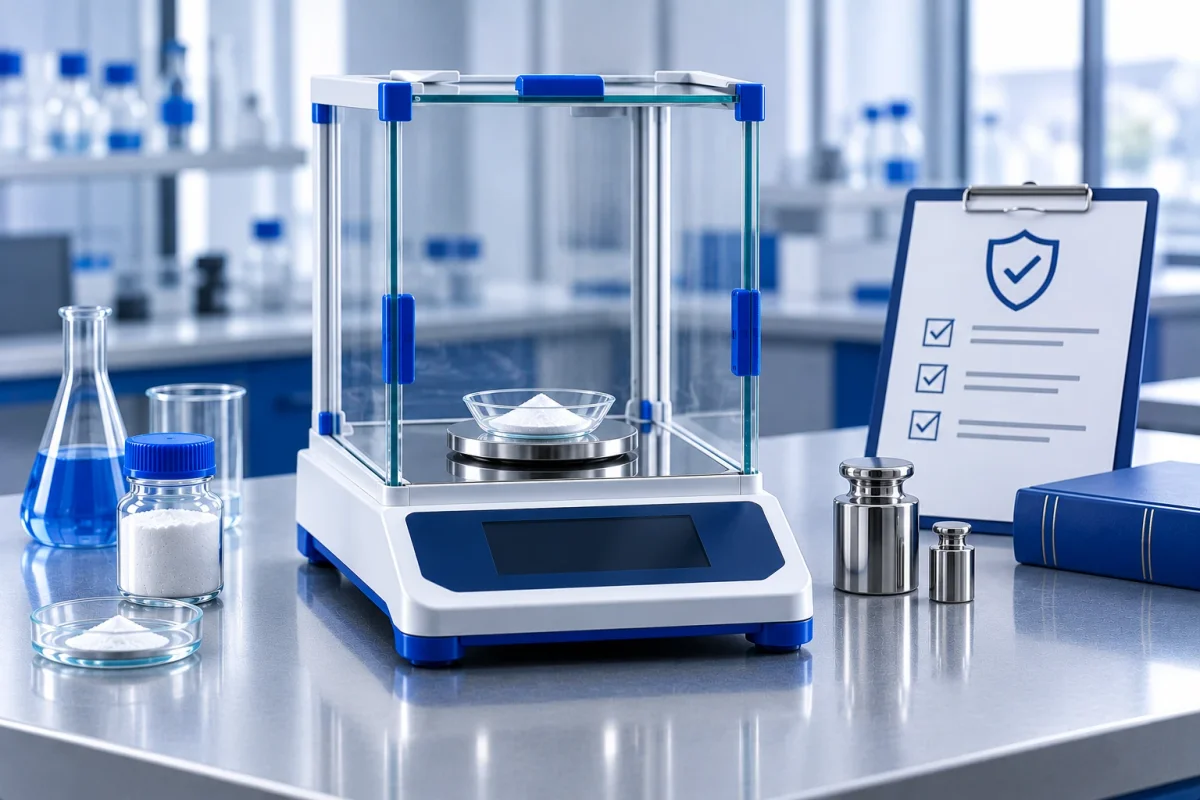
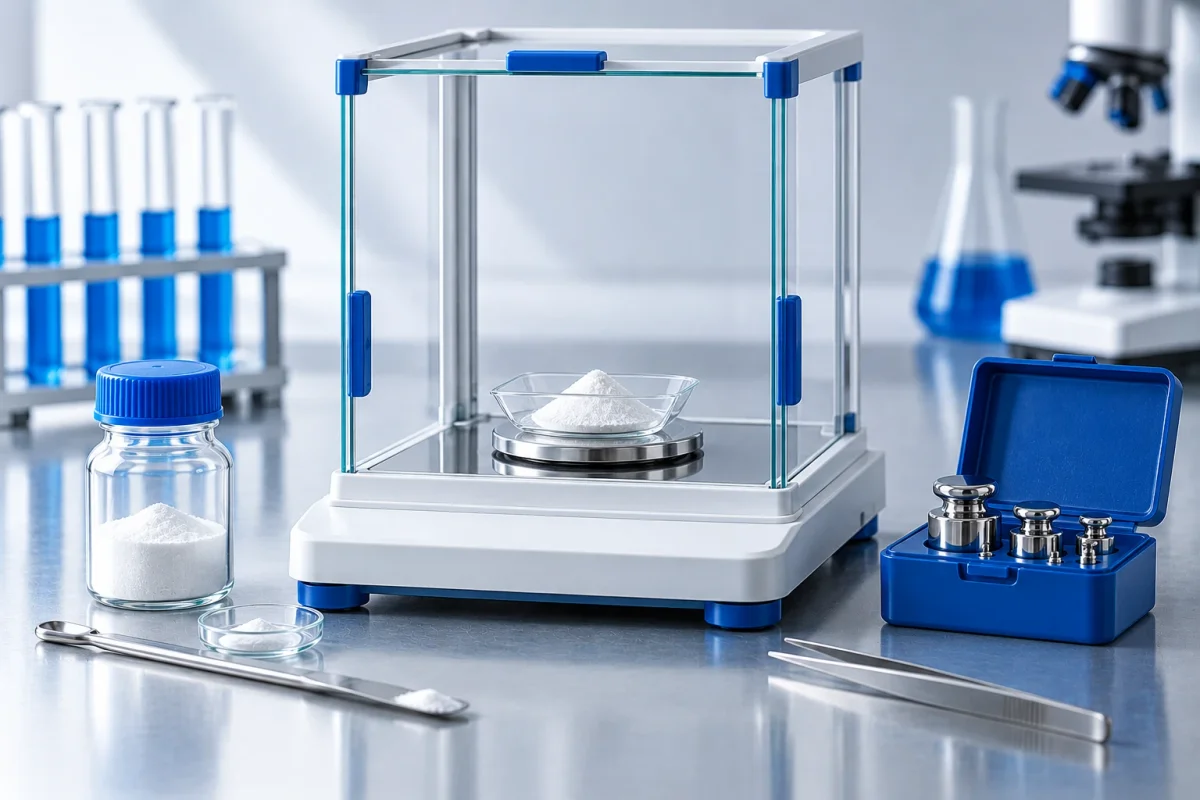
An analytical balance is a laboratory instrument for measuring mass with readability from 0.1 mg to 0.01 mg (i.e., 0.0001–0.00001 g). They are placed on anti-vibration tables, enclosed in draft shields, and used for samples in pharmaceuticals, chemical analysis, and preparation of standard solutions. Precision balances have readability of 1 mg–10 mg and capacities up to several kilograms: they suit solution preparation but not milligram samples. Industrial (or technical) scales offer readability from 0.1 g and up — for warehouses, packaging, and incoming raw material inspection.
The difference isn't just the number on the display. Analytical models compensate for external influences: a draft shield reduces air currents, built-in filters damp vibrations, and a temperature sensor corrects readings. Precision balances often lack a draft shield; industrial scales prioritize ruggedness and response speed. If you work with samples smaller than 10 mg, an analytical class is mandatory: on a precision balance such a sample would be within the error margin, making the result unreliable.
The LPS UZ catalog includes analytical laboratory equipment and general lab items, including balances of various classes. To choose, you just need to know your tasks and sample range. Below is how to translate those tasks into technical specifications.
How to Choose an Analytical Balance by Readability, Capacity, and Calibration Interval
An analytical balance for the lab is selected based on the smallest sample. Readability alone doesn't determine anything: repeatability and minimum weight (the smallest sample for which the balance maintains stated accuracy) matter more. So fill out the requirements table before calling a supplier.
The accuracy of an analytical balance depends on three datasheet numbers: readability, repeatability, and minimum weight. The first shows the display increment, the second the spread on repeated weighings, and the third the threshold below which results are unreliable. A model with d = 0.01 mg and minimum weight 20 mg won't work for a 5 mg sample, no matter how impressive the first number looks.
Choosing a laboratory balance is best done using a task-to-parameter comparison table. Fill it out for your methods and half your questions for the supplier will disappear.
| Task | Readability | Minimum Weight | Maximum Capacity |
|---|---|---|---|
| Standard solutions, 5–10 mg | 0.001–0.01 mg | below sample weight | 80–220 g |
| Samples 10–50 mg | 0.01–0.1 mg | below sample weight | 120–220 g |
| Samples from 100 mg | 0.1 mg | 10–50 mg | 220–320 g |
| Incoming raw material inspection | 1 mg and coarser | from 0.5 g | up to several kg |
Readability (Scale Interval): Which Accuracy Class Do You Need?
Readability (d) is the increment at which the balance displays mass. If the display shows 0.0001 g, readability is 0.1 mg. For weighing milligram samples, readability should be no coarser than 0.1 mg, and preferably 0.01 mg if your method demands high accuracy. But readability alone doesn't determine anything: repeatability (standard deviation) and minimum weight at which the balance maintains stated accuracy are crucial.
Rule of thumb: sample mass should be no less than the minimum weight specified in the datasheet. Minimum weight is often tied to repeatability and accuracy class. If you need to weigh 5 mg but the balance's minimum weight is 10 mg, the result will be unreliable even with 0.01 mg readability. Check the datasheet: it lists readability, minimum weight, and repeatability.
Analytical balance readability is chosen based on your method, not your budget. For preparing standard solutions with 10–50 mg samples, choose 0.01–0.1 mg; samples from 100 mg are covered by 0.1 mg; incoming raw material inspection can use 1 mg or coarser. If your method references OIML R 76-1, check the balance's accuracy class: analytical tasks typically require a special class balance. Don't confuse readability with accuracy class: the class is assigned based on test results and may be higher than what a single d value suggests.
Maximum Capacity and Minimum Weight: Finding the Right Balance
Maximum capacity (Max) is the upper weighing limit. It seems that bigger is better, but with analytical balances increasing Max often reduces accuracy: the sensor operates over a wider range, and minimum weight increases. So choose based on actual samples with a 20–30% margin, not the largest available.
Example: you weigh samples up to 200 mg into flasks. A balance with Max 220 g and d 0.1 mg will handle the task with margin. If the same lab occasionally weighs 50 g of raw material, buying a 500 g analytical balance is not cost-effective: accuracy at small samples may suffer. Better to separate processes: an analytical balance for small samples and a precision balance for sample preparation.
Reverse situation: a balance with Max 80 g and d 0.01 mg is accurate but can't accommodate a large vessel with solution. Check whether your glassware fits in the draft shield and whether the total mass exceeds Max. If you work with heavy flasks, choose a model with higher capacity but check minimum weight.
Comparing options is easier with a requirements table. Below is an example you can adapt for your lab.
| Parameter | What to Specify | How to Check |
|---|---|---|
| Minimum sample | e.g., 5 mg | Compare with datasheet minimum weight |
| Maximum sample | e.g., 200 mg | Add 20–30% margin |
| Readability | 0.01 mg or 0.1 mg | Match to method |
| Repeatability | no worse than required | Check datasheet, not just d |
Calibration Interval and Verification: What They Are and Why They Matter
Verification of laboratory balances is an official procedure confirming that the balance meets its approved type. It is performed by accredited organizations and results in a verification certificate. The calibration interval is the period between verifications set during type approval. It may be one year or several; the exact period is stated in the type description and certificate.
Not all balances require mandatory verification. If a balance is used in areas subject to state regulation of measurement uniformity (e.g., product accounting, healthcare, safety control), verification is mandatory. For internal research tasks, calibration is sufficient. Before purchasing, clarify whether you need verification: inclusion in the state register of measuring instruments and approved type sometimes increases the model's price, but without it documents won't be accepted.
If verification is required, check whether the model is in the register and what calibration interval is established. Plan the next verification in advance: a month before the expiry date. An expired certificate is equivalent to no verification for inspectors.
Balance Calibration: Internal and External, Frequency
Balance calibration is adjusting readings against a reference mass. Balances with internal calibration set readings using a built-in mechanism on command or automatically when temperature changes. External calibration uses external weights placed on the pan by the operator. Internal calibration is convenient for daily work; external is required for verification and for confirming accuracy with traceability to a standard.
Calibration frequency is set by the laboratory based on workload and method requirements. Typical practice: daily check with a control weight before a measurement series; full calibration on schedule or after moving the balance, sharp temperature changes, or repair. If the balance is used in an accredited lab, the calibration interval is documented in the quality management system.
Can you calibrate yourself? Internal calibration per instructions is performed by the operator. External calibration with reference weights can also be done in-house if the weights are verified and a procedure exists. But for official purposes and when in doubt, a service engineer is called. Self-calibration does not replace verification and does not provide a legally valid certificate.
When buying a laboratory balance, consider future maintenance: check whether service and reference weights are available, and how calibration is performed. At LPS UZ you can order balances and clarify service terms via contacts for selection and commercial offers. If you're ordering multiple items at once, also see spare parts and Class A and B volumetric glassware: they are often purchased together with balances.
Additional Features: Level, Vibration Protection, Interfaces
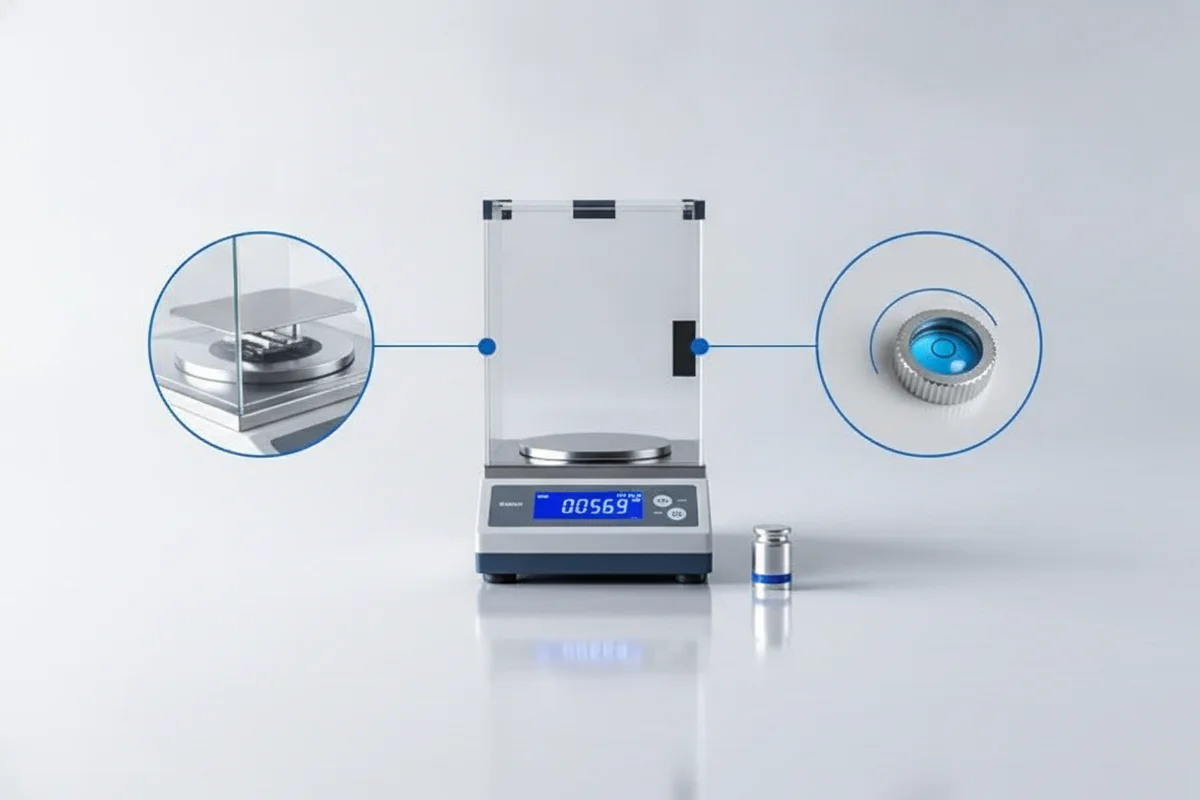
Analytical balances are sensitive to setup. A bubble level helps align the housing horizontally: tilting causes systematic error. Vibration protection (anti-vibration filter) smooths oscillations from equipment and passing traffic. If the lab is near a road or on an upper floor, choose a model with adjustable vibration protection and place it on a massive slab.
The draft shield should open smoothly and have enough space for your glassware. Interfaces (RS-232, USB, Ethernet) are needed to transfer data to a laboratory information system or printer. If you keep a manual log, you can save money, but with high workload automation reduces errors.
Also consider built-in applications: weighing, statistics, formulation weighing. More features mean higher price, but not all will be useful. Make a list of tasks and cross out the unnecessary. For routine samples, a basic model with internal calibration and draft shield is sufficient. If you need a balance with internal calibration and advanced automation, compare total cost of ownership with models without it.
How to Specify Requirements and Compare Models
It's best to write balance requirements in a table and send it to suppliers. That way you get comparable offers and don't miss a parameter. In the table, specify: minimum and maximum sample, readability, repeatability, minimum weight, whether verification is required and its interval, internal calibration, interface type, and chamber dimensions.
Compare models on the same points. If one quote lists only readability while another provides a full datasheet, that's not a level playing field. Request the type description and datasheet. Check whether the type description includes the calibration interval and accuracy class. For tasks where traceability matters, ask whether reference weights are supplied and their verification status.
It's useful to add a "total cost of ownership" criterion: balance price plus calibration, verification, and potential repair. A cheap model without service support may cost more in the long run. Mettler Toledo and SI Analytics offer analytical balances with documentation and service; compare them in the same table with other options.
Ready-to-use checklist for comparing models:
- Minimum weight not higher than your smallest sample.
- Maximum capacity with 20–30% margin.
- Readability matches the method.
- Repeatability and accuracy class stated in the datasheet.
- Calibration interval and registry inclusion — if verification is mandatory.
- Internal calibration and service availability.
- Chamber dimensions fit your glassware.
Common Mistakes When Choosing an Analytical Balance
Mistakes repeat from lab to lab. Below are those most often leading to unreliable results or unnecessary costs.
| Mistake | Consequence | How to Avoid |
|---|---|---|
| "Let's get the highest accuracy, extra won't hurt" | Overpaying and finicky operation | Base decision on smallest sample and method |
| Ignoring minimum weight | Unreliable results at small samples | Check minimum weight in datasheet |
| Ordering without verification when it's mandatory | Documents not accepted | Clarify application area in advance |
| Placing balance on a wobbly table | Readings "drift" | Anti-vibration table and level |
| DIY "calibration" without weights | Error goes unnoticed | Use verified weights or service |
A real client comment: "Give us the most accurate ones, we have a grant." Without calculating the minimum sample, such a balance may be useless for routine samples. Another case: a lab bought a balance with Max 500 g for 1 mg samples, but the model's minimum weight turned out to be 50 mg. They had to buy an analytical balance, and the first purchase sat idle.
Acceptance check: turn the balance on, let it warm up as instructed, check the level, run a calibration, and weigh a test weight. The readings should fall within the tolerance specified in the datasheet. If the result is unstable, check for vibration and drafts before calling service. For news about Waters and other brands' products, see the news section.
Frequently asked questions
What readability do I need for weighing milligram samples?
For samples of 1 to 10 mg, aim for a readability of 0.001 mg (1 µg) or 0.01 mg. Be sure to check the minimum weight: it must be below your sample weight. For samples of 10–50 mg, 0.01–0.1 mg is often enough, but the method is what decides.
How are maximum capacity and balance accuracy related?
With the same design, increasing the maximum capacity usually reduces accuracy at low masses. Choose a Max with 20–30% headroom over your actual samples so you don't lose sensitivity or pay extra for a range you don't need.
What is the verification interval and how often should verification be done?
It's the period between verifications set when the type is approved. It may be a year or several years; the exact term is stated in the certificate. Plan the procedure in advance so you're not working with an expired document.
Can I calibrate the balance myself, or do I need a service engineer?
The operator performs internal calibration according to the instructions. External calibration with certified weights can also be done yourself if you have a procedure. For official purposes, and when you're unsure of the result, call in a service engineer.
Which analytical balance brands should I consider?
Mettler Toledo, Sartorius, and SI Analytics are common in lab practice. Compare specific models by datasheet, service availability, and verification. The brand matters, but specifications and support matter more.
Conclusion
Choosing an analytical balance comes down to three numbers: minimum sample weight, maximum capacity, and required readability. Add the need for verification and calibration, and the requirements write themselves. To buy laboratory balances in Tashkent with selection by specifications, contact LPS UZ: our specialists will help you compare models, clarify verification and calibration terms, and prepare a quote.