
 Weighing
How to Eliminate Static Electricity When Weighing

Eliminating static electricity when weighing is a challenge faced by anyone working with analytical balances. People often blame the instrument for "floating" readings when the real culprit is accumulated charge. Static builds up from friction, pouring powders, handling plastic containers, and even air movement in the room.
In this article, you'll get practical steps to eliminate static at your workstation, learn how to set up grounding for laboratory balances and maintain proper humidity, when an air ionizer for balances is truly needed, and how to tell static electricity apart from an actual balance malfunction. At the end, you'll find a ready-to-use checklist.
Why Static Builds Up During Weighing: Causes in the Lab
The physics behind static electricity is straightforward: charges separate on surfaces through contact and friction. In a lab, this happens constantly—when pouring powder, rubbing a glass rod against a vessel wall, removing a plastic lid, wearing synthetic clothing, or even from air conditioning drafts. Static electricity on analytical balances with readability down to 0.1 mg is especially noticeable: the slightest charge on a sample or container creates a Coulomb force that distorts the gravitational force.
Main sources of static:
- Plastic and glass containers (especially dry and cold ones).
- Synthetic clothing and footwear worn by personnel.
- Low relative humidity (below 40%).
- Air movement in the weighing area (drafts, ventilation).
- Lack of grounding for laboratory balances and auxiliary equipment.
The drier the air and the more isolated the container, the higher the charge. Plastic weighing bottles and beakers can accumulate several kilovolts—enough to shift readings by several milligrams. That's why it's important to assess lab conditions before measurement.
How Static Distorts Results: Zero Drift, "Jumping" Readings, Milligram Errors
A charged object near the balance pan creates an electrostatic field that acts as an additional force. This manifests in various ways: zero drift can push readings in one direction, they change erratically, or don't return to zero after removing the load. Sometimes the balance shows a stable result, but it's off by several milligrams from the true value—critical when working with small samples. Floating readings are often mistaken for mechanical failure.
How to tell if static electricity is the culprit rather than mechanics? Run a simple test. Weigh the same object twice: immediately after removing it from the antistatic mat and after letting it sit for 10–15 minutes. If results differ by more than 0.5 mg on a balance with 0.1 mg readability, static is likely. Another sign is "sticking" readings when adding weight: the value changes in jumps rather than smoothly.
For diagnosis, you can use an antistatic ionizing gun or simply breathe on the balance pan—moisture condensation temporarily dissipates the charge, and readings stabilize. This trick confirms the electrostatic nature of the problem but doesn't replace proper equipment.
Workstation Setup: Grounding, Antistatic Mat, Humidity, and Temperature
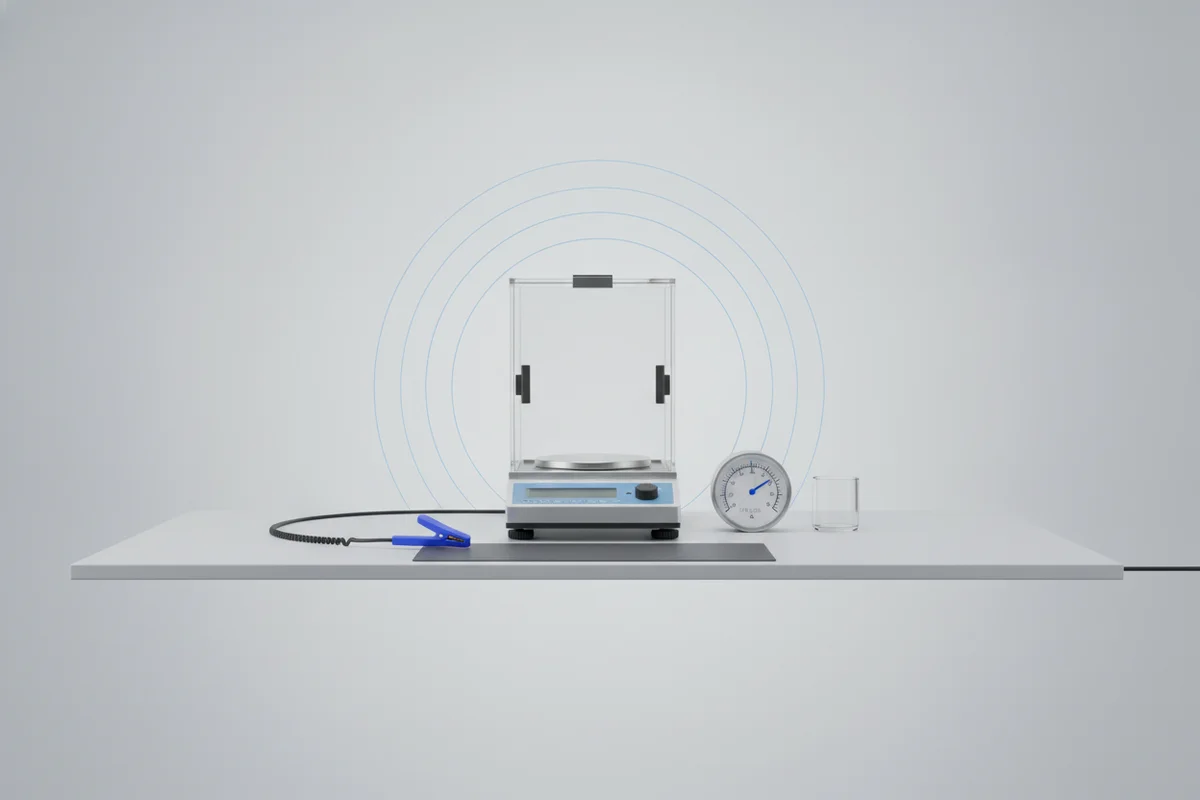
The fight against static in the lab starts with proper balance installation. Analytical balance manuals (Sartorius, Mettler Toledo) specify that the instrument must be grounded. If the lab lacks a grounding circuit, you can connect the balance to a grounded metal structure (e.g., a water pipe, but make sure it's actually grounded). Never use gas pipes or plastic conduits as grounding.
An antistatic mat for balances reduces charge accumulation on the work surface. Wipe it regularly with antistatic solution. Lab humidity and static are directly linked: maintain 45–60%—optimal for charge dissipation and comfortable work. However, don't exceed 60%: too much humidity can cause corrosion and condensation. Temperature should be stable, without sharp fluctuations.
Remove draft sources from the weighing area: air conditioners, fans, open windows. The workstation should be away from doors and walkways. Use a hygrometer and thermometer to monitor conditions.
Air Ionization and Antistatic Devices: When You Really Need Them
An air ionizer for balances is an effective tool but not always essential. If static occurs occasionally and is solved by an antistatic mat and humidification, buying an ionizer may be overkill. However, for constant work with powders, plastic containers, or in low-humidity conditions, an ionizer becomes a necessity.
When choosing a device, pay attention to the type: compact fan ionizers that sit next to the pan and neutralize charge on the sample and container work well for laboratory balances. An antistatic ionizing gun is handy for treating containers before weighing. Make sure the device doesn't create air currents that affect readings.
Remember: an ionizer doesn't eliminate the cause of charge buildup but neutralizes it. That's why it works best combined with grounding for laboratory balances and humidity control. Don't rely on ionization alone if the lab is dry and your balances aren't grounded.
Choosing Containers and Accessories: Plastic, Glass, Porcelain, and Sample Transfer
Container material directly affects static buildup. Plastic (polypropylene, polystyrene) is the top charge generator, especially in dry air. Glass and porcelain are less prone to electrification but can still charge through friction. For analytical work, prefer [borosilicate glass] or antistatic plastic. Compare the main options in the table.
| Material | Static tendency | When to use |
|---|---|---|
| Polypropylene | High | Only with ionizer and antistatic treatment |
| Polystyrene | High | Single-use operations, not for precise weighings |
| Borosilicate glass | Medium | Daily analytical work |
| Porcelain | Low | Drying and ashing |
| Metal (spatulas) | Almost none | Sample transfer, dispensing |
When transferring samples, use metal spatulas or stainless steel spoons: they don't accumulate charge and are easy to ground. Avoid plastic spoons and paper bags. If the sample is already charged, treat it with an ionizer or leave it in an antistatic chamber.
How to remove charge from containers if no ionizer is available? Wipe them with an antistatic cloth or rinse with antistatic solution and dry. Don't use regular synthetic fabrics—they are themselves a source of static.
Proper Weighing Procedure: Wait Time, Repeat Measurements, Working with Samples
Even with antistatic tools, procedure matters. After placing the container on the pan, wait 10–15 seconds for the charge to dissipate and readings to stabilize. If the balance has an automatic stabilization function, wait for it to engage. Static when weighing powders builds up more than usual, so add sample in small portions to avoid the triboelectric effect.
Take repeat measurements: weigh the sample three times in a row. If the spread exceeds the allowable error (e.g., ±0.2 mg for Class I accuracy), check for static. For critical analyses, use an antistatic mat for balances and an ionizer. The accuracy of weighing small samples is hard to verify without these measures.
Don't leave containers with samples open for long periods—they can pick up charge from the air. After each weighing, clean the balance pan with an antistatic cloth.
When the Problem Isn't Static: Balance Diagnostics, Calibration, and Service
If readings remain unstable after all antistatic measures, the cause may be balance malfunction: sensor wear, contamination, or misalignment. Malfunction or static on the balance is a question resolved by the tests from previous sections. In ambiguous cases, professional diagnostics are needed. Regular [balance calibration] helps ensure the instrument operates within tolerances. Calibration frequency depends on usage intensity and method requirements; typically once a year or after repair. It's convenient to track scheduled checks in a table.
| Event | What is checked | Frequency |
|---|---|---|
| Adjustment with external weight | Reading deviation | Daily before work |
| Balance calibration | Compliance with accuracy class | Once a year |
| Verification (if required) | Approval for measurements | Per lab schedule |
| Unscheduled service | Drift, errors, mechanics | After failure or repair |
Contact service if the balance doesn't respond to calibration, shows an error, or has mechanical damage. A specialist will check grounding for laboratory balances, sensor condition, and replace worn parts if needed.
For laboratories in Tashkent and across Uzbekistan, LPS UZ offers analytical and precision balances, antistatic accessories, as well as service and calibration. In particular, you can order Sartorius balances in Tashkent through our website. For equipment selection and engineer call-out, use the contact information.
Eliminating Static Electricity When Weighing: Action Checklist
Start with the simplest and fastest checks. The static elimination checklist looks like this:
- Check grounding for laboratory balances: are they connected to a grounded circuit?
- Measure room humidity: optimal is 45–60%.
- Remove draft sources (air conditioner, fan).
- Use an antistatic mat for balances and wipe it regularly.
- Replace plastic containers with glass or antistatic ones.
- Before weighing, treat containers and samples with an ionizer.
- Observe a 10–15 second wait time after placing on the pan.
- Perform control weighings to detect zero drift.
- Check if the balance calibration is up to date.
If the problem persists after these steps, contact service for diagnostics. Some items on the list are consumables and accessories—convenient to order together with balances: see general laboratory equipment and spare parts.
Mistakes That Undermine All Antistatic Measures
Even with an ionizer and grounding, results remain unstable if the weighing procedure is set up incorrectly. Below are the most common situations and their cost.
| Mistake | What it leads to | How to avoid |
|---|---|---|
| "I'll discharge it by breathing on the pan" | Moisture and saliva particles on the pan, additional zero drift | Use an ionizer or antistatic mat; don't touch the pan with hands or breath |
| "I'll wipe the plastic spoon with a cloth" | Friction generates new charge, readings "jump" even more | Use an antistatic spoon or metal spatula; don't rub plastic |
| "I'll put the balance by the window—better light there" | Sun heats the housing, creating convection currents, drift up to 1–2 mg | Place the balance on a stable table away from windows, radiators, and fume hoods |
| "I'll add sample and record the mass immediately" | Charge hasn't dissipated; result is low or high | Wait 10–15 seconds after placing the container; add sample with the same tool |
| "We'll wipe the pan with alcohol before each weighing" | Evaporation cools the surface, creating air flow and floating zero | Clean the pan per SOP; let it dry and warm to room temperature |
Check yourself at two control points. Weigh the same sample twice with a one-minute interval: a difference over 0.2 mg on a working balance indicates static or a procedure violation. Second: bring a charged plastic ruler 2–3 cm from the pan with the sample. If readings shift, the field around the sample is still active—let the sample "rest" in the ionizer.
How to Estimate a Budget for Static Control
Choose measures based on how often the problem occurs and the balance class, not the manufacturer's price list. Benchmarks for a lab weighing powders daily: an antistatic mat for balances costs around $30–80, a benchtop air ionizer for balances—$200–600, antistatic spoons and spatulas—$10–40 each. Grounding an outlet or building grounding circuit is calculated separately and is often already in place.
Count not the cost of the device but the cost of one error. If a sample goes into an expensive reagent or a batch of 50 samples, a 5% reject rate from drift costs more than the mat and spoon. For a few weighings a day, a mat and air humidification suffice: an ionizer pays off only with high sample throughput. Include consumables in your calculation: ionizer filters are replaced about every 6–12 months; an antistatic mat for balances lasts for years with careful use.
Do the math on time separately. If every weighing with a "jumping" zero costs an extra 2–3 minutes in reworks, then across 30 samples a day that's 1–1.5 hours of a lab technician's work. That figure is a much easier way to justify buying an ionizer to management than vague talk about quality. The fight against static in the lab starts with a calculation, not with buying the most expensive instrument.
If you need not just the accessory but the balance itself, take a look at analytical equipment and the brands Mettler Toledo and SI Analytics. For humidity monitoring, hygrometers from the general laboratory equipment section will come in handy, while the procedures and Class A and B volumetric glassware will help you build a weighing procedure that doesn't need redoing.
How to remove static charge from a sample without touching it
The most common cause of drift isn't the balance but the sample itself: the powder or granules arrive on the pan already charged. You can remove the charge without touching the sample in three ways, each taking from a few seconds to a couple of minutes. Choose based on sample size and available equipment.
The first method is air ionization. Point the ionizer's airflow at the pan with the sample for 5–10 seconds, holding the nozzle 10–15 cm away. A metal or semiconductor ionizer without a fan removes charge faster than spot air streams. The second is an anti-static chamber: hold the sample container in it for 2–3 minutes and the charge drains through the conductive walls. The third is a humidity chamber, but use it only if the sample isn't hygroscopic: keep the sample over a humidifier in a sealed desiccator for 5–10 minutes, the humidity near the surface will rise and the charge will dissipate.
| Method | Time | When it works | Limitation |
|---|---|---|---|
| Air ionizer | 5–10 seconds | Any loose or granular samples | Don't create airflow over the pan |
| Anti-static chamber | 2–3 minutes | Glassware and sample packaging | Requires bench space |
| Humidity chamber | 5–10 minutes | Non-hygroscopic samples | Distorts the mass of hygroscopic samples |
| Anti-static wipe | 10–20 seconds | External surfaces of glassware | Don't rub the plastic inside |
The check is simple: after treatment, place the sample on the pan and wait 10 seconds. If the reading doesn't "creep" by more than 0.1–0.2 mg, the charge is gone. Treat the sample before every control weighing, not just at the start of a run.
Static under different conditions: dry winter, air conditioning, working in gloves
The same measures work differently depending on the season and how well-equipped the lab is. During the heating season, indoor humidity drops to 20–30%, and then even glass picks up noticeably more charge. In summer with the air conditioning running, the air gets even drier, even though it's humid outside: the AC pulls moisture out of the air, and the airflow from the indoor unit blows the charge off the pan to the side.
Gloves are a story of their own. Latex and nitrile gloves insulate the hand and accumulate charge themselves when pulled off the packaging. If a technician handles glassware in fresh gloves, the static transfers to the vessel and from there to the balance. What to do: put gloves on in advance, 2–3 minutes before work, or use anti-static carbon-fiber gloves. A grounding wrist strap for the operator is also useful if they work with the same sample for a long time.
Check three spots in the room with a hygrometer during the day: in the morning, mid-shift, and before closing. If the humidity spread is more than 15 percentage points, put a humidifier with a hygrostat next to the weighing area. In Uzbekistan's dry winter climate, a humidifier is often needed continuously rather than occasionally.
How to explain to management that static is money, not a nuisance
The technician sees a "jumping" zero, but the manager only sees the reagent bill. Translate the problem into numbers and a solution will come faster. Use the formula: number of reworked weighings per day × cost of one sample × number of working days. If there are 10 reworks a day at $50 per reagent sample, that's $500 a day, or about $10,000 a month over 20 working days.
Add time on top: 10 reworks × 3 minutes = 30 minutes a day per employee. Over a month that's about 10 hours, over a year nearly 120 hours of working time. Compare that with the price of an ionizer at $200–600 and a mat at $30–80: payback in the first month is obvious if the reworks really eat up that much.
For clarity, put together a short "before / after" table over two weeks: number of reworks, reading spread, time per run. After two weeks with an ionizer and a mat, the numbers usually drop several-fold, and the conversation with management is then based on facts, not feelings.
Frequently asked questions
Why do analytical balance readings "drift" and how do I know it's static?
Drift can be caused by either static or a fault. With static, readings change slowly or in jumps, and stabilize once the charge is removed (e.g., by treatment with an ionizer). Run a test with repeated weighings: if the spread exceeds the permissible error, static is likely. Also check the grounding of the laboratory balance and the humidity.
How do I ground the balance and the workspace if the lab has no grounding loop?
You can use grounded metal structures (water pipes), but make sure they are reliably grounded. Don't connect to gas pipes. As a temporary solution, use an anti-static mat for the balance and an ionizer. For a permanent solution, install a grounding loop for the laboratory balance.
Does raising the humidity help, and within what range is it safe?
Yes, raising humidity to 45–60% reduces static. However, don't exceed 60%: excessive humidity can cause condensation and corrosion. Keep the level stable and use a humidifier with a controller.
Do I need an air ionizer for the balance or is an anti-static mat enough?
It depends on the conditions. If static is rare and humidity is normal, a mat and grounding of the laboratory balance are enough. For continuous work with plastic and low humidity, an air ionizer for the balance is needed to neutralize the charge on the sample and glassware.
How often should the balance be calibrated and when should I contact service?
The balance is usually calibrated once a year, but more often under heavy use or after repair. Contact service if the balance fails calibration, shows an error, or has mechanical damage.
You can get rid of static electricity during weighing by acting consistently: ground the balance, control humidity, use an anti-static mat, anti-static glassware, and an ionizer, and follow the procedure. For equipment selection and professional balance calibration, contact LPS UZ — we'll help you set up the workspace and provide service.