
 Weighing
Electromagnetic Force Compensation vs. Strain Gauge Scales: Which to Choose?

Electromagnetic force compensation or strain gauge? This question comes up for anyone equipping a lab. A common misconception: the more expensive the scale, the more accurate it is. In reality, accuracy and stability depend on the measurement principle, which determines whether a model suits your tasks.
In this article, we'll look at how both types are built, compare them in practice, and provide a checklist to help you choose a scale for specific work—whether it's analytics, precision weighing, or technical operations.
Electromagnetic Force Compensation vs. Strain Gauge: How the Measurement Principles Differ
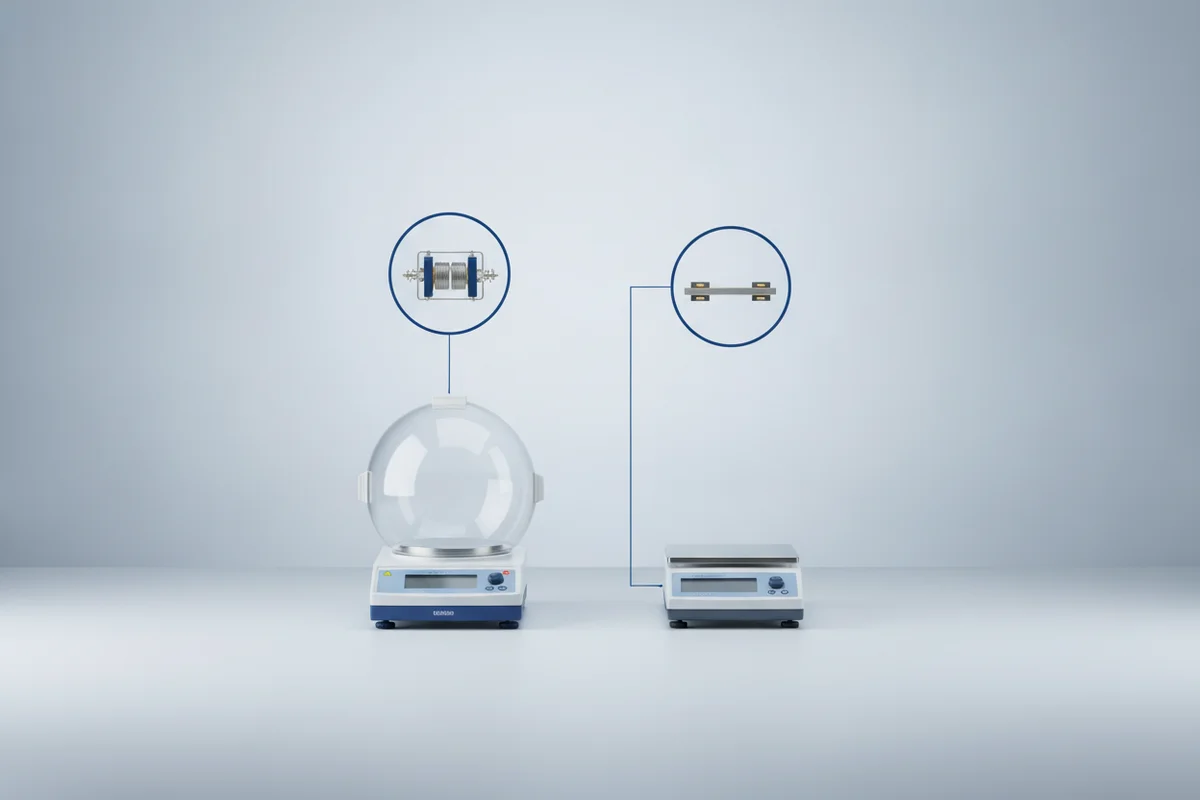
Scales with electromagnetic force compensation (EMFC) measure mass through a force that balances the load in a magnetic field. When you place a sample on the pan, a position sensor detects the displacement and sends current to the coil. The resulting electromagnetic force returns the lever to its original position. The current is directly proportional to the mass.
The key advantage: the moving system has virtually no friction, so these scales deliver high resolution and low zero drift. This is the principle behind analytical and laboratory-grade precision balances. In Sartorius and Mettler-Toledo models, EMFC is the foundation of accurate measurements; you can find their catalogs in the brands section.
What this means in practice: stable readings during prolonged weighing, fast response, and minimal influence from external factors. But the design is more complex, and the cost is higher than strain gauge models.
How a Strain Gauge Works: Design and Features
A strain gauge for scales is built on an elastic element that deforms under load. Strain gauges are attached to its surface; their resistance changes under tension or compression. The resistance change is converted into an electrical signal proportional to the mass.
This design is simpler and cheaper to manufacture, so strain gauge scales are common in technical and entry-level precision models. They are resistant to overloads, require no complex electronics, and need repairs less often. However, the elastic element can accumulate fatigue over time, and resolution is limited by the material's mechanical properties.
For most industrial and production lab weighing tasks, a strain gauge is sufficient. But if you need high accuracy in analytics, EMFC scales win on resolution and weighing repeatability.
Accuracy, Stability, and Zero Drift: A Practical Comparison
In terms of accuracy, EMFC scales usually outperform strain gauge counterparts of the same class. This is due to the absence of friction and lower temperature influence on the measuring system. EMFC has minimal zero drift, so repeatability is higher.
Strain gauges also provide good accuracy, but under prolonged load or temperature fluctuations, readings can "drift." For analytical scales, this is critical: an error of tenths of a milligram distorts the result. Laboratory scale accuracy is determined not only by the scale interval but also by repeatability.
| Parameter | EMFC | Strain Gauge |
|---|---|---|
| Resolution | High, down to micrograms | Medium, down to milligrams |
| Zero drift | Minimal | More noticeable when heated |
| Stability over time | High | Medium |
| Reproducibility | Excellent | Good |
When choosing a laboratory scale, look at the specifications of the specific model, not general promises. The accuracy class and resolution are stated in the documentation.
Response Speed and Behavior During Loading/Unloading
Response speed matters when you're weighing many samples in a row. EMFC scales respond faster: the frictionless moving system returns to equilibrium instantly. After removing the load, readings stabilize almost immediately, and reading stability over a long series is higher.
A strain gauge needs time for elastic deformation and recovery. With frequent loading and unloading, this slows down the work. If an operator performs dozens of weighings per shift, the difference becomes noticeable.
However, for occasional measurements or weighing large samples, speed is not critical. Here a strain gauge handles the job without issues. Pay attention to the auto-stabilization function: modern models of both types have it, but EMFC is more precise.
Sensitivity to Vibration, Temperature, and Drafts
Laboratory scales of any type are sensitive to external influences, but in different ways. An EMFC system with feedback compensates for vibrations better: the electronics actively damp oscillations. A strain gauge transmits vibration to the elastic element, and readings can "jump."
Temperature fluctuations affect both types, but EMFC scales have temperature compensation in the control loop. A strain gauge depends on the temperature coefficient of the strain gauges. Drafts are dangerous for analytical scales: they create aerodynamic force on the pan. For both EMFC and strain gauges, it's equally important to protect the weighing area with a draft shield.
When installing, choose a location away from doors, air conditioners, and equipment that generates vibration. Use an anti-vibration table. For analytical scales, a draft shield is mandatory.
Service Life, Repairability, and Cost of Ownership
EMFC scales are more complex to manufacture, so they are more expensive to buy and repair. The main components are the coil, position sensor, and control board. If one element fails, qualified service is required. But with proper use, they last long and maintain accuracy.
Strain gauge scales are easier to repair: replacing the strain gauge or board is cheaper. Cost of ownership is lower if there are no high accuracy requirements. But under intensive use, the elastic element can fatigue, and then the sensor will need replacement. Look for consumables and spare parts in the spare parts section.
When budgeting, consider not only the price but also the costs of scale calibration, verification, and possible repairs. For analytical tasks, investing in EMFC pays off in data quality. For technical weighing, a strain gauge is more cost-effective.
How to Choose: A Task-Based Checklist (Analytical, Precision, Technical Scales)
To avoid mistakes, start with the task. Here's a brief checklist:
- Determine the required readability and accuracy class per your method.
- Assess the workload: how many weighings per day.
- Check the conditions: vibration, drafts, temperature fluctuations.
- Clarify whether scale verification and inclusion in the state register of measuring instruments are needed.
- Compare cost of ownership, including calibration and repair.
For analytical scales, choose EMFC. For precision tasks, both types work if the readability is sufficient. Technical scales are more often based on strain gauges. LPS UZ offers analytical and precision scales, as well as calibration and verification services. You can find the model range in the Carl Roth section or on the about the company page.
Scale Calibration and Verification: What to Consider
Laboratory scales require regular calibration. The frequency depends on usage intensity and method requirements. Typically, calibration is done annually, and more often under high load. Verification is mandatory if the scale is used in areas subject to state regulation.
For calibration, certified weights of the appropriate accuracy class are needed. Manufacturers recommend daily internal checks with control weights or before a series of measurements. This helps catch drift in time.
When ordering the service, clarify whether verification is included in the price and what documents are provided. LPS UZ can advise on calibration and weight selection. A reliable supplier confirms equipment quality and provides service support.
FAQ
How do EMFC scales differ from strain gauge scales in accuracy?
EMFC provides higher resolution and lower zero drift due to the absence of friction. Strain gauges have limitations in stability under prolonged load. For specific figures, see the model's datasheet.
For which tasks is a strain gauge sufficient, and where is electromagnetic compensation needed?
A strain gauge is suitable for technical and most precision weighings. EMFC is necessary in analytical chemistry, pharmaceuticals, and anywhere microgram accuracy is essential.
Do vibrations and drafts affect different scale types, and how to account for this during installation?
Both types are sensitive, but EMFC compensates for vibrations better. Install the scale on an anti-vibration table away from drafts and heat sources. For analytical models, use a draft shield.
How much more expensive is maintenance for EMFC scales, and what about repairs?
Maintenance and repair costs are higher due to the complex design. Repairs require qualified specialists. Strain gauge scales are simpler and cheaper to maintain.
How often should laboratory scales be calibrated and verified?
Calibration is usually done once a year, more often under intensive use. Verification is required by law and methods. Check zero and readings daily with a control weight.
Common Mistakes When Choosing Scales: Typical Situations
The difference between EMFC and strain gauge shows up not in the datasheet but in operation: two models with the same readability can behave differently by the third month. Below are the mistakes that most often surface during acceptance and in the first weeks of use.
- "I'll get extra accuracy just in case." A scale with 0.1 mg readability on a bench next to a fume hood will "float" more than a 1 mg model in a quiet corner. Extra accuracy class doesn't help if vibration and drafts aren't addressed.
- "The readability matches—so the scale fits." Accuracy class is determined not only by the scale interval but also by repeatability and minimum weighing capacity. Check the verification interval (e) and maximum capacity per your method, not just the scale interval.
- "We'll weigh on whatever we have, then recalculate." Recalculating from one model to another doesn't save you: a strain gauge's zero drift over a shift can eat up the difference you're trying to catch.
| Mistake | Consequence | How to Avoid |
|---|---|---|
| Placing the scale by a door or in a passageway | Reading fluctuations of 0.5–2 mg, repeat weighings | Dedicated table in a corner, anti-vibration plate, no draft from air conditioner |
| Skipping verification after purchase | Protocols fail audits, results are revoked | Include initial verification and inter-verification interval in the procurement budget upfront |
| Weighing without warm-up | Zero drift in the first 20–40 minutes, false deviations | Turn on the scale 30–60 minutes before a series, leave it on throughout the shift |
| Containers without tare and without accounting for static electricity | Readings high by 0.2–1 mg on dry powders and plastic | Ionizer or anti-static chamber, tare before each series |
Acceptance and Registration of Scales: What to Check in the First Days
The scale has arrived, unpacked, and reads zero. Now the most important part begins—on-site checks while the warranty is valid and before signing the acceptance act. Spend 40–60 minutes on this; it will pay off.
Procedure:
- Check the completeness against the packing list: pan, draft shield, power adapter, cable, verification certificate (if provided), manual in Russian or Uzbek.
- Turn on the scale and let it warm up for 30 minutes. Zero should stabilize without manual adjustment.
- Check repeatability: weigh the same weight 5–7 times; the spread should be within the specified repeatability (usually ±1–2 scale intervals).
- Check linearity at three points: 10%, 50%, and 100% of maximum capacity. Deviation should be within the datasheet tolerance.
- Verify the serial number on the body and in the verification certificate.
For labs working under methods with normative control, address verification immediately: without a valid certificate, results won't be accepted by internal audit or the customer. Clarify the inter-verification interval—usually 1 year, for some models 2 years.
If, after checks, repeatability exceeds tolerance or zero drifts with a 2–3 °C temperature change, don't wait for it to "settle." Document it in the act and contact the supplier: at this stage, replacement or adjustment is easiest. When choosing a supplier, check if they are ready to perform on-site commissioning and train staff on tare and calibration. Contact details are on the contacts page.
Conclusion
The choice between EMFC and strain gauge is determined by the task, required accuracy, and budget. For analytics, choose electromagnetic force compensation scales; for technical and precision weighing, a strain gauge is often sufficient. At LPS UZ, we can help you select laboratory scales, arrange calibration and verification, and provide consultation on installation and operation.