 Labware
Markings on Volumetric Glassware: What the Labels on Flasks and Cylinders Mean

Volumetric glassware markings are often read on the fly: you see the number 100 mL and fill to the brim. Then a series of results doesn't match the method, and the cause is sought in the reagents, not in the flask. But the glass already tells you what you have: nominal volume, accuracy class, calibration temperature, tolerance, and intended use.
A common story in the lab: an employee grabs the first graduated flask from the shelf to prepare a standard solution. A day later it turns out that the glassware is general-purpose or was calibrated at a different temperature. The analysis has to be redone.
Below we'll explain how to read the inscriptions on volumetric glassware, how Class A and Class B differ in practice, what checks to perform before the first measurement, and how much to budget for procurement.
Volumetric glassware markings: why the labels on flasks matter
Volumetric glassware is designed for precise volume measurement. General-purpose glassware is for mixing, pouring, and storage, and its graduation is rarely intended for analytical tasks. The label on the glass separates these categories: it shows which numbers you can rely on. Markings on volumetric glassware solve this problem without needing a certificate at hand.
The accuracy class of volumetric glassware and calibration conditions are printed on the glass, so a quick glance is enough. The labels on volumetric glassware provide four pieces of information:
- nominal volume at the specified temperature;
- accuracy class or permissible deviation;
- calibration for delivery (Ex) or for content (In);
- glass type and calibration conditions.
The data is applied by etching, printing, or laser. If the paint on the graduations is already wearing off, the item is downgraded to auxiliary glassware: there will be no way to verify the volume. Requirements for such glassware are described in GOST 1770-74; international manufacturers follow ISO standards.
Nominal volume and units: what the number on the flask means
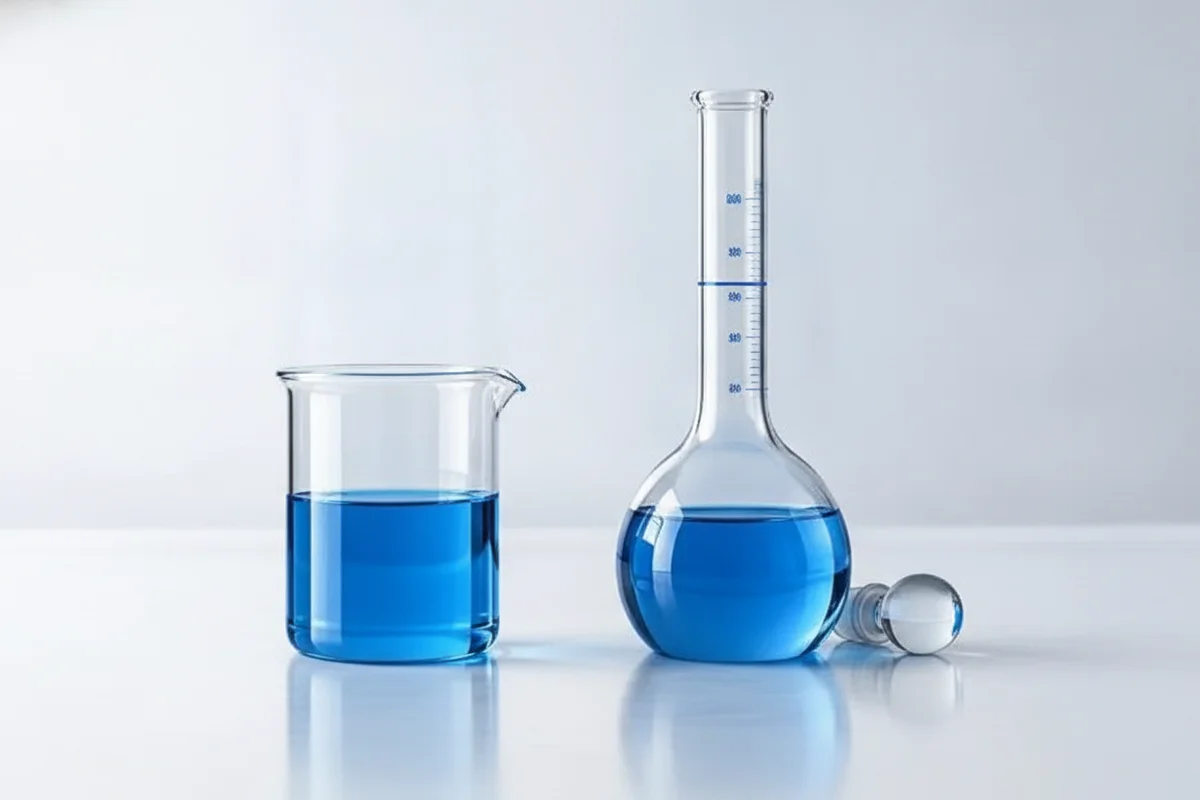
The large number on a flask or cylinder is the nominal volume for which the item is calibrated. For a 100 mL volumetric flask, the mark on the neck corresponds to 100 mL at the specified temperature. You must not fill above or below the mark: the volume will be different. The nominal volume of a flask on large containers is indicated in liters.
Units are usually milliliters (mL) or cubic centimeters (cm³): 1 mL = 1 cm³. Large containers may show liters, and pipettes may show microliters.
On a graduated cylinder, the scale runs along the entire height, and next to the numbers is the graduation interval: 1 mL, 2 mL, 5 mL. The graduation interval of a graduated cylinder is shown right by the scale, and on a vessel with 10 mL graduations, a difference of 2–3 mL cannot be distinguished. The finer the graduation, the more accurate the reading. If the scale has a step of 10, a difference of 2–3 mL is invisible. A graduated cylinder whose scale has a step of 0.5 mL is better suited for intermediate readings.
- Single-mark flask — one exact volume.
- Two-mark flask — two nominal volumes, usually for content and for delivery.
- Beaker — approximate scale, lower accuracy class.
- Volumetric pipette — one mark and fixed volume.
Accuracy class of volumetric glassware: how to tell A from B on the glass
Class A has a narrow tolerance, Class B a wider one. On the glass, this is the letter A, AS, or B next to the nominal volume. Some manufacturers do not duplicate Class A on the flask and state it in the batch certificate, so request the specification when purchasing.
| Feature | Class A | Class B |
|---|---|---|
| Where to look | Letter A or AS on the glass, otherwise in the batch certificate | Letter B on the glass |
| When to use | Standard solutions, titration, quantitative analysis | Sample dilution, rinsing, auxiliary operations |
| Price | Higher | Lower |
If the method requires Class A, substituting B shifts the result. Dimensional tolerances are published in catalogs by manufacturers such as Duran and Simax. Class A and Class B glassware also differ in price: purchasing Class B for routine operations reduces costs. A full breakdown of classes is in a separate article Class A and B volumetric glassware.
Ex and In markings: glassware for delivery and for content
Ex (from Latin ex — 'out of') means calibration for delivery: after free draining, the volume remaining in the vessel is within tolerance. In means calibration for content: the volume corresponds to the contents of the vessel. Ex and In glassware differ in procedure, and for the lab this matters more than it seems: the entire series depends on it.
The difference changes the workflow. If you measure a solution to pour into another container, use Ex. If you prepare a solution directly in the vessel and bring it to the mark, you need In or a double mark. Calibration for delivery accounts for the residue on the walls: after draining, do not wait for complete drainage of drops longer than the specified time, otherwise the volume will be distorted. The test method is described in ISO 4787.
- Ex — account for residue on walls, standard drain time.
- In — measure by the liquid level inside.
- Ex/In or double mark — found on volumetric flasks and cylinders.
Do not mix Ex and In glassware in one series: if both types are in use, label the shelves so an employee doesn't grab the wrong one out of habit.
Calibration temperature 20 °C: why volume depends on temperature
Glass expands when heated, so volume depends on temperature. The label '20 °C' means the nominal volume is correct at that temperature. The calibration temperature of 20 °C is the value at which factory graduation is accurate.
In summer, in a non-air-conditioned lab in Tashkent, the temperature rises above 25 °C. For Class A such a deviation is critical; for Class B it usually remains within tolerance. Below is a procedure that reduces the temperature effect:
- Bring solutions to room temperature before measurement.
- Do not store glassware on windowsills or near heaters.
- Prepare standards in a room with stable temperature.
- Verify volume when working conditions change.
If the method specifies a different temperature, follow the calibration temperature of the glassware indicated on the glass, not the usual value.
Material and glass type: borosilicate glass and its designations
Volumetric glassware is mostly made of borosilicate glass: it withstands temperature changes and reacts weakly to most reagents. Domestic manufacturers use designations 'ТС' and 'ХС'; foreign ones use series designations.
Flasks made of borosilicate glass withstand sterilization and drying without losing graduation. Ordinary glass cracks and becomes cloudy faster with frequent heating, and marks become less readable. Borosilicate glass gets its properties from these characteristics, not from price.
Polypropylene volumetric items are used for approximate work and where glass is undesirable. They also have an accuracy class and temperature range, but plastic is not suitable for precise analyses involving heating.
The brand Carl Roth and other manufacturers publish the glass type and tolerances for each item in their catalogs.
Error and tolerances: how to read ± on a cylinder and flask
The '±' sign with a number indicates the permissible deviation from nominal volume. On a 100 mL Class A flask, the tolerance is within tenths of a milliliter; for Class B it is wider. The tolerance of volumetric glassware is best checked in the batch certificate or on the glass itself.
The smaller the nominal volume, the smaller the absolute error, but the relative error may remain significant. Example calculation: a tolerance of ±0.1 mL on a 100 mL flask gives 0.1 ÷ 100 × 100% = 0.1%. The same tolerance on a 10 mL flask gives 1%. Small volumes require more careful work.
| What you see | What it means | How to account for it |
|---|---|---|
| ± and a number | Tolerance on volume | Compare with method requirements |
| Class A or B | Accuracy category | Choose according to the task |
| 20 °C | Calibration temperature | Measure at this temperature |
| Ex or In | Intended use | Follow the procedure |
If the tolerance is not indicated and the glassware is for quantitative analysis, request the certificate. ISO 1042 describes requirements for single-mark volumetric flasks.
How to verify volumetric glassware markings and not confuse them with general-purpose glassware
Before first use, perform an inspection. Five checks will take a few minutes:
- Examine the labels: nominal volume, class or tolerance, temperature, Ex/In. If these data are missing, the glassware is likely general-purpose.
- Check readability of marks: graduations are not worn off or scratched.
- Compare volume with the method: for standard solutions, use Class A.
- Check the stopper fit and neck integrity of the flask.
- Ensure room conditions are close to the calibration temperature.
Cross-check the volume, class, temperature, and Ex/In found on the glass with the product certificate or batch specification: a discrepancy is grounds to return the item to the supplier before work begins. This way, laboratory glassware markings stop being a formality and work toward the result.
Do not use volumetric glassware for storing solutions: prolonged contact with reagents changes the volume and damages the marks. For storage, use general-purpose glassware with a tight stopper. To see which items the company supplies, visit the general laboratory equipment section.
| Mistake | Risk | How to avoid |
|---|---|---|
| 'I'll take the first graduated flask' | Error exceeds method tolerance | Check class and tolerance |
| 'I measured a warm solution — that's fine' | Volume overstated due to thermal expansion | Bring solution to 20 °C before measuring |
| 'The mark wore off, I'll redraw it with a marker' | Makeshift line without tolerance, result unreliable | Downgrade the item to auxiliary glassware or write it off |
A note on the meniscus. For transparent solutions, align the bottom of the meniscus with the top edge of the mark, with your eyes at the level of the line. For dark liquids, use the top of the meniscus. An error of 1 mm in the neck height of a 100 mL flask gives 0.1–0.2 mL, which is comparable to the Class A tolerance. Volumetric flask markings are easier to read when you know where to look.
Do not confuse graduation with verification. How to read flask markings in a verification protocol is evident from the temperature and tolerance records: they must match the label on the glass.
How much to budget for glassware and selection: guidelines in sums
The price of volumetric glassware in sums depends on volume, accuracy class, glass type, and mark type. A Class A flask costs noticeably more than a Class B flask of the same volume, and borosilicate glass items cost more than ordinary glass and plastic. Check exact prices per item with the supplier: they depend on the batch, manufacturer, and exchange rate on the order date.
A simple formula helps estimate the budget: item cost × quantity + reserve for breakage and wear. Calculate the reserve based on workload: with daily serial analyses, a couple of replacement flasks pay for themselves faster than downtime due to one broken flask.
As for calibration and verification, prices are set by accredited laboratories and vary across Uzbekistan. Request a quote for your specific list of glassware: volume, class, and quantity affect the total more than the brand. Calibration of volumetric glassware in a verification protocol must be based on the same temperature as indicated on the glass.
| What affects price | How to save without losing quality |
|---|---|
| Accuracy class | Use A only for quantitative analysis; cover the rest with Class B |
| Volume | Don't buy a large nominal volume 'just in case': small volumes are more accurate in work |
| Material | Plastic for auxiliary operations, glass for analysis |
| Reserve | Keep 1–2 replacement items, not a year's stock |
Compare supply terms and product ranges in the analytical equipment and brands sections.
How to store and label glassware so markings don't wear off
Factory markings last for years if not rubbed with abrasives. Alkalis, concentrated acids, and hot washing with powder accelerate wear of enamel and etching. Wash with mild detergent, rinse with distilled water, and dry inverted on pegs.
For organization, use a simple scheme: Class A glassware on one shelf, Class B separately, auxiliary separately. Label the shelves, not the flasks themselves. Stickers on glass wash off and leave adhesive that interferes with reading the mark. Check with company information if you are ordering a replacement batch.
If the marking is partially worn off, the item is downgraded to auxiliary glassware or written off. Re-marking in laboratory conditions is not allowed: calibration is done at the factory, and a makeshift line has no tolerance.
Frequently asked questions
Can a volumetric flask be used for storing solutions?
No. A flask is designed for measuring volume, not for long-term storage. Constant contact with reagents and repeated opening distort the volume and damage the markings. For storage, use chemical glassware with a suitable stopper.
What does the number and the ± sign on a volumetric flask or cylinder mean?
It is the permissible deviation from the nominal volume at the specified temperature. If a 100 ml flask is marked ±0.1 ml, the volume at calibration falls within this range. Class A has a tighter tolerance than class B; the exact value is given in the certificate.
Can worn-off markings be restored on your own?
No, markings are not reapplied in the laboratory: graduation is performed at the factory, and a makeshift line has no confirmed tolerance. Such an item is downgraded to auxiliary glassware or written off. For critical analyses, take a new item with a certificate.
How does accuracy class A differ from class B, and where is this indicated on the glassware?
Class A provides a tighter tolerance, class B a wider one. The designation is usually applied to the glass next to the nominal volume. Some manufacturers state class A in the batch certificate rather than on the flask itself.
Why does one item have a mark on the neck while another has a scale along its entire height?
These are different types of glassware. A flask with a single mark delivers one precise volume, so it is used for preparing solutions. A cylinder and a beaker with a scale allow intermediate values to be read, but the division size limits reading accuracy.
Markings on volumetric glassware help you choose the right tool for the task and avoid redoing the analysis. Note the requirements of your method, check the inscriptions on the glass and the working conditions, and then decide on the volume and accuracy class. LPS UZ supplies laboratory glassware and consumables across Uzbekistan and selects items to match your specifications.