How to Choose a Laboratory Pipette: Volumetric, Graduated, or Serological

How to choose a pipette for the lab? The short answer: first determine what your protocol requires — measuring one exact volume, drawing several different volumes, or performing a series of dispensings in microbiology. That dictates the pipette type: volumetric, graduated, or serological. In this article, we'll cover the design of each type, accuracy classes, materials, and handling rules so you can buy the right glassware and avoid paying for features you don't need.
Many labs buy pipettes "by eye," focusing on price and appearance. As a result, titrations run with unacceptable error, and sterile cultures fail due to the wrong scale. We'll help you systematize your choice.
What are pipettes and why are they divided into volumetric, graduated, and serological?
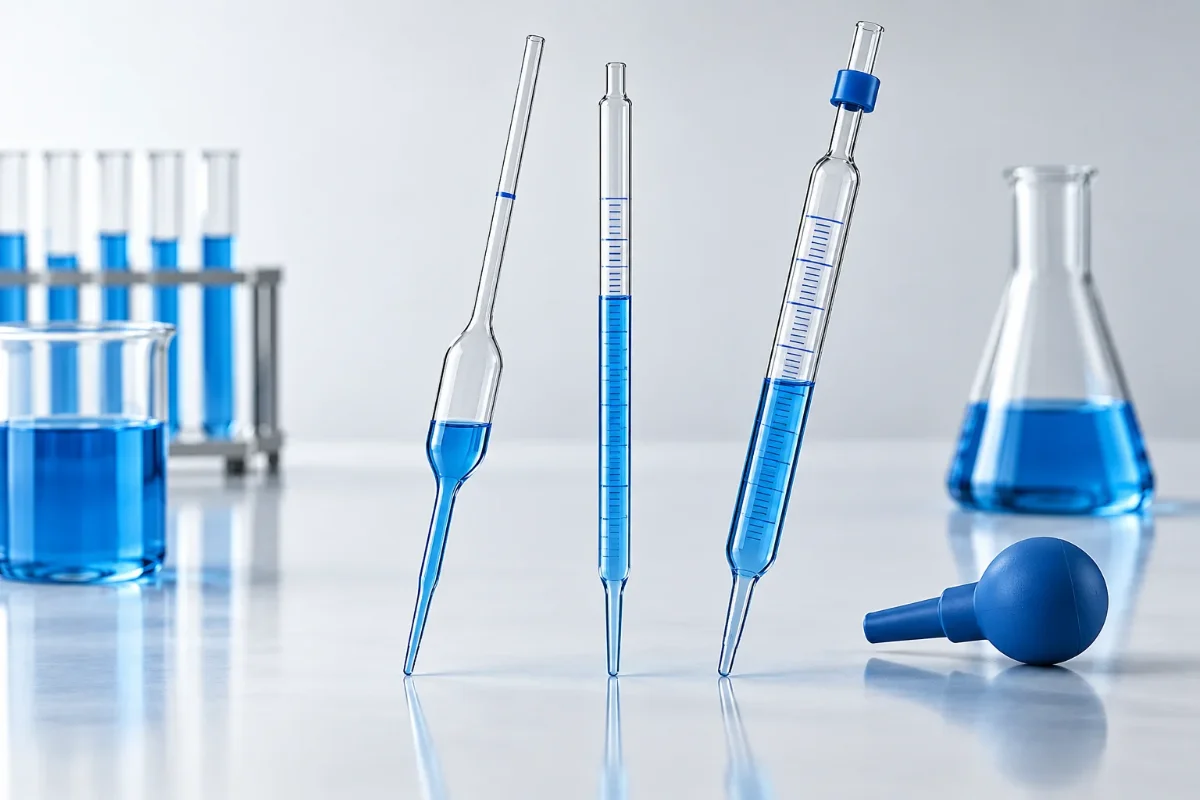
A pipette is volumetric glassware for transferring a specified volume of liquid. By design and purpose, there are three main types, each solving its own task.
- Volumetric pipettes (to deliver) have a single mark and are designed for one-time measurement of an exact volume.
- Graduated pipettes are equipped with a scale and allow drawing various volumes within the range.
- Serological pipettes are a type of graduated pipette with a special scale where divisions are marked "to deliver," which is convenient for serial dilutions in microbiology.
The division relates to accuracy requirements and application. For example, in titration, minimal error is critical, so volumetric pipettes or burettes are used. In clinical analyses, serological pipettes are often needed to quickly transfer identical volumes of serum. For more on types of glassware and how to choose it, see the laboratory glassware section.
Volumetric pipettes (to deliver): design, accuracy classes, when they are essential
A volumetric pipette is a glass tube with an enlargement and a single ring mark. The volume indicated corresponds to the amount of liquid that flows out under free drainage. These pipettes are available in Class 1 and Class 2 accuracy; specific tolerances are set by GOST or ISO 648. For example, for a 10 mL pipette, the tolerance may be a few hundredths of a milliliter — check the current standard for the exact value.
Volumetric pipettes are essential when the protocol requires delivering an exact volume of reagent without variation. This includes preparing standard solutions, quantitative analysis, and titration (though burettes are more often used there). If your procedure says "add 5.00 mL," you need a volumetric pipette of the appropriate class.
When buying, pay attention to the markings: the glass should show the nominal volume, accuracy class, and temperature (usually 20 °C). For critical analyses, choose Class 1. Visually check that the mark is clear and doesn't rub off. The pipette's accuracy class determines whether it fits your protocol.
Graduated pipettes: range, accuracy, use in titration and routine procedures
A graduated pipette has a scale with divisions, allowing you to draw any volume within the nominal. Their accuracy is lower than volumetric pipettes due to more marks and the influence of wetting. They are used when you need to quickly measure an approximate volume or perform several different withdrawals.
In titration, graduated pipettes are used for auxiliary operations, such as adding indicator or diluting the sample. For the titration itself, a burette with an accuracy class is better, but if unavailable, you can use a volumetric pipette to deliver. Graduated pipettes are convenient for routine procedures: dispensing detergents, preparing cleaning solutions.
When choosing, look at the range: the wider it is, the larger the divisions and the lower the accuracy. For small volumes (up to 1 mL), choose a pipette with a division value of 0.01 mL. Check that the scale is clearly marked and free of defects.
Serological pipettes: scale features, use in microbiology and clinical analyses
Serological pipettes differ from regular graduated ones in that they are calibrated to deliver: the last drop is not included in the nominal volume, so after draining the liquid, you don't need to wait for additional drainage. Their scale often starts at zero at the tip and goes up. This speeds up work with serial dilutions, where speed matters more than maximum accuracy.
In microbiology, pipettes are used for inoculations, preparing dilutions of bacterial suspensions, and transferring culture media. In clinical analyses, pipettes are needed for dispensing serum, plasma, and reagents in immunological and biochemical methods. The accuracy of serological pipettes usually corresponds to Class 1 or 2, but specific tolerances are set by the standard (e.g., ISO 835).
If the protocol requires a strictly defined volume with minimal error, a serological pipette is not suitable — use a volumetric one. For routine serial operations, it saves time.
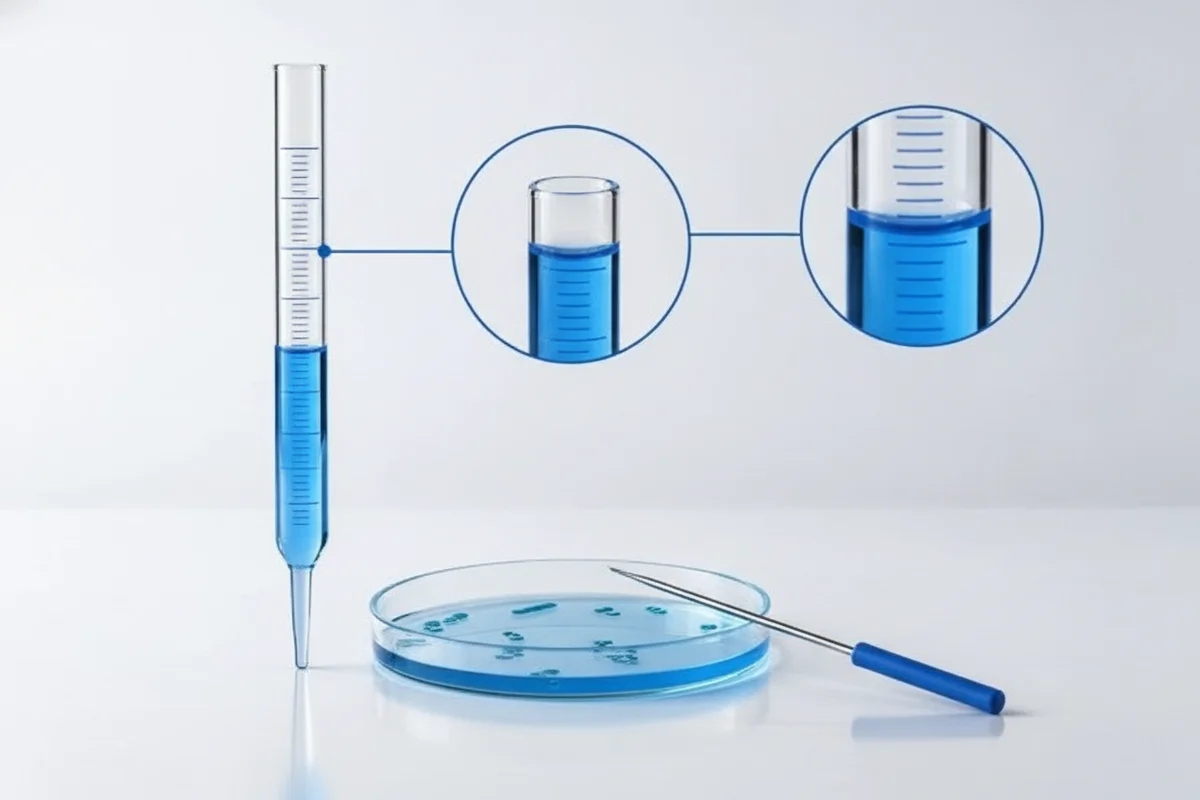
How to choose a lab pipette: volume, accuracy class, glass type, tip, protocol task
Start with the task. The protocol directly states what volume and with what accuracy to measure. If the instructions say "measure 10 mL to within 0.02 mL," a Class 1 volumetric pipette will do. If it says "add approximately 5 mL," you can use a graduated one.
Then consider:
- Volume: choose a pipette so that the working volume is close to the nominal — accuracy drops at the edge of the scale.
- Accuracy class: for quantitative analysis — Class 1; for auxiliary operations — Class 2.
- Glass type: borosilicate glass 3.3 (e.g., Simax, Duran) is resistant to temperature changes and aggressive media; regular glass is cheaper but less durable.
- Tip: for precise drainage, pipettes with a drawn-out tip are better; for viscous liquids — a wider one.
- Protocol task: titration, serial dilutions, clinical analyses — each dictates its own type (volumetric, graduated, serological).
To choose a glassware brand, refer to the brand catalog. It lists manufacturers that supply certified volumetric glassware.
For specific tolerances by volume and accuracy class, look in GOST or ISO tables: for pipettes without divisions — ISO 648, for graduated — ISO 835. The standard specifies the maximum deviation for each nominal and class. If the protocol doesn't reference a standard, rely on the pipette's certificate: it states the tolerance for conditions at 20 °C. To compare accuracy class requirements, see the article on Class A and B volumetric glassware.
Borosilicate glass and other materials: what to look for when buying
Most laboratory pipettes are made of borosilicate glass 3.3. This glass withstands autoclaving at 121 °C, is resistant to acids and alkalis (except hydrofluoric acid), and has a low thermal expansion coefficient. When buying, check the marking: the glass should say "borosilicate 3.3" or similar.
Plastic pipettes (polypropylene, polystyrene) are cheaper but less accurate and often disposable. They are used in microbiology for sterile work or with aggressive media where glass may degrade. For precise measurements, plastic is unsuitable due to deformation and static electricity.
Pay attention to scale quality: it should be applied with durable paint or etched. Cheap pipettes with poor graduation quickly lose legibility after a few washes. For volumetric glassware, stick to specialized brands that supply certified products.
Proper use: wetting, drainage, cleaning, storage, common graduation errors
To ensure a long service life and accurate results, follow the rules for pipette use and care.
Wetting: before drawing, rinse the pipette with a small portion of the same liquid. This reduces error from wetting the walls.
Drainage: after draining, wait the time specified in the certificate (usually 5–10 seconds), hold the pipette vertically, touching the vessel wall with the tip. Do not blow out the residue unless the design allows.
Cleaning: after use, immediately rinse the pipette with distilled water. To remove organics, use chromic acid or special detergents, then rinse thoroughly. Do not use abrasives.
Storage: store pipettes vertically, tip up, in a special rack to prevent water from pooling inside.
Common graduation errors: working with hot liquids (glass expands, volume changes), using a pipette for viscous media (wetting distorts drainage), ignoring temperature correction. If a pipette has been misused, its accuracy may decrease — check calibration.
Proper pipette care extends service life and maintains measurement accuracy. Graduated and volumetric pipettes require different handling: the former cannot be dried horizontally, the latter is vulnerable to impacts on the enlargement.
What to look for when purchasing and verifying accuracy (verification/calibration, documentation, class)
When purchasing pipettes, request documents from the supplier: a certificate or declaration of conformity stating the accuracy class, material, and tolerances. For critical analyses, it is important that pipettes undergo initial verification or calibration. In Uzbekistan, a verification system for measuring instruments is in place; check with the supplier for a certificate.
You can verify pipette accuracy gravimetrically: measure distilled water, weigh on an analytical balance, and calculate the volume taking temperature into account. The deviation must not exceed the class tolerance. If readings do not match, the pipette is rejected or sent for calibration. Pipette calibration is a mandatory procedure for labs working to quality standards.
For titration, choose Class 1 pipettes with valid verification. For auxiliary work, Class 2 is sufficient. When buying, check the integrity of the glass, the clarity of the mark, and the absence of chips on the tip.
DIY pipette accuracy check checklist
Gravimetric verification can be done in the lab without special equipment, except an analytical balance. The procedure is:
- Take distilled water and let it stand at room temperature (20±2 °C).
- Weigh an empty weighing bottle (beaker) on an analytical balance, record the mass.
- Fill the pipette with water to the mark, drain into the weighing bottle, touching the wall with the tip, wait 5–10 seconds.
- Weigh the bottle with water, calculate the mass of water: m = m2 – m1.
- Convert mass to volume using V = m / ρ, where ρ is the density of water at that temperature (at 20 °C, ρ ≈ 0.9982 g/mL).
- Compare the obtained volume with the nominal. The deviation must not exceed the tolerance specified in the certificate or standard for your accuracy class. For example, if the certificate for 10 mL states a tolerance of ±0.02 mL, a result within 9.98–10.02 mL is considered normal.
Take three measurements and average them. If the deviation consistently exceeds the tolerance, the pipette cannot be used for precise work: send it for calibration or replace it. Checking pipette accuracy takes 15–20 minutes per unit.
Batch volume calculation: how many pipettes are needed per analysis cycle
Pipettes break, clog, and go for verification. If a lab has four analysts and each performs 30 draws per shift, one pipette per person won't suffice. Calculate demand from the daily number of operations and the wear rate.
The formula is simple: number of draws per shift × number of shifts until next purchase ÷ service life of one pipette + verification reserve = minimum stock. The service life of a glass pipette with careful handling is 300–500 cycles before the tip chips; less with aggressive media.
Example: 4 analysts × 30 draws × 22 working days = 2,640 operations per month. Divide by 400 cycles, we get 6–7 pipettes of each working volume per month if the load is evenly distributed. Reserve for pipette verification — another 20–30% of the fleet.
| Indicator | How to calculate | Benchmark for the lab |
|---|---|---|
| Draws per shift | from the protocol log | 20–60 per analyst |
| Pipette service life | cycles until chipping/clouding | 300–500 |
| Verification reserve | % of working fleet | 20–30% |
| Breakage reserve | % of monthly norm | 10–15% |
How to store and label pipettes to avoid mixing up volumes
The most common cause of errors in the lab is not a low accuracy class but a mixed-up pipette. Two tubes for 5 and 10 mL look similar, the label fades after autoclaving, and the analyst grabs the wrong one. This is solved by labeling and rack organization.
A real example: after autoclaving, the label on a 5 mL pipette faded, and the analyst took it instead of 10 mL for serum dilution. The result — a series of analyses was ruined, 12 samples had to be redone. To prevent this, use color labels on the tip and record the pipette number in the log.
Check yourself against four points:
- Open the pipette rack drawer → all pipettes are arranged by increasing volume from left to right → the order is the same on every shift.
- Take a pipette → label it with a permanent marker or color code → the color matches the zone on the rack.
- Open the logbook → write down the pipette number next to the result → if a result is disputed, you can trace what was used to measure it.
- Send a set out for verification → remove it from the drawer while it's away → the working rack stays stocked and colleagues aren't hunting for a missing pipette.
Store pipettes vertically, tip up, in a closed rack. Horizontal storage on the benchtop lets residual liquid run into the tip and causes the glass to cloud.
| Mistake | What it risks | How to avoid it |
|---|---|---|
| Pipettes lying on the benchtop | chipped tips, liquid seepage | use a rack, tip up |
| Label worn off | volumes get mixed up | color code + logbook |
| One pipette for every volume | growing error | a separate one for each nominal volume |
| Washing in hot water | deformed markings | warm water, neutral detergent |
Before making a final choice of set, check the method: some protocols explicitly prohibit using graduated pipettes for precise volumes. If the method says nothing, use a volumetric pipette at full volume for key operations and a graduated one for auxiliary transfers.
Frequently asked questions
What's the difference between a volumetric and a graduated pipette, and which one should I choose for a method?
A volumetric pipette has a single mark and is designed for accurately measuring a volume once. A graduated pipette lets you take different volumes with lower accuracy. Choose based on the protocol: if you need an exact volume, use a volumetric pipette; if it's approximate or variable, use a graduated one.
Which pipettes are used in microbiology and clinical assays, and why serological ones?
In microbiology and clinical assays, serological pipettes are often used because they are calibrated for outflow and allow rapid serial dilutions without waiting for the full drip. This speeds up routine operations.
What accuracy class is needed for titration, and how do I check it?
For titration, class 1 accuracy is usually used. You can check it gravimetrically: weigh the measured water and compare it with the nominal volume. Tolerances are specified in GOST or ISO.
What glass should I choose for pipettes, and how do I wash and store them properly?
It's best to choose borosilicate glass 3.3 — it resists temperatures and reagents. Wash immediately after use, rinse with distilled water, and store in a vertical rack.
Can I use a pipette for hot or aggressive liquids?
Hot liquids change the volume of the glass, so accuracy drops. Aggressive media (hydrofluoric acid, hot alkalis) can damage the glass. For such media, use special plastic pipettes or vessels made of inert materials.
How do I check accuracy, and what should I do if the readings don't match the class?
Carry out a gravimetric check. If the deviation exceeds the tolerance, the pipette cannot be used for precise work. It can be sent for calibration or replaced. Pipette calibration in Uzbekistan is done at accredited metrology centers, and it usually takes 3–10 working days.
Choosing a pipette comes down to three parameters: type (volumetric, graduated, serological), accuracy class, and material. Work from the method — don't buy glassware "to grow into." If in doubt, consult your supplier. The company LPS UZ supplies laboratory glassware and equipment in Tashkent and across Uzbekistan, and can help you select pipettes for your needs and place an order. You can browse the range in the brand catalog.