 Labware
How to Choose a Volumetric Flask: Volume, Accuracy Class, Joint

How to choose a volumetric flask? The answer depends on the task: for quantitative analysis, go with accuracy class A; for auxiliary work, class B is sufficient. Choose the volume to match your working range, and the joint based on whether you need an airtight seal.
What Is a Volumetric Flask and Why You Need One in the Lab
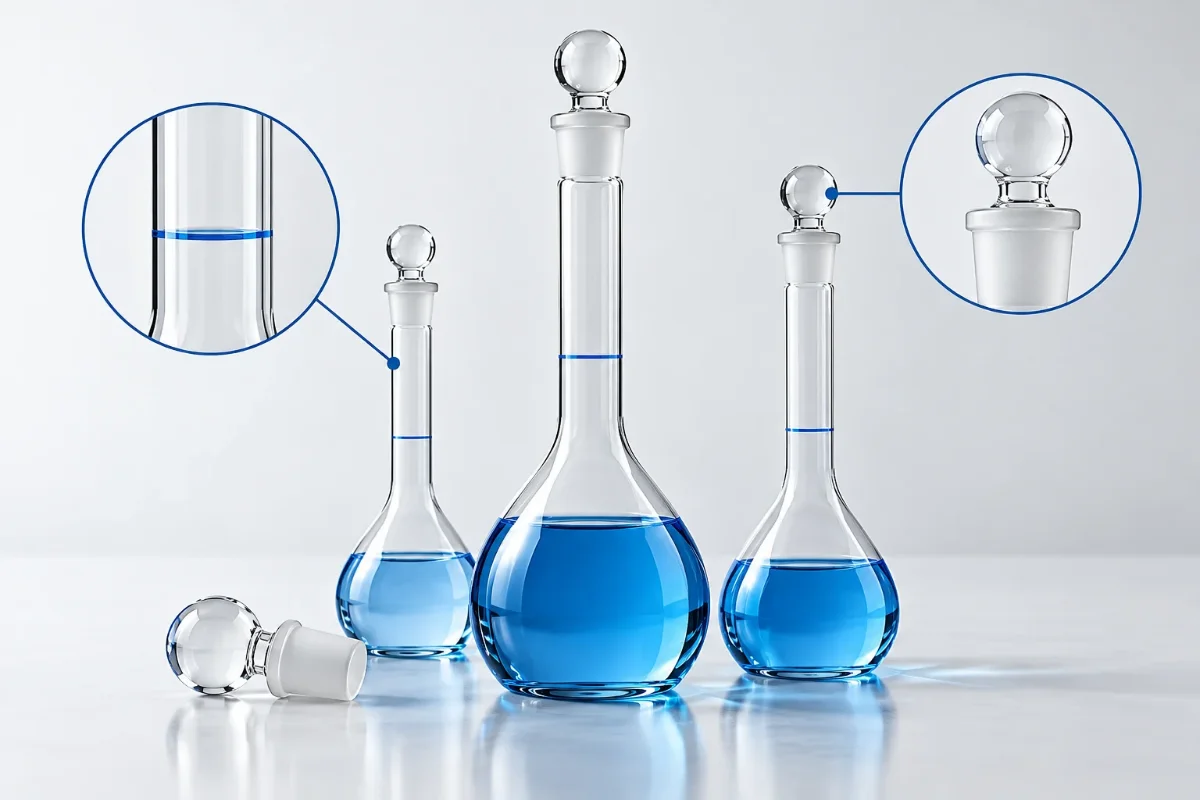
A volumetric flask is a glass vessel with a narrow neck and a single circular mark on it. It is designed for preparing solutions of precise concentration and measuring exact volumes of liquid. Unlike an Erlenmeyer flask or a graduated cylinder, a volumetric flask has a calibrated mark and allows accuracy down to hundredths of a milliliter.
Its main uses are preparing standard solutions, diluting samples, and titration. If you just need to measure an approximate volume or run a reaction with mixing, an Erlenmeyer flask or a graduated cylinder will do. A volumetric flask is needed where reproducibility matters: in analytical chemistry, pharmaceuticals, and clinical laboratories.
In lab practice, volumetric glassware holds a special place, and the choice of a specific flask type depends on the accuracy class and operating conditions. For example, class A flasks are used for preparing solutions for HPLC or spectrophotometry. For routine analyses with lower tolerance requirements, class B is sufficient.
Volume and Shape: What Volumetric Flasks Are Available (100 mL, 250 mL, 500 mL, etc.)
The standard range of volumetric flask volumes: 5, 10, 25, 50, 100, 200, 250, 500, 1000, 2000 mL and larger. The choice of volume is dictated by the sample volume and the required solution concentration. For example, a 100 mL volumetric flask is convenient for preparing small amounts of solutions for a single series of measurements. For larger volumes (e.g., preparing mobile phases for chromatography), use 1–2 liter flasks.
Flasks come in round and pear-shaped forms, but the most common is round with a flat bottom. The neck can be straight or widened. For easier mixing and to prevent splashing when bringing to the mark, flasks with a conical neck are used. Some manufacturers offer flasks with a plastic coating for protection against mechanical damage.
Accuracy Classes A and B: What's the Difference and When Class B Is Sufficient
The accuracy class determines the permissible volume error. Class A (1) — high accuracy, class B (2) — lower. The difference in tolerances: for a 100 mL class A flask, the error is typically ±0.1 mL; for class B, ±0.2 mL (according to ISO 1042). Most quantitative analyses require class A. Class B is suitable for qualitative determinations, preparing wash solutions, and auxiliary operations.
Choose class A if the analysis result depends on precise concentration (e.g., when building calibration curves, in pharmacopoeial tests). Class B is acceptable in teaching labs, for rough measurements, or when a 0.2% error is not critical. When buying, pay attention to the labeling: the flask should indicate 'A' or 'B' and the error value.
Joint and Stopper: How to Choose the Connection Type and Keep It Airtight
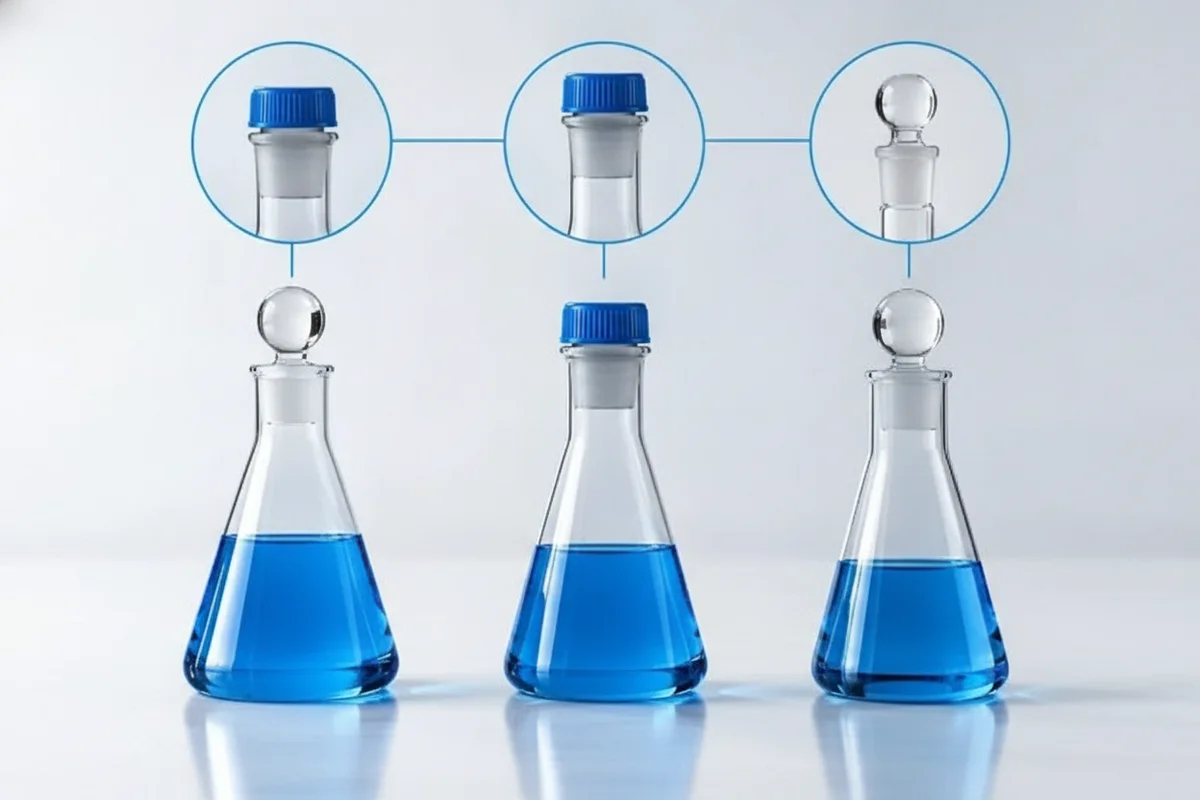
A joint is a ground-glass connection between the flask neck and the stopper. It ensures airtightness when storing solutions and prevents evaporation. Joints can be conical (ISO 383 standard) or spherical. For volumetric flasks, conical joints with a size number (e.g., 14/23, 19/26) are most common. The number indicates the diameter and length of the joint. The larger the number, the larger the connection.
The stopper can be glass or plastic (e.g., PTFE). A glass ground-glass stopper provides the best airtightness but requires careful handling. Plastic is convenient but may not be suitable for aggressive solvents. If the flask is used for preparing solutions that are then transferred, a stopper is not necessary. For storing solutions, it's better to choose a flask with a joint and stopper.
Checking the joint before purchase is easy: wet it with water and insert the stopper with a slight twist. The stopper should go in smoothly, without jamming, and after turning 90°, it should stay in place. If the stopper falls out or, conversely, jams, the joint is poorly ground.
Material: Why Borosilicate Glass Matters and How to Spot a Quality Flask
Laboratory borosilicate glass (e.g., glass 3.3) has a low coefficient of thermal expansion and is resistant to temperature changes and chemical attack. Volumetric flasks made of this glass do not deform when heated and maintain calibration accuracy. Cheap alternatives made of ordinary glass may have residual stresses and lose their shape over time.
You can identify a quality flask by its labeling: it should indicate the material (e.g., 'Boro 3.3'), accuracy class, volume, and calibration temperature (usually 20 °C). The joint is also marked. Check for bubbles and chips in the glass. A reliable supplier provides a certificate of conformity.
The service life of a borosilicate glass 3.3 flask with careful handling is 5–7 years. A soda-lime glass flask loses calibration faster, especially after cycles of washing and drying at elevated temperatures.
Calibration 'To Deliver/To Contain' and Common Mistakes in Volume Measurement
Volumetric flasks are calibrated 'to contain' (TC) or 'to deliver' (TD). 'To contain' — when you need to pour an exact volume into the flask; 'to deliver' — when a certain volume is poured out of the flask (e.g., a pipette). Volumetric flasks are usually calibrated 'to contain'. When using, it's important to bring the meniscus to the mark so that the bottom edge of the meniscus touches the mark line, with your eyes level with the mark.
Common mistakes: heating the flask (never heat a volumetric flask, as the glass expands and the volume changes), using dirty glassware, incorrect eye position when bringing to the mark. Also, do not store solutions in a volumetric flask that may react with the glass.
| Mistake | Consequence | How to Avoid |
|---|---|---|
| 'I'll eyeball it, the mark is close' | Error of 0.5–2%, invalidates a series of analyses | Bring up dropwise with a pipette, eyes level with the mark |
| Drying the flask over a hotplate or in an oven at 150 °C | Glass deforms, calibration shifts | Dry at 50–60 °C or air-dry upside down |
| Storing alkali in a flask with a joint | Joint seizes, stopper won't come off without force | Transfer alkali to polyethylene containers |
Care, Cleaning, and Storage of Volumetric Glassware
Wash volumetric glassware with warm soapy water or a weak acid solution, then rinse with distilled water. Do not use abrasives or stiff brushes to avoid scratching the glass. After washing, dry flasks upside down on special racks. Store volumetric flasks in a closed cabinet to avoid contamination and mechanical damage.
When storing solutions in a volumetric flask, always use a stopper. If the solution is aggressive, it's better to transfer it to another container. Don't forget to label the flask.
For heavily soiled flasks after organics, soak in chromic acid or alkaline solution for 2–4 hours, then rinse with tap water and rinse three times with distilled water. When storing, place a strip of paper between the joint and the neck: the stopper won't seize.
How to Recalculate Concentration If You Need a Different Flask Volume
Preparing a 0.1 M solution but only have a 200 mL flask instead of 250 mL? Recalculate the sample for the actual volume. The formula is simple: mass (g) = molarity (mol/L) × volume (L) × molar mass (g/mol).
Example with sodium chloride (M = 58.44 g/mol). For 250 mL of 0.1 M solution, you need 0.1 × 0.25 × 58.44 = 1.461 g. For a 200 mL flask: 0.1 × 0.2 × 58.44 = 1.169 g. The difference in sample is almost 0.3 g: if you prepare using the old sample in a smaller flask, the concentration will increase by 25%.
The procedure is the same: weigh the sample on an analytical balance (accuracy 0.0001 g), transfer to the flask through a funnel, rinse the funnel with distilled water, dissolve with mixing, then bring to the mark. Read the mark at the bottom of the meniscus at eye level.
Three Calculation Mistakes That Ruin Results
First: calculating volume based on the nominal flask volume, not the calibration. If a class B 250 mL flask, the actual volume may differ by ±0.4 mL, which is significant for precise work.
Second: confusing the mass of anhydrous salt and crystalline hydrate. For CuSO₄·5H₂O, the molar mass is 249.7 g/mol, not 159.6. The sample differs by a factor of 1.56.
Third: dissolving the substance in the flask by pouring water to the mark immediately. Dissolution involves volume change, so first dissolve in a small amount of water, then bring to the mark.
What Determines the Price of a Volumetric Flask
The price of a volumetric flask depends on four factors: volume, accuracy class, material, and presence of a joint. A rule of thumb: a 1000 mL flask costs about 2 times more than a 250 mL one, and moving from class B to class A adds 30–50% to the price.
A simple formula helps estimate the budget: base price for a 100 mL class B flask × volume factor × class factor. Take the volume factor for 100 mL as 1, for 250 mL → 1.3, for 500 mL → 1.6, for 1000 mL → 2.0. Class factor: for A — 1.4, for B — 1.0. A PTFE stopper joint adds another 10–20%.
| Option | When to Choose | What to Consider |
|---|---|---|
| 100 mL, class B, no joint | Teaching lab, wash solutions | Most affordable option in the line |
| 250 mL, class A, joint 14/23 | Routine quantitative analysis | Versatile working option |
| 1000 mL, class A, joint 19/26 | Preparing mobile phases, standards | Needs a stable stand, heavy |
Pre-Purchase Checklist: What to Check in the Product Listing
When ordering online, you don't have the flask in your hands. These points will help you weed out unsuitable glassware before paying.
| Parameter in Listing | What Should Be Specified | Why It Matters |
|---|---|---|
| Material | Borosilicate glass 3.3 | Withstands autoclaving and temperature changes |
| Accuracy class | A (1) or B (2) | Determines volume tolerance and price |
| Calibration | TC (to contain) or TD (to deliver) | Affects measurement procedure |
| Joint | Size (e.g., 14/23, 19/26) and type | Without size, you can't match a stopper |
| Documents | Calibration certificate, passport | Needed for method validation and audits |
Also ask the seller whether the flask has manufacturer and batch markings. If the listing only has a photo and price without specifications, request a datasheet: a reliable supplier will send it within a day or two.
Check delivery times with the manager: they depend on stock availability and order volume.
Practical Example: Preparing a 0.1 M Solution from a Sample in a 250 mL Flask
Let's go through a typical task a lab technician faces on the first day. You need to prepare 250 mL of 0.1 M sodium chloride (NaCl) solution. The molar mass of NaCl is 58.44 g/mol. Calculate the sample: 0.1 mol/L × 0.25 L × 58.44 g/mol = 1.461 g.
Then the procedure is:
- Weigh 1.461 g NaCl on an analytical balance, transfer to a 100–150 mL beaker.
- Dissolve in 50–70 mL distilled water, stir until crystals are completely dissolved.
- Pour the solution into a 250 mL volumetric flask through a funnel, rinse the beaker 2–3 times with small portions of water (5–10 mL each) and pour the rinsings into the same flask.
- Add water to 2–3 cm below the mark, then bring to the mark dropwise so that the bottom edge of the meniscus touches it.
- Close with a stopper and invert the flask 10–15 times to mix.
The water used to rinse the beaker is part of the total volume: that's why you can't dissolve the sample directly in the flask. If you fill to the mark in a flask with undissolved salt, the volume will change after dissolution and the concentration will be off.
Where the Flask Lies: Three Sources of Error and How to Catch Them
Even class A glassware gives an incorrect result if used improperly. The three most common causes differ from a lab technician's expectations, and each can be checked without complex equipment.
| Symptom | Cause | What to Do |
|---|---|---|
| Volume consistently 0.1–0.3 mL less than stated | Drops of solution remain on the neck walls above the mark | After bringing to the mark, mix and let the film drain; do not top up 'by eye' again |
| Results from different lab technicians differ by 0.5% | Meniscus read differently: some by the top edge, some by the bottom | Establish a rule: read at the bottom of the meniscus at eye level |
| Flask 'holds' volume worse after washing in hot water | Heating above 60 °C changes glass geometry and calibration | Wash with warm water up to 50–60 °C, do not dry over open flame |
You can check the flask yourself as follows. Fill with distilled water to the mark at 20 °C, weigh on a balance with 0.01 g accuracy, subtract the mass of the empty dry flask. For 250 mL at 20 °C, the water mass should be about 249.6 g (density 0.9982 g/mL). A deviation of more than 0.5 g for class B and more than 0.2 g for class A is a reason to recalibrate or replace the glassware.
Don't confuse a certified flask with household measuring glassware: a calibration certificate indicating temperature (usually 20 °C) and tolerance comes with class A glassware. If the document is needed for an accredited laboratory, request it from the supplier in advance.
How to Choose a Volumetric Flask for a Specific Method
Start with the method: it specifies the flask volume and the accuracy class. If the method references GOST 1770 or ISO 1042, you can't deviate from them. When the method allows options, follow the rule of "the smallest volume that fits the most concentrated sample."
Below is a quick five-step selection process.
- Step 1. Write down the volume and required tolerance from the method — this immediately determines the class.
- Step 2. Check whether you'll store the solution in the flask: storage requires a ground-glass joint with a stopper.
- Step 3. Check the material: only borosilicate glass 3.3 works for handling acids and alkalis.
- Step 4. Confirm the calibration: TD or EX, and at what temperature.
- Step 5. Request the certificate and data sheet before paying.
For HPLC and spectrophotometry, use class A flasks calibrated at 20 °C. For routine sample preparation in a clinical lab, class B at 50–100 mL is often sufficient. For educational work, class B without a ground joint is enough.
Red Flags: When Not to Buy a Flask
Five signs that you should walk away and look for another supplier.
- The product listing doesn't state the class or calibration temperature.
- The material is listed as "glass" without grade 3.3.
- The joint is described only as a "joint" with no size number.
- The price is 2–3 times below the market average for the same volume and class.
- There's no calibration certificate or batch data sheet.
Also look at the packaging: class A flasks ship in individual crates with padding. A batch in a single box without neck support often arrives with cracks around the joint.
Where You Can Save / Where You Can't
Saving on a volumetric flask makes sense where the tolerance doesn't affect the result. There's no point paying extra for class A in an educational lab.
| You can save on | You can't save on |
|---|---|
| Class B for rinse and educational solutions | Class A for quantitative analysis |
| Flasks without a ground joint if you don't need storage | Borosilicate glass 3.3 |
| Smaller volume when working with small portions | Calibration certificate for an accredited lab |
Our in-house articles help you cross-check glassware requirements: read about class A and B volumetric glassware, and general lab equipment questions are covered in the methodological works section.
Frequently Asked Questions
How is a volumetric flask different from an Erlenmeyer flask and a graduated cylinder?
A volumetric flask has a narrow neck and a single mark, which provides high volume accuracy. Erlenmeyer flasks and graduated cylinders are less precise and are used for mixing, heating, or approximate measurement.
Can a volumetric flask be used to store solutions?
Yes, if the flask has a stopper and the solution isn't aggressive toward glass. For long-term storage, it's better to use dedicated containers.
How often does a volumetric flask need to be recalibrated?
The recalibration interval depends on your lab's regulations and how heavily the flask is used. With daily use, a water-based volume check is usually done once a year; a flask kept in storage without use holds its calibration longer.
What should I do if the ground-glass stopper is stuck?
Don't force it. Put the flask in warm water for 10–15 minutes and tap the neck with a spoon handle. If that doesn't help, put a few drops of glycerin on the joint and try again.
Can a plastic volumetric flask replace a glass one?
Class B polypropylene flasks work for routine tasks and where impact resistance matters. For precise quantitative analysis and work with organic solvents, use glass.
How to Order Volumetric Flasks in Tashkent and Across Uzbekistan
At LPS UZ, you can source volumetric flasks in the volume, accuracy class, and joint you need. We supply borosilicate glass labware from trusted manufacturers. To place an order, contact us using the details on the website. Our managers will help you decide and provide information on availability and delivery terms. For advice on our volumetric glassware range, go to the contacts page. You can also confirm prices and delivery times there. To keep browsing lab glassware, visit the lab glassware section.
When choosing a volumetric flask, start from the task: class A for quantitative analysis, class B for auxiliary work; the volume for your working range; the joint for your storage method. Check the markings and documents before paying. LPS UZ specialists will help you find a flask for your method and advise on availability and delivery terms.