 Labware
How to Use a Separatory Funnel for Extraction

How do you use a separatory funnel? To perform an extraction, assemble the funnel, check the stopcock and stopper for leaks, add the phases, shake with regular pressure venting, and let the mixture separate. Then separate the phases without losing a drop. This article walks through each step in practice, including common mistakes and ways to break emulsions.
What a separatory funnel is and what it's used for
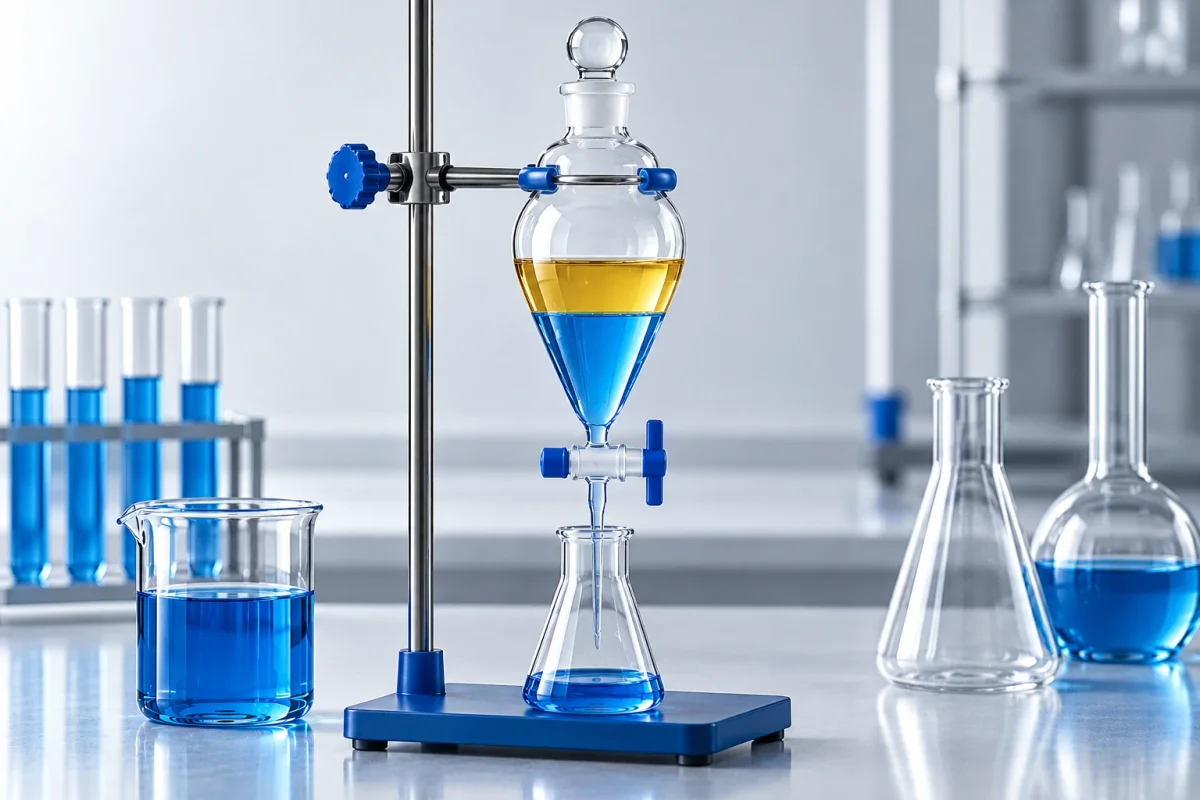
A separatory funnel is laboratory glassware used to separate immiscible liquids and perform liquid–liquid extraction. It has a conical body, a stopcock at the bottom, and a stopper on top. You pour solvent through the top opening and drain the lower phase through the stopcock.
Main tasks where a separatory funnel is used:
- extraction with a separatory funnel — transferring a substance from an aqueous phase into an organic solvent;
- phase separation after a reaction or washing;
- washing organic extracts with water or a weak solution;
- separating a precipitate when filtration isn't feasible.
A separatory funnel differs from a filter funnel and a Büchner funnel by having a stopcock and a stopper: it's designed for pressure in a closed vessel and for controlled liquid drainage. Filter funnels are for separating solid precipitates; a separatory funnel is for liquid–liquid separation. Don't confuse them: a laboratory funnel for filtration won't withstand shaking under pressure.
For aggressive media, use a laboratory separatory funnel made of borosilicate glass or polypropylene. Glass funnels are transparent, let you see the phase boundary, and resist most organic solvents.
Funnel design: body, stopcock, stopper, joints, and stopcock types
The funnel body is a cone with a cylindrical neck. A stopcock is sealed into the bottom. The top opening is closed with a stopper on a joint. Joints can be conical (interchangeable) or spherical; their sizes are standardized, but check the specific numbers in the product datasheet.
Stopcocks differ by material and design:
- ground-glass stopcock — requires lubrication, suitable for most solvents;
- PTFE stopcock (Teflon) — requires no lubrication, resistant to alkalis and strong acids;
- polyethylene stopcock — for aqueous solutions and mild reagents.
The stopper should fit into the neck freely but not wobble. A stopper that's too tight creates excess pressure during shaking; one that's too loose lets vapors escape. Check the joint for chips: even a small scratch breaks the seal. For precise work, choose a separatory funnel with a volume mark and graduations — it makes dosing phases easier.
Preparation: leak check, stopcock lubrication, choosing the volume
Before extraction, assemble the funnel and check for leaks. Here's a simple test:
- Close the stopcock and fill the funnel halfway with water.
- Insert the stopper and invert the funnel, holding the stopper with your hand.
- Shake for 5–10 seconds. If water seeps around the stopcock or stopper, the seal is broken.
Apply a thin layer of lubricant to the ground portion of the stopcock if it's glass. Excess lubricant can get into the extract and ruin the analysis. PTFE stopcocks need no lubrication.
Choose the funnel volume so the total liquid volume takes up no more than 50–70% of the nominal capacity. For example, for 100 mL of aqueous phase and 100 mL of solvent (200 mL total), use a 500 mL funnel. This leaves room for mixing and reduces the risk of ejection. If the sample volume is unknown, go by the maximum: better to take a larger separatory funnel than a smaller one.
Check that the stopcock is closed tight. Open it smoothly, without jerking. Make sure you have a container ready for draining the lower phase.
Step-by-step extraction procedure: loading, shaking, pressure venting, phase separation
Here's the sequence for extraction with a separatory funnel:
- Secure the funnel in a stand or hold it in your hand. Make sure the stopcock is closed.
- Pour the aqueous phase through the top opening. Add the solvent. The solvent volume is usually equal to or less than the aqueous phase — the exact ratio depends on the procedure.
- Insert the stopper. Hold the funnel so the stopper is pressed with your palm and the stopcock points away from you and others.
- Shake for 10–20 seconds. Then invert the funnel with the stopcock up and carefully open the stopcock to vent vapor pressure.
- Repeat shaking and venting 2–3 times. Hold the stopper each time.
- Place the funnel in a stand and let the phases separate. Don't open the stopcock until separation is complete.
- Place a container under the stopcock. Open the stopcock smoothly and drain the lower phase. When the interface approaches the stopcock, reduce the flow, then close the stopcock.
- Pour the upper phase out through the neck.
During shaking, don't open the stopcock fully: a small turn is enough to release vapors. If the stopper fits tightly, hold it with your finger. Pressure in a closed funnel rises quickly, especially with volatile solvents (diethyl ether, dichloromethane).
Phase separation in a separatory funnel speeds up if you let it stand undisturbed. Don't rush it: the boundary must become clear. If the phases turn cloudy, return to the shaking step after settling.
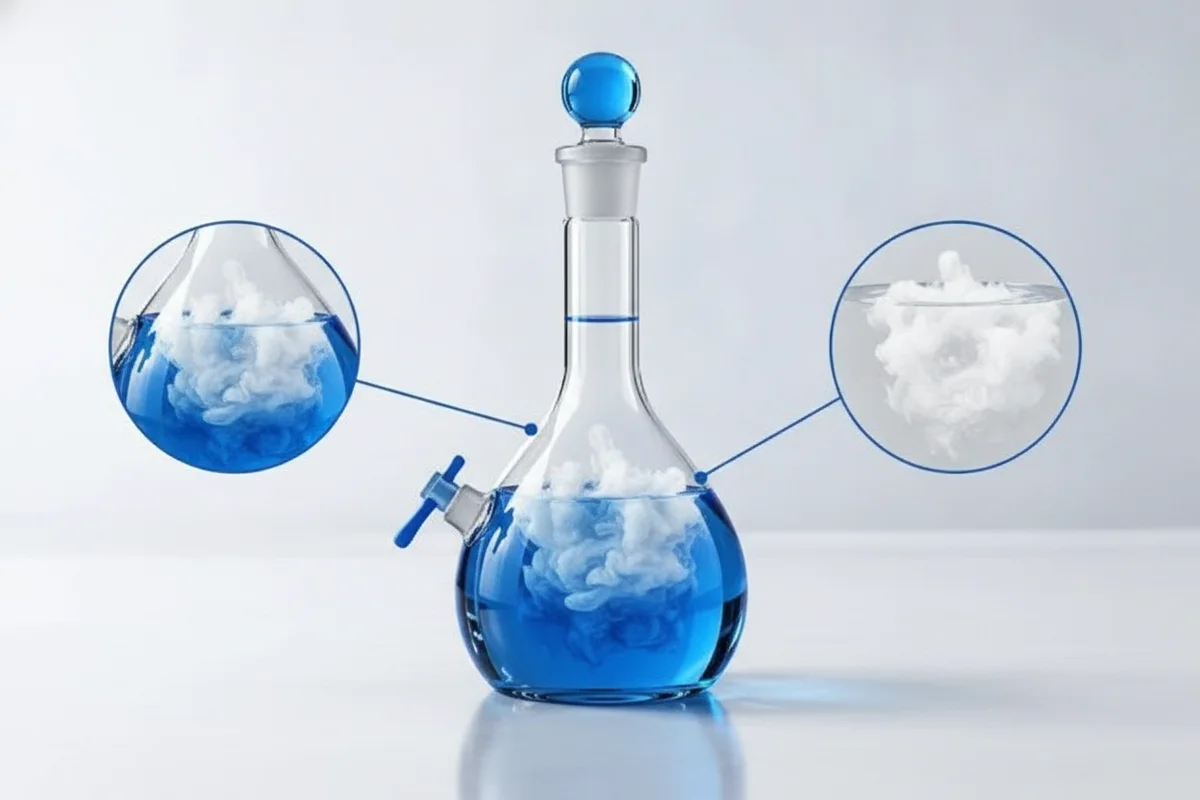
How to use a separatory funnel: dealing with emulsions and poor separation
An emulsion in a separatory funnel is a suspension of droplets of one phase in the other. It appears with vigorous shaking, the presence of surfactants, high salt concentrations, or a large density difference. A stubborn emulsion hinders separation and causes losses.
Ways to break an emulsion in a separatory funnel without losing substances:
- let the funnel stand for 10–15 minutes; this is often enough;
- add saturated sodium chloride solution (for aqueous systems) — it increases ionic strength and promotes separation;
- gently stir the contents with a glass rod;
- centrifuge if the volume allows and a centrifuge is available;
- use filtration through paper (only if the phases have already partially separated).
Don't try to break the emulsion by adding a large amount of solvent: this changes the phase ratio and can worsen the extraction. If the emulsion persists, reduce the shaking intensity next time.
For poor separation, check whether the funnel volume is too small: crowding prevents the phases from coalescing. Sometimes lightly tapping the body with your finger helps. For viscous samples, choose an extraction separatory funnel with a wide stopcock: a narrow bore gets clogged with droplets.
Safety with a separatory funnel: volatile solvents, vapor pressure, aggressive media
Working with a separatory funnel involves vapor pressure and aggressive liquids. Follow these rules:
- shake the funnel in a fume hood or a well-ventilated room;
- point the stopcock away from yourself and colleagues;
- wear safety glasses and gloves resistant to the reagents used;
- don't fill the funnel more than 70% — this leaves room for vapors;
- vent pressure after every shake, even if it seems unnecessary.
With volatile solvents (ether, acetone, chloroform), pressure rises especially fast. Before the first shake, make sure the stopper isn't seized. If the stopper is stuck, don't force it: hold the neck under warm running water or use a special stopper remover.
For aggressive media (concentrated acids, alkalis), choose a funnel with a PTFE stopcock and check material compatibility. Glass isn't resistant to hydrofluoric acid or hot alkalis. Safety with a separatory funnel starts with the product datasheet: it lists acceptable media and temperatures.
Separatory funnel care: washing, drying, and storage
Rinse the funnel immediately after use. Residual solvents and resins can clog the stopcock. Procedure:
- Drain the remaining phases into the appropriate waste containers.
- Rinse the funnel with tap water, then distilled water.
- For organic contamination, use a suitable solvent (acetone, alcohol), then water again.
- Don't use abrasives — they scratch glass.
Dry the funnel upside down on a stand or a special rack. Remove the stopper and stopcock and dry them separately. Don't dry in a hot oven if the funnel has plastic parts.
Store the funnel in a closed cabinet to avoid dust. Insert the stopper loosely so the joint doesn't seize. If the funnel has a PTFE stopcock, store it in the open position to avoid deforming the seal. Caring for a separatory funnel takes 5–10 minutes after each shift, but the stopcock won't seize for months.
Choosing a separatory funnel for extraction and ordering in Tashkent
When choosing a separatory funnel, consider volume, stopcock material, and joint type. For most extractions, a 250–1000 mL glass funnel with a PTFE stopcock is suitable. If you work with aggressive media, choose polypropylene or a Teflon stopcock.
Comparison of extraction funnel types:
| Type | Material | Best for | Features |
|---|---|---|---|
| Glass with ground-glass stopcock | Borosilicate glass | Organic solvents, aqueous solutions | Requires lubrication, phase boundary visible |
| Glass with PTFE stopcock | Glass + PTFE | Alkalis, acids, most solvents | No lubrication needed, chemically resistant |
| Polypropylene | Polypropylene | Aqueous solutions, mild reagents | Lightweight, unbreakable, but turns cloudy |
In Tashkent, separatory funnels and other laboratory glassware can be ordered from LPS UZ. The company supplies analytical and general laboratory equipment, glass and plastic ware, and reagents. To choose a funnel for your tasks, contact us via contacts for ordering and consultation. More laboratory glassware — in the general laboratory equipment catalog. Laboratory separatory funnels are supplied to order; confirm lead times and terms with the manager.
Common mistakes: what most often ruins an extraction
Experienced technicians lose yield not on complex procedures but on small details. Below are the slip-ups most often seen in protocols: from overloading to removing the stopper under pressure.
| Mistake | Consequence | How to avoid |
|---|---|---|
| Loading phases more than 2/3 of volume | Liquid ejected through the top opening during shaking, sample loss | Pause: total phase volume no more than 60–70% of nominal funnel capacity |
| Opening the stopcock without removing the stopper | Vacuum prevents liquid from flowing, phases don't separate | Remove the stopper before draining the lower phase, keep it in hand, not on the bench |
| Shaking without venting pressure | Stopper or stopcock blown out, solvent sprayed in the hood | Vent pressure every 5–10 seconds of shaking, point the stopcock away from yourself |
| Vigorous shaking 'until foaming' | Stubborn emulsion, separation takes tens of minutes | Smooth 180° inversions instead of shaking, 3–5 minutes per stage |
| Draining a phase into wet or dirty glassware | Film contamination, false results at the end | Rinse the receiver with the first milliliter of the drained phase |
| Separating without accounting for the interphase | Loss of some target substance at the boundary | Leave 1–2 mL at the boundary and repeat separation after settling |
Most of these mistakes boil down to one rule: slower on loading and venting, faster on draining. The classic line 'I'll speed it up, it'll separate anyway' is exactly what leads to foam that then takes half an hour to settle.
Working checklist before shaking and after draining
Get in the habit of going through a short list before and after the operation. It takes 30–40 seconds and saves repeat loadings. For volume control, use Class A and B volumetric glassware.
- Stopcock closed, lever moves smoothly without sticking, joint lightly lubricated.
- Stopper fits tightly but isn't stuck, top opening at hand for pressure release.
- Funnel in the stand, ring tightened, stopcock pointed into the hood or away from you.
- Volumetric receivers for both phases labeled and at hand, caps ready.
- After draining: stopcock rinsed, lower tip wiped, funnel dried or rinsed with solvent.
| Check | Tool | Standard |
|---|---|---|
| Stopcock leak | Water to half volume, stopper closed, shake | Dry under the stopcock, no drops for 2–3 minutes |
| Joint movement | Light turn of the stopper by hand | Turns without grinding or effort |
| Pressure venting | Open stopcock into hood after first seconds of shaking | Hissing occurs, but liquid doesn't eject |
| Separation | Stand, 5–10 minute pause | Phase boundary clear, interphase no thicker than 2–3 mm |
If after the third extraction separation is slower than the first, don't rush to add salt. Often the cause is droplets clinging to the walls: just swirl the funnel and let it stand. Problematic mixtures are best loaded in 50–100 mL portions into a 250 mL funnel.
How long does one extraction take, and how to fit it into a shift
Beginners think an extraction is just a minute of shaking. In reality, one stage with separation takes 7–12 minutes: loading 1–2 minutes, three shakes with pressure release 3–4 minutes, settling 5–10 minutes, draining 1–2 minutes. If the procedure requires three consecutive extractions of one sample, plan for 30–40 minutes per sample.
Hence the simple arithmetic of a batch: 12 samples at 35 minutes each is about 7 hours of pure work—a full shift with no buffer for washing glassware or unexpected emulsions. In practice, a batch of 10–12 samples is spread over two days, or 6–8 samples per shift with a 20–30% time buffer. A batch of 20 samples in one day is only realistic with an assistant to wash glassware and label containers.
You can speed up three steps. Prepare and label all containers before starting: this saves 3–5 minutes per sample. Use a second funnel while the first is settling: two 500 mL funnels nearly double throughput. Place the rack next to the fume hood so you don't carry the funnel around the lab. You can't speed up the shaking, but you can optimize your workspace.
What determines the price of a separatory funnel
The price range for separatory funnels at the laboratory Supplye is wide, and it comes down to four parameters. Volume: a 100 mL funnel costs less than a 2000 mL one, with differences up to 2–3 times. Stopcock material: a PTFE stopcock adds 30–50% to the price compared to a ground-glass one. Glass type: borosilicate 3.3 is more expensive than standard laboratory glass. Manufacturer and the presence of a graduated scale also affect the final price.
You can estimate the budget using the formula: base price by volume × stopcock coefficient × material coefficient. For example, a 250 mL glass funnel with a glass stopcock is the base, while the same funnel with a PTFE stopcock costs about 1.3–1.5 times the base price. A 250 mL polypropylene funnel is usually 20–40% cheaper than glass but lasts less long when working with solvents.
| Volume | Working mixture volume | What it's sufficient for |
|---|---|---|
| 100 mL | 50–70 mL | Microsamples, teaching experiments |
| 250 mL | 125–175 mL | Routine analyses, samples up to 150 mL |
| 500 mL | 250–350 mL | Standard laboratory extraction |
| 1000 mL | 500–700 mL | Preparative tasks, large aliquots |
It makes sense to save on volume: a 500 mL funnel covers 80% of routine tasks, and buying a liter funnel right away for 100 mL samples is pointless. Don't skimp on the stopcock: a cheap glass stopcock without a ground-glass reserve seizes up within a month, and you'll have to replace the funnel. One 500 mL funnel with a PTFE stopcock is usually cheaper than three glass ones over a year.
Frequently asked questions
How is a separatory funnel different from a Büchner funnel and a filter funnel?
A separatory funnel has a stopcock and a stopper and is designed for shaking under pressure and separating liquids. A Büchner funnel is used for vacuum filtration, while a filter funnel is for gravity filtration. Their designs do not provide a hermetic seal.
How to properly open the stopcock during shaking to avoid blowing out the stopper?
Hold the funnel with the stopcock up and press the stopper with your palm. Open the stopcock slowly with a small turn until you hear the hiss of escaping vapors. Do not release the stopper at that moment. After releasing pressure, close the stopcock and continue shaking.
Why does an emulsion form, and how to break it without losing compounds?
Emulsions form due to vigorous mixing, the presence of surfactants or salts. You can break them by settling, adding sodium chloride solution, gentle mixing, or centrifugation. These methods do not change the chemical composition of the phases.
What funnel volume should I choose for my sample volume?
The total volume of liquids should not exceed 50–70% of the funnel's nominal capacity. For 200 mL of mixture, use a 500 mL funnel; for 400 mL, use a 1000 mL one. If the sample volume may increase, choose with a margin.
How does a glass separatory funnel differ from a polypropylene one in practice?
Glass is transparent: you can see the phase boundary and interphase, making drainage easier to control. Polypropylene is unbreakable and cheaper but becomes cloudy over time and withstands organic solvents less well. For precise extractions, glass is more often chosen; for teaching and aqueous tasks, plastic.
A separatory funnel requires care, but with proper preparation and following the steps, extraction proceeds without losses. If you need help choosing a funnel or other laboratory glassware, the specialists at LPS UZ will select the right option for your tasks and volumes, and provide information on availability and ordering conditions.