 Weighing
Daily Verification of Laboratory Balances

Daily verification of laboratory balances takes 5–10 minutes, but it is precisely this step that protects you from errors that can cost weeks of experiments. Many laboratories only think about balance control before calibration, and until then they work on “conditionally functional” equipment. As a result, zero drift or loss of sensitivity goes unnoticed, and weighing results become questionable.
In this article, you will learn which parameters to check every morning, how to select a check weight, what to record in the log, and when it's time to call a service engineer. We'll also clarify the difference between daily verification, calibration, and verification (metrological certification), so you don't confuse these procedures or place undue expectations on them.
Why daily verification of laboratory balances is necessary and how it differs from calibration and verification
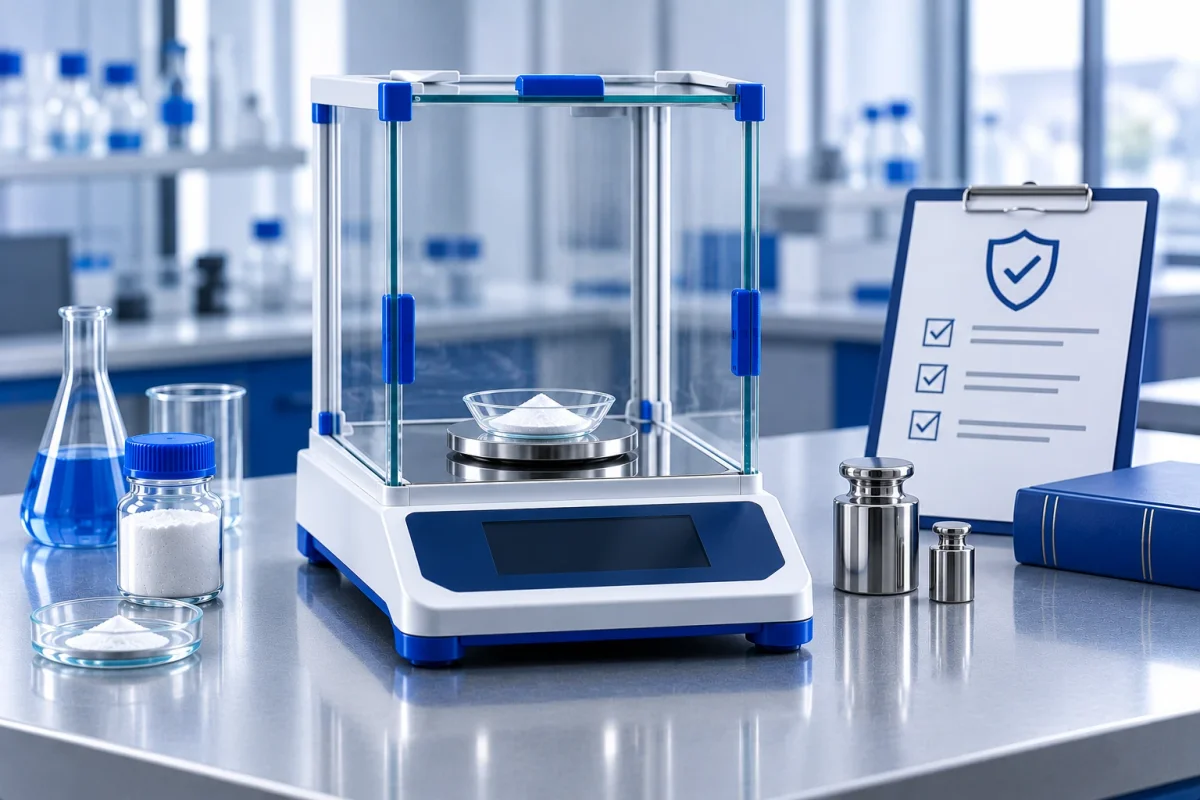
Daily verification of laboratory balances is a quick check of balance performance before measurements begin. Its purpose is to ensure that the balance gives stable and reproducible results within the limits set by your method or the manufacturer's manual. The check is performed by the operator who will use the balance, not by a service engineer.
Calibration is the determination of the actual metrological characteristics of the balance and their comparison with a reference. Based on calibration results, you obtain corrections or confirmation that the balance meets tolerances. Calibration is carried out by a specialized organization using high-class reference weights.
Verification of laboratory balances (metrological certification) is a procedure required by legal metrology. It confirms that the balance corresponds to an approved type and can be used in areas subject to state metrological control. Verification is documented with an official certificate.
Daily verification does not replace calibration and verification. It only shows that the balance is currently performing predictably. If daily control reveals deviations, it is a signal for unscheduled calibration or repair.
| Procedure | Performed by | Frequency | Result |
|---|---|---|---|
| Daily verification (internal balance control) | Laboratory operator | Every working day before measurements | Log entry, decision on work approval for the balance |
| Calibration | Metrology service or balance service engineer | On schedule, usually once a year or after repair | Calibration certificate with corrections |
| Verification | Accredited organization | Within the timeframes established by law | Verification certificate |
Which balances require daily control: analytical, precision, technical
The higher the measurement accuracy, the more sensitive the balance is to external conditions and the more important daily verification becomes. Analytical balances with a readability of 0.1 mg or 0.01 mg require verification before each measurement series. Any zero shift or loss of repeatability is critical here.
Precision balances (readability from 1 mg to 0.1 g) also need daily verification, especially if they are used for weighing samples for quantitative analysis. Technical balances can be checked less frequently, but if they are used for preparing solutions or weighed portions with specified error, daily equipment control is still recommended.
General rule: if the weighing result affects the reliability of the analysis or product quality, laboratory balances must be verified daily. For auxiliary operations (tare weighing, rough weighing), periodic control established by internal procedure is sufficient.
In laboratories equipped with analytical balances, daily verification should include a check of weighing repeatability and zero shift. For technical balances, it is sufficient to check zero and perform one control weighing.
What to check before work: zero shift, repeatability, sensitivity, eccentricity
Daily verification of balances includes several parameters. Start with a visual inspection: the pan must be clean, the level is set, the doors of analytical balances are closed, and there are no sources of vibration or drafts nearby.
Zero shift: zero the balance and observe the readings. If they deviate from zero beyond the permissible limit (according to the manufacturer's manual or internal procedure), re-zero. Stable zero drift may indicate contamination or a sensor malfunction.
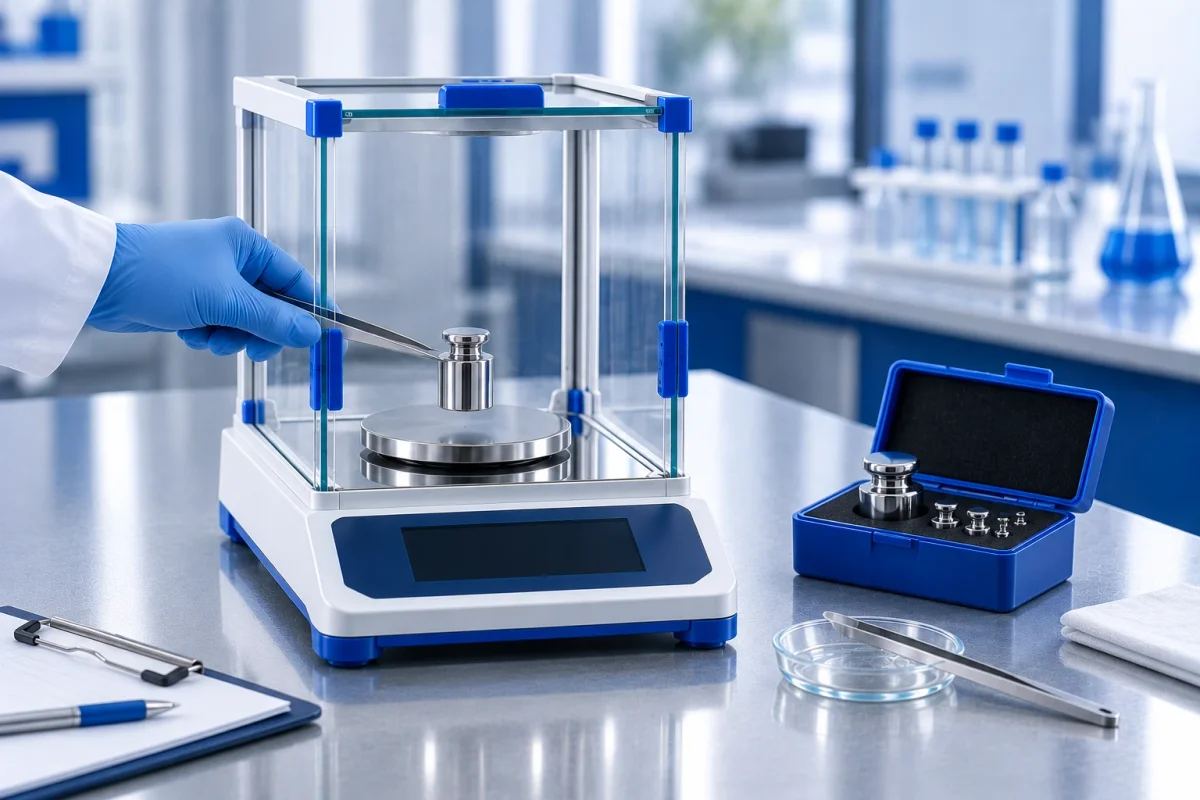
Repeatability: place a check weight on the pan and take a reading. Repeat 3–5 times, removing and replacing the weight each time. The spread of results must not exceed the tolerance specified in the balance documentation. For analytical balances, the specified repeatability is usually the reference.
Sensitivity is checked by the response to a small additional load. If adding a weight equal to the scale interval does not change the reading, sensitivity is impaired.
Eccentricity (error from off-center loading) is checked by placing the weight in the center and at the edges of the pan. The difference in readings must not exceed the permissible limit according to the manual. This check can be done once a week or after moving the balance, but for daily control, it is sufficient to use the central position of the weight.
How to select a check weight and use it correctly
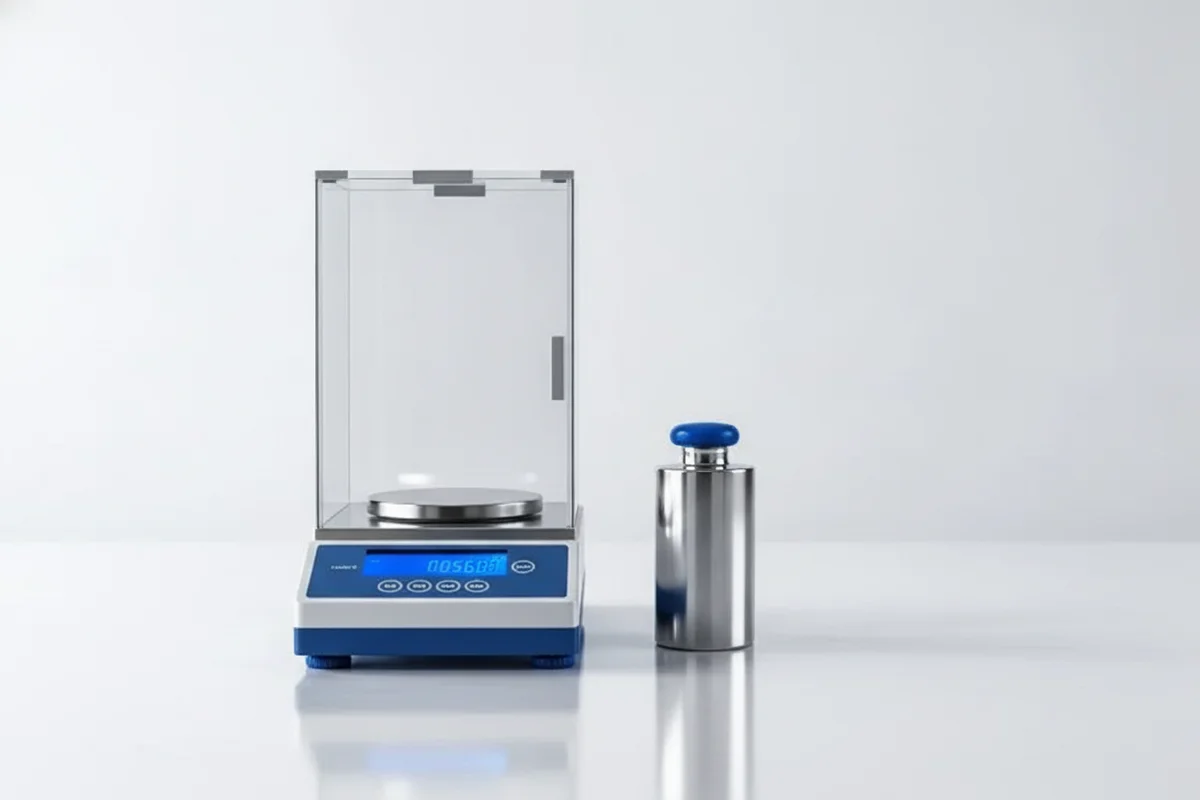
For daily verification, you need one or several check weights. The weight mass should be close to the typical working load: if you frequently weigh 100–200 mg portions, there is no point in checking the balance only with a 50 g weight. Ideally, have a weight corresponding to the upper third of the range and a weight for sensitivity control.
The accuracy class of the check weight for the balance must be at least as high as required for your measurements. For analytical balances, class E2 or F1 weights are usually used. For technical balances, class F2 or M1 is sufficient. The weight must be certified and have a verification certificate. Weight verification is performed within the established timeframes, usually once a year, by an accredited organization.
Handle the weight carefully: store it in its case, pick it up with tweezers or gloves, without touching the surface with your fingers. Before weighing, let the weight acclimatize to room temperature if it was stored in another room. Regularly clean the weight with a soft cloth, without using aggressive solvents.
If the weight is dropped or scratches appear, it cannot be used for control until re-certification. Keep a separate log for weights with verification notes.
How to set up a daily verification log and what records to keep
The balance verification log is the primary document for internal balance control. It records the date, time, balance identifier (inventory number), verification parameters, and results. Records must be kept by the operator who performed the verification, with a signature.
Recommended log structure:
- Date and time of verification.
- Balance and weight identifier (verification certificate number).
- Zero reading (zero shift).
- Repeatability results: 3–5 readings and the spread.
- Sensitivity check result (change in reading when adding a load).
- Conclusion: approved / not approved for use.
- Operator signature.
The log can be kept in paper or electronic form. An electronic form is more convenient for archiving and trend analysis. If results are consistently close to tolerance limits, it is worth plotting a day-by-day graph: this will help detect an impending malfunction.
Keep logs for at least the period established by your laboratory's quality management system. Typically, this is 1–3 years.
Common mistakes in daily verification and signs that the balance needs servicing
Mistake: “I check the balance once a week; nothing bad will happen.” Risk: zero shift or loss of sensitivity goes unnoticed, and analysis results have to be redone. How to avoid: make daily verification of laboratory balances a mandatory procedure before starting work.
Mistake: “I use any weight I find, as long as it's there.” Risk: a weight with an expired verification or of an unsuitable class gives a false sense of reliability. How to avoid: maintain a weight register and check their verification dates.
Mistake: “I only record good results in the log, and if something is wrong, I just redo it.” Risk: you lose history and cannot track balance degradation. How to avoid: record all results, including deviations, and note what actions were taken.
Signs that the balance needs servicing: readings do not stabilize, calibration errors appear, zero shift repeats day after day, repeatability deteriorates, the balance does not respond to small loads. In these cases, do not try to “tweak” the balance yourself—call a service engineer.
When calibration and verification by a specialist are needed, and when internal control is sufficient
Daily verification provides operational control but does not determine the actual metrological characteristics of the balance. If daily verification results exceed permissible limits, unscheduled calibration is required. Calibration is also performed after repair, moving the balance, or changes in operating conditions.
Verification is mandatory for balances used in areas of state metrological control (e.g., trade, medicine, precious metals accounting). Verification deadlines are established by the legislation of Uzbekistan. If your balance is not subject to mandatory verification, you can limit yourself to calibration and internal control.
For laboratories accredited to ISO/IEC 17025, balance calibration must be traceable. Daily verification remains an element of internal quality control.
When to call a specialist: after dropping the balance, when mechanical damage appears, with stable deviations in daily verification, before starting critical tests. A service engineer will perform diagnostics and repair the balance if necessary.
To order balance calibration, verification, or repair, contact the service center. If you need to choose new balances or weights, browse laboratory balances in the catalog. For any questions, contact us via contacts.
Frequently Asked Questions
How does daily verification of balances differ from calibration and verification?
Daily verification is a quick performance check by the operator. Calibration determines the actual characteristics of the balance and is performed by a specialist. Verification of laboratory balances is an official procedure confirming compliance with legal requirements.
Which balance parameters should be checked daily before measurements?
Zero shift, repeatability, and sensitivity. For analytical balances, it is also advisable to check reading stability with the weight in the center position.
Which weight should be used for daily verification and how often should it be verified?
Use a weight of an accuracy class corresponding to your measurements (e.g., E2 or F1 for analytical balances). The weight is verified annually by an accredited organization.
What to do if daily verification results exceed permissible limits?
Do not start measurements. Check the cleanliness of the pan, the level, and the absence of drafts. If deviations repeat, call a service engineer for balance calibration or repair.
Is a daily verification log necessary and what should be recorded in it?
Yes, the log is needed to confirm control. Record the date, balance identifier, results of zero, repeatability, and sensitivity checks, the approval conclusion, and the operator's signature.
Practical example: a day in the life of a laboratory with and without daily verification
Let's compare two identical working days in two laboratories that weigh 100–200 mg portions on analytical balances with 0.1 mg readability. The conditions are the same; the only difference is the procedure.
Laboratory A checks the balance every morning: visual inspection, zeroing, one 100 mg check weight, log entry. It takes 6 minutes. On Wednesday, the operator notices that the weight reading has shifted to +0.6 mg instead of the usual ±0.2 mg. The balance is sent for adjustment before the series begins. The loss is half a day of downtime. The alternative without verification would look like this: a series of 40 samples weighed with a shift, the result rejected at the validation stage, repeating the series—that's already 2–3 days of work and consumed reagents.
Laboratory B checks the balance once a week “for show.” The shift accumulates slowly, there is no log with history, and the moment when the balance went out of tolerance cannot be established. During an audit, the inspector asks to confirm that the balance was within specification on the day of a specific analysis. There is nothing to confirm with.
Do the math yourself: 6 minutes a day is about 2 hours a month per balance. One redone analysis series usually costs more than these 2 hours, even without considering delayed deadlines under the contract with the client.
Checklist: what to prepare before the first day under the new procedure
If you are introducing daily verification of laboratory balances from scratch, preparation takes one working day. Below is a set of actions in order of execution.
- Appoint a responsible person for verification and a backup in case of vacation or sick leave: the procedure should not stop because of one person.
- Select a check weight for your working portions and verify that it meets the accuracy class for your balance.
- Set up a log: paper or electronic, with fields “date,” “time,” “operator,” “weight,” “reading,” “deviation,” “decision.”
- Determine the permissible deviation for each model and record it in the procedure in milligrams, not with the wording “within normal limits.”
- Specify the action to take when tolerance is exceeded: whom to notify, what to do with already completed weighings, who decides on work approval for the balance.
- Train operators: one demonstration and one supervised independent performance is usually sufficient.
| What to prepare | Who's responsible | Timeline | Sign of readiness |
|---|---|---|---|
| Responsible person and backup | Lab manager | 1 day | Order issued or regulation entry made |
| Reference weight | Metrologist | 1–3 days | Weight with a valid certificate |
| Inspection log | Responsible person | 1 day | Form approved, fields being filled in |
| Tolerances in mg | Metrologist | 1 day | Figures entered in the regulation |
| Operator training | Responsible person | 1–2 hours | Each operator has performed the check independently |
Keep a short list of red flags on hand — the ones that mean stopping the scale immediately: the reading doesn't return to zero after the load is removed, the spread of repeated weight readings has doubled compared with normal, or moving the load on the pan changes the result by more than the tolerance. In these cases, the daily check of the laboratory scale has already done its job: now you need a specialist.
Conclusion
A daily check of laboratory scales is a simple and reliable way to keep measurements accurate. Make it part of your operating procedure, keep a log, and watch the weight verification deadlines. If you need help with scale calibration, verification of laboratory scales or scale repair, LPS UZ is ready to provide service and help you choose the right equipment and accessories. Contact our specialists to discuss the terms of cooperation.