 Weighing
Analytical vs. Precision Balances: What's the Difference?

What's the difference between analytical and precision balances? In short: accuracy class and readability. Analytical balances read down to 0.1 mg and operate in a draft-shielded chamber, while precision balances offer readability from 1 mg to 0.1 g and are designed for larger samples. Below we explain how this difference affects your choice.
Many labs buy balances with "extra accuracy" and then struggle: slow stabilization, sensitivity to drafts, no large tare allowed. Or they go for a simpler instrument and end up with unacceptable error when weighing reference standards. Mistakes cost money and require reworking methods.
In this article, you'll learn how to tell analytical and precision balances apart by their specs, where each is sufficient, how room conditions change the choice, and what to do about calibration and verification.
Analytical vs. precision balances: what's the difference?
The difference comes down to two things: readability and maximum capacity. Analytical balances read down to 0.1 mg but handle small samples. Precision balances offer readability from 1 mg to 0.1 g and work with larger tare. The method dictates the choice: if the mass tolerance is 0.1 mg, you can't do without an analytical balance.
What are analytical balances: readability, accuracy class, applications
Analytical balances are instruments with a reading interval of 0.1 mg or less (0.01 mg for semi-micro and micro balances). They are used where sample mass directly determines the result: preparing standard solutions, weighing reference standards, pharmacopoeial testing.
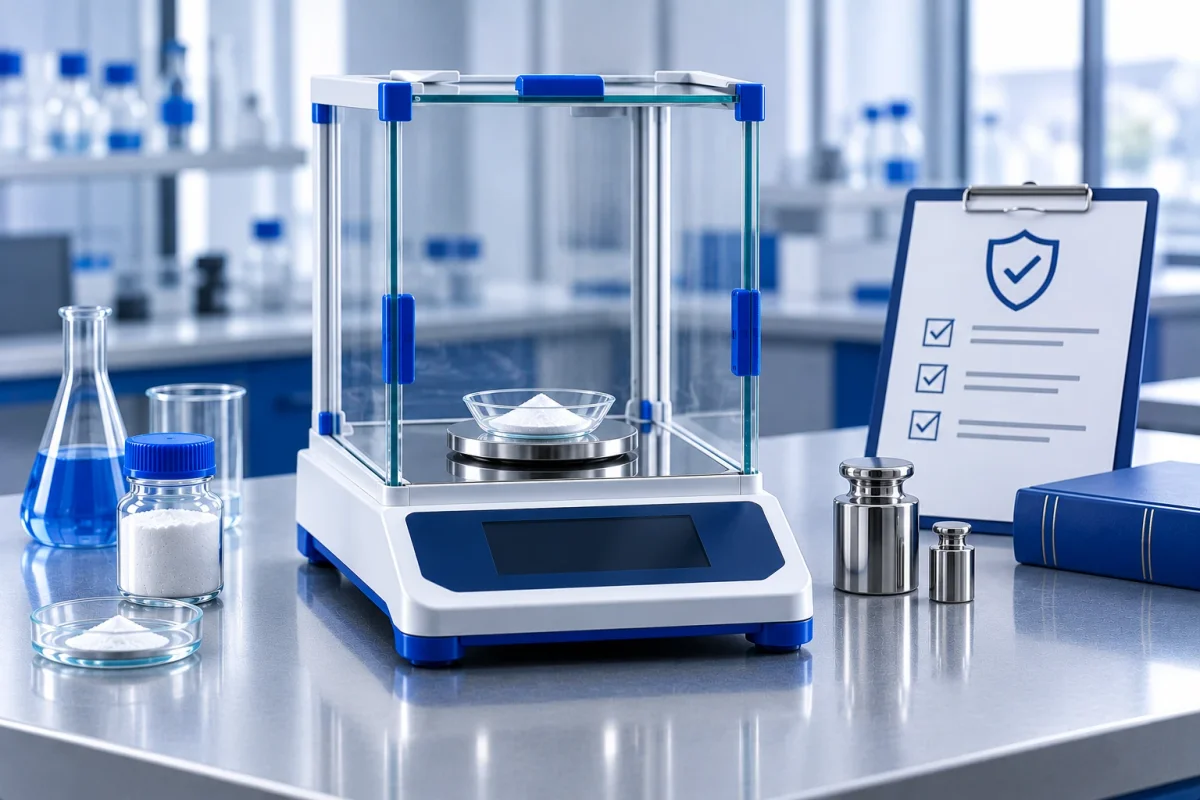
By design, these are instruments with a fully enclosed weighing chamber: draft shields, internal calibration, often built-in temperature and humidity sensors. The weighing range is usually limited, and maximum capacity is small compared to precision models. But the error within the working range is minimal.
The accuracy class is defined by OIML R 76 — a document harmonized with OIML recommendations for non-automatic weighing instruments. In the specification, check the verification interval e and the number of intervals n: the higher the class, the stricter the requirements for installation conditions.
Analytical balances are sensitive to vibration, drafts, and temperature fluctuations. Even the right model in a busy room near a door will give unstable readings. That's why analytical balances are placed on an anti-vibration table in a separate room.
Typical applications: pharmaceuticals, quality control, metrology labs, research with small samples.
What are precision balances and how do they differ from technical balances?
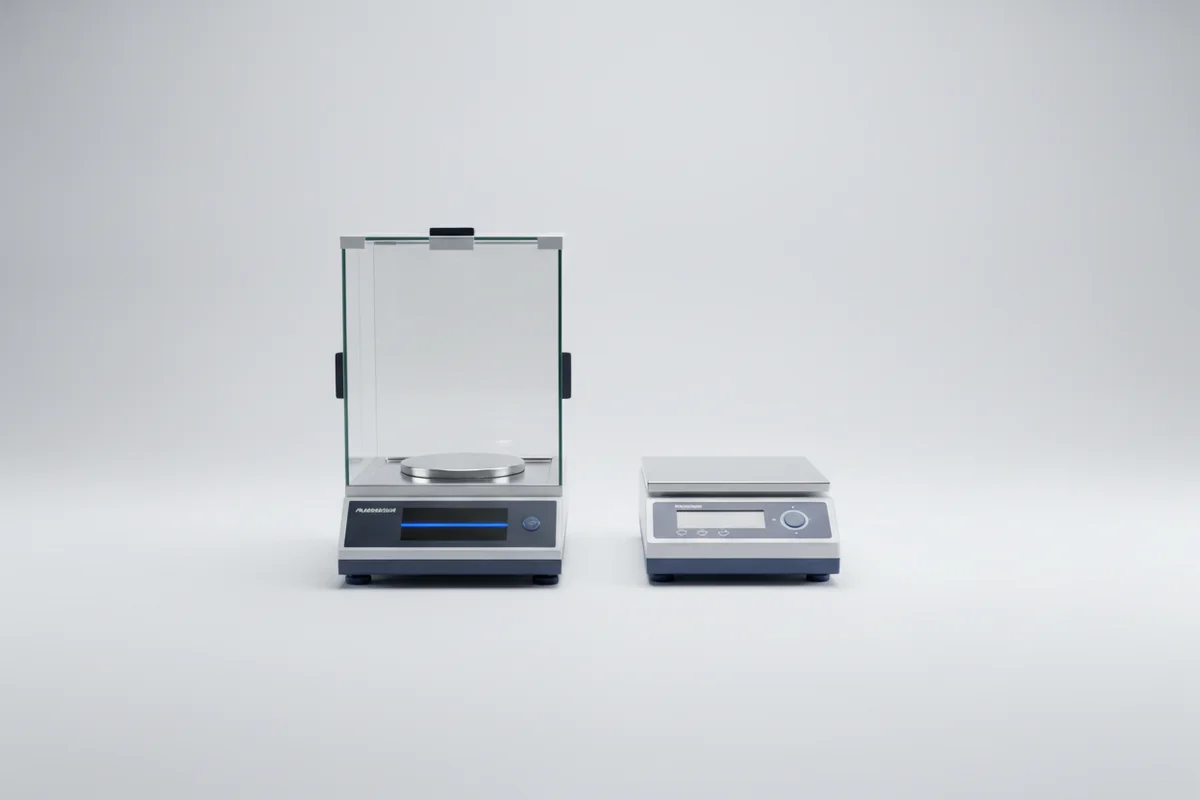
Precision balances are instruments with readability from 1 mg to 0.1 g and an extended weighing range. They are often called general-purpose laboratory balances. They are more accurate than technical (household and commercial) balances but inferior to analytical ones in resolution.
The difference from technical balances lies in metrology and design. Precision models have standardized error and accuracy class according to the same OIML R 76, overload protection, often built-in calibration, and data interfaces. Technical balances are designed for household and commercial accuracy and are not suitable for laboratory methods.
Many precision models have draft shields, but not full enclosure: a glass cover protects the pan, yet room requirements are less strict. The instrument can be installed in a regular lab room if there is no strong vibration or direct airflow from an air conditioner.
Precision balances are more convenient for working with large tare: flasks, beakers, large weighing bottles, sample containers. For analytical balances, such samples often exceed the working range.
Key differences: readability, weighing range, sensitivity to conditions
Let's compare specifications by three parameters that most often determine the choice. The figures below are general metrological guidelines; check exact values in the model's specification.
| Parameter | Analytical balances | Precision balances |
|---|---|---|
| Readability (scale interval) | 0.1 mg and below | From 1 mg to 0.1 g |
| Maximum capacity | Small, tens to hundreds of grams | From hundreds of grams to kilograms |
| Draft shield | Full chamber, glass on all sides | Partial, cover above the pan |
| Installation conditions | Anti-vibration table, separate room | Regular lab without drafts |
| Typical task | Reference standards, pharmacopoeia | Sample preparation, reagents, QC |
Readability is the main marker. If the datasheet says 0.1 mg, it's analytical class. Readability of 1 mg is borderline: such models can be both precision and semi-micro; rely on the accuracy class and method recommendations.
Sensitivity to conditions is directly related to readability: the smaller the scale interval, the more vibration, drafts, and temperature affect the reading. This is not a defect but the physics of weighing small masses.
Where analytical balances are needed: pharma, quality control, reference standards
Analytical balances are indispensable where sample mass is part of concentration calculations. In pharmaceuticals, this includes preparing standard solutions and testing according to pharmacopoeial methods with strict tolerances.
In quality control, analytical balances are used for weighing reference standards and preparing calibration solutions for chromatography and spectrometry. An error in sample weight here carries over to the entire analysis result.
In metrology and research labs, analytical balances are needed when working with small amounts of expensive reagents: losing a milligram per sample adds up to real money.
If the method explicitly specifies weighing accuracy of 0.1 mg or requires an analytical balance, you cannot choose a precision one: the result won't pass validation. Extra accuracy is justified here.
Where precision balances are sufficient: sample preparation, reagents, process control
Precision balances cover most routine lab tasks. Sample preparation, weighing reagents for solutions to the nearest milligram, dispensing, and batch control — all within their range.
In production process control, precision balances are more convenient: large platform, large tare, fast response. You don't need 0.1 mg readability here, but resistance to equipment vibration and speed matter.
For teaching and factory labs, precision models often become the primary instrument. Analytical balances are purchased additionally for specific methods.
Rule of thumb: if the method's mass tolerance is 1 mg or higher, precision balances suffice. If 0.1 mg or lower is required, you need analytical.
Environmental impact: vibrations, drafts, temperature, anti-vibration table, and draft shield
Room conditions matter as much as the instrument class. An analytical balance on an unsuitable table will drift and show an unstable zero.
Check the room before buying. Here are five checks you can do yourself:
- Place a glass of water on the table near the intended balance location: ripples on the surface reveal vibration from equipment and foot traffic.
- Hold a sheet of paper near the location: noticeable deflection indicates a draft from an air conditioner or door.
- Measure temperature in the morning and afternoon: a change of more than a couple of degrees per shift is undesirable for analytical balances.
- Assess proximity to centrifuges, compressors, fume hoods: sources of vibration are best moved to another room.
- Check table level with a spirit level: analytical balances are set using the built-in level; tilt causes systematic error.
Analytical balances require an anti-vibration (marble or massive) table and a separate room without active foot traffic. The draft shield protects the pan but doesn't eliminate room requirements. Precision balances are more tolerant, but they also need a level table away from drafts.
How to choose: algorithm from task to accuracy and budget
Start with the method, not the instrument. The algorithm is simple and works for any lab.
- Write out the required weighing accuracy and maximum sample with tare from your methods.
- Compare with readability: required accuracy 0.1 mg → analytical balance; 1 mg or higher → precision balance.
- Check the room using the five checks above and include an anti-vibration table if analytical is needed.
- Verify the accuracy class per OIML R 76 and whether verification is included.
- Choose a brand and model within budget, factoring calibration into the cost of ownership.
When buying Sartorius balances in Tashkent, look at readability, maximum capacity, accuracy class, internal calibration, and service support. Sartorius and Mettler Toledo models are widely used in labs; their technical manuals help verify specifications.
Calculate budget by cost of ownership, not just instrument price: verification, calibration, test reagents. Analytical balances are more expensive to maintain. To choose a balance by brand, match models to your lab's tasks.
Calibration and verification of balances: how to maintain accuracy
Calibration and verification of laboratory balances are needed to confirm accuracy. Verification is a mandatory procedure for instruments used in state metrological control; calibration confirms characteristics for internal quality control.
Frequency is set by method and regulatory requirements, usually once a year, while internal checks with control weights are performed daily or before a series of measurements. Daily checks take minutes: place a control weight and compare the reading against tolerance.
Common mistakes and how to avoid them:
| Mistake | Consequence | How to avoid |
|---|---|---|
| "Let's get a more accurate balance, we'll figure it out later" | Unstable readings, reworking methods | First check the room and the task |
| Saving on an anti-vibration table | Zero drift, unreliable weighings | Include the table in the analytical balance budget |
| Skipping daily weight checks | Hidden accuracy drift between verifications | Implement a pre-shift checklist |
Keep calibration and verification records: during audits they confirm measurement traceability. For DLAB balances and other models, ask the supplier about service and documents.
Practical calculation: what balances your lab needs
Take your method and write out two numbers: minimum and maximum sample. Then a simple rule applies: instrument readability should be 10 times smaller than the smallest sample. If the method requires weighing 20 mg, readability should be 2 mg or finer (that's already analytical class). For a 500 mg sample, 50 mg readability is enough, but for margin take 10 mg.
The second step is the number of weighings per day. If an operator does 30–50 cycles, time lost to stabilization of analytical balances (5–15 seconds per measurement) adds up to 10–15 minutes per shift. When such weighings number in the hundreds, precision balances with fast response save hours, but only if the method allows their readability.
Example setup for a small four-person lab:
- analytical balance 220 g / 0.1 mg — 1 unit for standard solutions and quality control;
- precision balance 2200 g / 10 mg — 2 units for sample preparation and reagents;
- precision balance 6000 g / 100 mg — 1 unit for dispensing and large tare;
- anti-vibration table and draft shield — for the analytical balance.
Checking the calculation is easy: multiply the maximum daily sample by safety factors. If the total mass per day on one instrument approaches half the maximum capacity, add a second balance of the same class. This way you avoid queues and don't overpay for one ultra-precise instrument that sits idle.
Common mistakes when working with balances and how to avoid them
Most inaccurate results are not due to instrument failure but to operator habits. Below are the most common causes of rejects.
Mistake → Consequence → How to avoid: "We'll weigh right on the table cover, then clean up" → vibrations cause scatter of several tenths of a milligram, results are not reproducible → install the balance on a separate anti-vibration table and take zero only after warm-up and stabilization.
Mistake → Consequence → How to avoid: "I'll check the instrument with a weight once a year, that's enough" → verification and internal calibration are not maintained, accuracy drifts with temperature and humidity → keep a daily calibration log and send for verification on schedule.
Mistake → Consequence → How to avoid: "An open draft shield door doesn't matter" → air currents disturb zero and increase response time → perform all sample operations with the draft shield closed, work with gloves and tweezers.
Daily checklist for analytical balances: warm up the instrument for 30–60 minutes → check level by the bubble → perform internal calibration → weigh a control weight and record the result in the log → work only with the draft shield closed → clean the pan at the end.
Red flag when choosing a contractor or supplier: no datasheet and verification certificate, unclear error in the working range, no draft shield or anti-vibration table offered. If an instrument is offered without documents, the stated accuracy is unconfirmed.
Frequently Asked Questions
Can I weigh large samples on an analytical balance?
Only within the instrument's maximum capacity. Large containers and big samples often exceed the working range. For such tasks, use precision balances with a larger platform.
Do balances need verification for an in-house laboratory?
It depends on whether the results are used in the sphere of state metrological control. For internal quality control, calibration and daily checks with test weights are sufficient, but the requirements of the method may be stricter.
How do semi-micro and micro balances differ from analytical ones?
They have a smaller readability: 0.01 mg and below. They require even stricter conditions and special tables. For most pharmacopoeial methods, an analytical balance with 0.1 mg readability is sufficient.
How often should balances be checked with test weights?
Before each measurement series or daily. Choose a weight close to the working range of samples and record the result in a log. This catches accuracy drift between verifications.
The choice between an analytical and a precision balance is determined by the method and the room conditions, not the price of the instrument. Start with the required weighing accuracy and a check of the room, then select a model and plan for calibration. At LPS UZ they will help you choose laboratory balances for your task and arrange calibration: send the list of methods and the required accuracy via a balance selection and calibration request, and browse the brand's models in the DLAB balances and laboratory equipment section.