 Chromatography
Causes of Pressure Build-Up in HPLC

Pressure build-up in HPLC rarely happens overnight: usually the gauge needle creeps up over several days, and the operator only notices when the system throws an error. Blaming it all on an "old column" is the most common mistake. The causes of pressure build-up in HPLC can lie in a clogged eluent filter, precipitated buffer salts, a worn pump seal, or a closed valve.
Below is a practical, component-by-component breakdown: how to tell column clogging from a hardware fault, which checks take half an hour, and how to set up preventive maintenance so pressure doesn't spike after every mobile phase change. We'll cover typical mistakes and a real-world case too.
Causes of Pressure Build-Up in HPLC and How the Hydraulic System Works
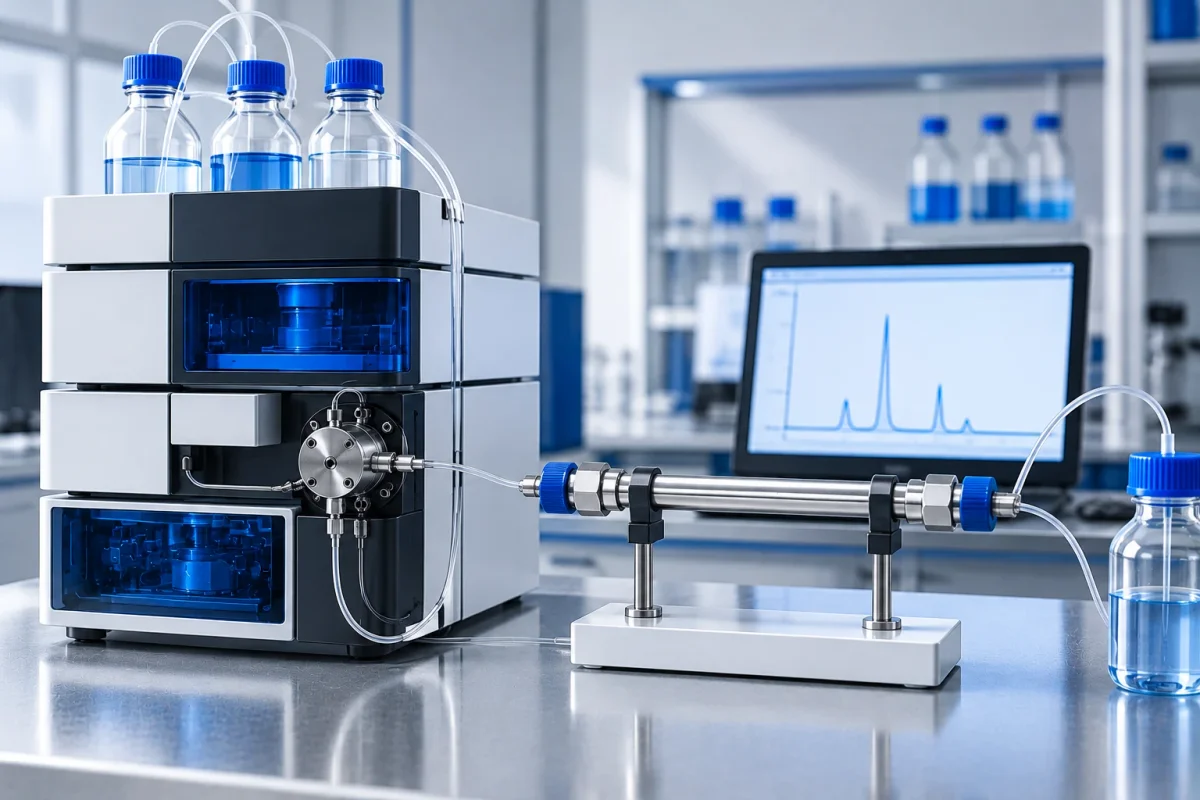
The liquid travels a path: eluent bottle → filter → degasser → pump → injector → guard column → analytical column → detector → waste. Pressure is generated by the pump and depends on the resistance of each section: the smaller the sorbent particles and the narrower the internal diameter, the higher the operating value.
A rough guide for a column with 5 µm particles and a 4.6 mm diameter at a 1 mL/min flow rate is about 80–150 bar on a typical reversed phase. For columns with 1.7–3 µm particles, pressure is 2–3 times higher. Check the exact limit for your model in the manufacturer's manual: HPLC instruments of different generations have different safety margins.
The warning sign is not the absolute number but its trend. If pressure has risen 10–15% from baseline on the same method and the same column, find the cause right away. A rise of 30% or more usually points to serious clogging or a mechanical failure. The chromatograph's hydraulic system is designed so that each component contributes to the total resistance, and pressure build-up in HPLC almost always has one specific source.
External Causes: Clogged Mobile Phase Filter, Degasser, and Capillaries
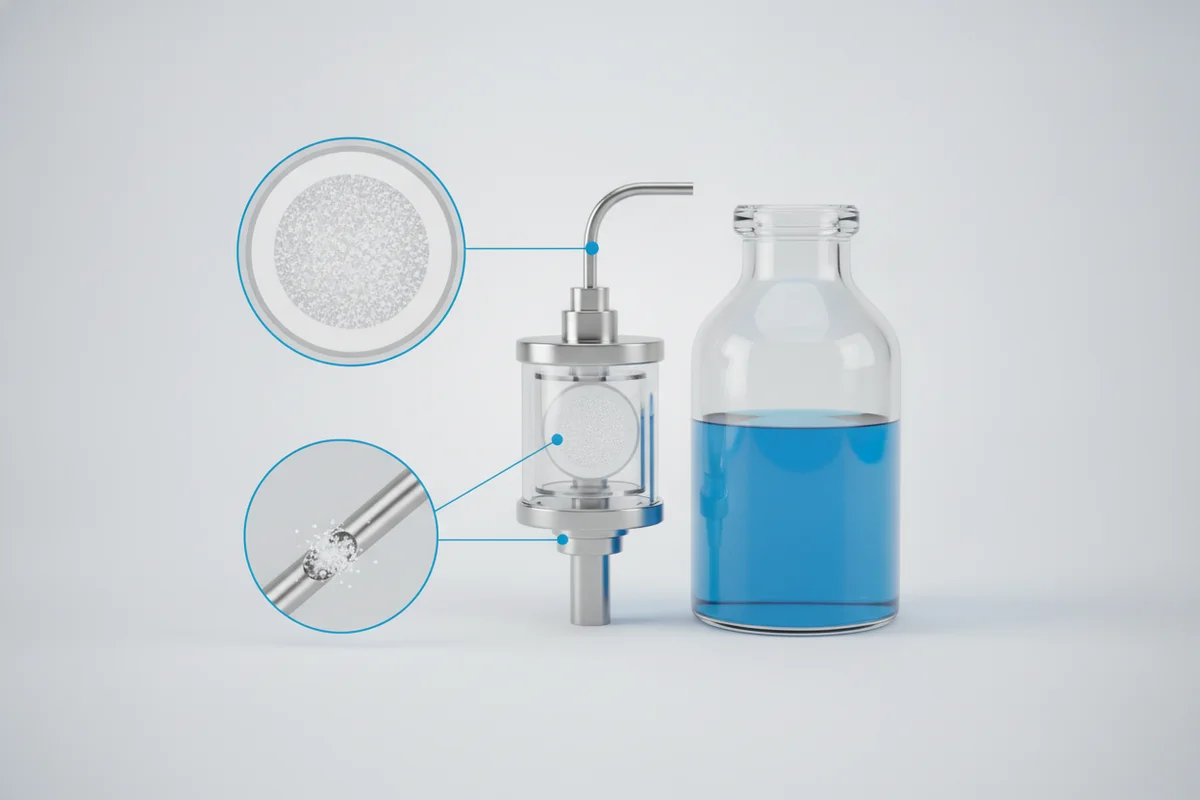
The first place where dirt accumulates is the inlet filter in the eluent bottle. Salt particles, dust, and filter paper fibers settle on it over weeks of operation. The check is simple: remove the filter and run the pump on pure solvent without the column. If pressure drops to 3–8 bar, the inlet filter or the capillary upstream of the pump is to blame. A clogged mobile phase filter is one of the most common causes.
The HPLC degasser and capillaries suffer from salt crystals when the system isn't properly flushed after buffer eluents. If the system sat with phosphate buffer without flushing, salts may have precipitated in the narrow channels. Flushing with warm water (40–50 °C) through all lines removes fresh deposits, but old blockages sometimes require replacing the capillary. When system pressure is unstable, start with component-by-component troubleshooting of the chromatograph.
What to check first:
- the inlet filter for film and mechanical particles;
- the clarity of the eluent in the bottle — no sediment or haze;
- the tightness of connections: air leaks cause not only bubbles but also pressure spikes;
- the condition of spare parts — seals and filters that are past their service life.
Column and Guard Column: Sorbent Clogging, Salt Deposition, Bed Deformation
The HPLC column is the most heavily loaded component. The sorbent gets clogged with particles from the sample, and salts and proteins gradually accumulate at the inlet. The telltale sign: pressure rises only with the column connected, while the system holds normal pressure without it. An additional symptom is pressure rising toward the end of a gradient or after a series of "dirty" samples. HPLC column clogging is often confused with a pump fault.
How to Tell Column Clogging from a Hardware Problem
Disconnect the column and cap the line. If pressure without the column is normal but rises with it, the cause is inside the column. The opposite picture means the problem is in the pump or filters. Second step: replace the guard column with a new one. If pressure returns to operating level, the main column's sorbent is fine and the guard cartridge was the culprit. Sorbent clogging in the guard column is normal after a hundred injections.
Salt deposition is treated by flushing with water for at least 10–20 column volumes, then with a transition solvent. Bed deformation (voids at the inlet) can't be fixed by flushing: the column must be replaced. You can't promise that flushing will restore any column: much depends on the nature of the contamination and the sorbent's remaining life.
For replacement, choose chromatography columns and consumables matched to your specific method: phase, particle size, length, and internal diameter.
Mobile Phase Mistakes: Incompatible Solvents, Buffer Salt Precipitation, Wrong pH
Changing the eluent is a common cause of a sharp pressure rise. Mix acetonitrile with a high-salt buffer and you get precipitate right inside the column. Prepare the phase in the correct order: first the aqueous part with the buffer, then the organic, and only then combine them. Prepare the mobile phase in small batches: buffer with salts in an open container evaporates and changes composition within a day.
The second source of problems is pH. Phosphate buffer above pH 7 in contact with silica gel accelerates sorbent dissolution. Buffer salt precipitation occurs when the solution cools or the organic portion evaporates in an open bottle. This is one of the most underrated reasons why pressure rises.
| Mistake | What it risks | How to avoid it |
|---|---|---|
| Mixing buffer and organic without control | Salt precipitate, clogged column | Prepare the phase in order, filter through 0.45 µm |
| pH above what the phase tolerates | Sorbent degradation, pressure build-up | Keep pH within the manufacturer's specified range |
| Eluent sitting in the bottle for a week | Evaporation, composition change, higher viscosity | Prepare a fresh batch each shift |
Water for eluents must be purified: water purification systems remove ions and organics that would otherwise deposit on the sorbent.
Mechanical and Hardware Causes: Worn Pump Seals, Sticking Valves, Clogged Valve
The pump is the second most frequent culprit. HPLC pump seals wear out over hundreds of hours of operation: micro-leaks appear, pressure "floats" and rises when trying to maintain flow. The check: remove the column and pump water. Steady 3–8 bar without pulsation means the pump is fine; spikes and noise point to worn seals or valves. An HPLC pump fault rarely shows up immediately as a complete failure.
Sticking check valves produce a characteristic picture: pressure won't build or jumps sharply. A clogged injector valve (for example, after viscous samples) restricts flow, and the gauge shows a rise even without the column. Flushing HPLC capillaries and the valve in an ultrasonic bath with a suitable solvent often solves the problem, but worn parts are replaced with new ones from the spare parts kit.
Don't forget the pressure sensor: if it's giving false readings, you'll be hunting for a clog that doesn't exist. Compare the readings against a reference gauge during pumping. Pressure spikes in the system can also result from air entrapment after changing the eluent.
Step-by-Step Troubleshooting: How to Locate the Pressure Rise in 30–60 Minutes
Work from simple to complex, recording pressure at every step.
- Remove the column and pump pure solvent: 3–8 bar means the hydraulics up to the injector are fine.
- Check the inlet filter and eluent: replace the filter, inspect the bottle for sediment.
- Connect the guard column without the main column: a pressure rise points to its clogging.
- Install the column and run water: if pressure is 15% or more above operating level, the column needs flushing or replacement.
- Inspect the pump seals and valves, check the injector valve.
Each step takes 5–15 minutes. Most often the cause is found in the first three — you never get to disassembling the pump. Log the results: the pressure trend over weeks shows when it's time to replace chromatography consumables.
Prevention: Eluent Preparation Rules, Filtration, Guard Column Use, and Column Care
Most pressure spikes are prevented by a 15-minute-a-day routine. Filter eluents through a 0.45 µm membrane, degas before pumping, and prepare buffers fresh. After working with salts, flush the system with water for at least 10 column volumes, then switch to organic. HPLC prevention starts with disciplined solution preparation.
The HPLC guard column is inexpensive and takes on sample contaminants: replace the cartridge every 100–200 injections or when pressure rises 5–10%. Replace the eluent filter once every 1–2 months under intensive use. Store the column in the recommended solvent, never letting the sorbent dry out. Regular column flushing after buffer series extends its life by months.
| Item | When to replace | Sign of wear |
|---|---|---|
| Eluent filter | Once every 1–2 months | Film, pressure rise without the column |
| Guard column | Every 100–200 injections | 5–10% pressure rise |
| Pump seals | Per the manual's service life | Pulsation, leaks |
Keep a log: replacement date, pressure after installation, number of injections. Within a month you'll have your own statistics for each column.
Frequently Asked Questions
What HPLC pressure is considered normal, and when should you worry?
Go by the specification for your column and method, not a general number. Normal is stable pressure without pulsation that doesn't change from run to run. Concern begins when pressure rises 10–15% above baseline on the same method.
How do I know the pressure rise is from the column and not the pump?
Disconnect the column: if pressure is normal without it, the problem is in the column or guard column. If pressure is high even without the column, look at the eluent filter, capillaries, or pump. In such cases, sorbent clogging is almost always visible at the column inlet.
Can a clogged column be flushed, and how do I do it correctly?
Flushing helps with salt and organic residue contamination: run water, then a transition solvent in reverse at low flow. Bed deformation and degraded sorbent won't be restored by flushing, and the column will have to be replaced.
Why does pressure rise after changing the mobile phase or after the weekend?
After a phase change, salts may have precipitated when incompatible solvents were mixed. Over the weekend, the system sits with buffer residue: crystals clog capillaries and the valve. Flushing with warm water and checking the filter solve most such cases. A clogged mobile phase filter is to blame here more often than you'd think.
Real Case Study: Pressure Rose from 120 to 210 bar in Three Days
A lab was running reversed-phase chromatography: a C18 column 150×4.6 mm, 5 µm, eluent — acetonitrile with 20 mM phosphate buffer, pH 6.8, flow rate 1.0 mL/min. The specified pressure for this method was 110–125 bar. On Monday the system read 118 bar, on Wednesday 165, on Thursday 210, and it tripped the upper limit.
The operator started by replacing the column: installed a new one, and pressure dropped to 140 bar. Two injections later it was 190 again. So the cause was upstream, and the money spent on the column was wasted. Next they removed the guard column — pressure on bare hydraulics with pure acetonitrile was 9 bar, which is within the normal range for a system without a column. That left the eluent itself and the column inlet.
They checked the bottle: flakes of phosphate on the bottom, the inlet filter white with sediment. The buffer had been prepared a week earlier and stored in the fridge without a tight lid, some water evaporated, and salts precipitated. They replaced the eluent with fresh, flushed the system with water for 20 minutes, then with acetonitrile — pressure returned to 121 bar and held steady through the whole series. The result: two hours of work instead of three days of back-and-forth with service, and the old column stayed in service.
What this case changed in the procedure: buffer eluent is now prepared for no more than 3 days, stored in a sealed container, and the initial pressure is logged before every series. A deviation of more than 15% from baseline is a reason to stop before the first injection, not after the tenth. In such cases, column clogging is confirmed faster than you'd think.
Mistake → What It Risks → How to Avoid It: Five Situations That Keep Repeating
Below are the remarks you hear at the chromatograph almost word for word. Each one ends either in a column replacement costing 60,000–120,000 sums or more, or in half a day of downtime.
| Operator's mistake | What it risks | How to avoid it |
|---|---|---|
| "I'll raise the flow rate, there are lots of samples" — from 1.0 to 2.0 mL/min without checking the column | Pressure doubles with the square of the flow rate, crushes the sorbent bed at the inlet, the column loses efficiency | Increase flow in steps of 0.2 mL/min and make sure pressure stays within the specified limit |
| "I'll flush with water, salts dissolve" — water right after buffer on a C18 | In an aqueous phase on a reversed-phase column the bed "collapses," pressure spikes, recovery takes hours | Flush at the same organic proportion as the working eluent, then gradually reduce the water content |
| "The bottle filter has been there forever, it looks clean" | Salt sediment and fibers travel into capillaries and the column inlet, pressure rise of 20–40 bar | Replace the 0.45 µm inlet filter every 1–2 weeks, more often when working with buffers |
| "I'll set the pH by guess and check later" | Going outside the salt's buffer capacity causes precipitate right in the flow, the guard column clogs | Measure pH before every eluent change, stay within ±0.5 of the buffer's pKa |
| "I'll crank the fitting tighter so it won't leak" | An overtightened nut deforms the seat, creating dead volume and micro-leaks, pressure "floats" | Tighten to first contact plus a quarter turn; if it leaks, replace the fitting rather than tightening harder |
The golden rule for all five points: whatever you do with the hydraulics, keep an eye on the pressure gauge. If the reading hasn't moved the way you expected after a step, that step didn't work — don't push harder, just go back to the previous state. Buffer salt precipitation shows up here in two out of five cases.
Checklist: what to log every time the pressure rises
A chromatographer's logbook saves more time than any service contract. Five lines per run — and a month later you'll see the pattern: if pressure climbs after buffer runs, it's the salts, not the pump. Set aside a dedicated page for chromatography consumables so replacement deadlines for worn parts stay in plain sight. A chromatograph's hydraulic system demands attention to every component.
- Baseline pressure of the run and the current reading in bar, along with flow rate and eluent composition.
- When the inlet filter was changed and the buffer prepared — date and lot number.
- What changed in the system over the past 24 hours: column, guard column, fittings, eluent.
- Result of a bare-hydraulics test: pressure without a column on pure solvent.
- Date of the last plunger seal replacement and pump run time in hours.
A self-check: open the log for the last 10 runs. If pressure rose 10–15% and didn't come back down after flushing, the guard column is due for a change. If the jump landed exactly on a buffer lot change, the mobile phase is to blame, not the hardware. Write it down right away — reconstructing the timeline from memory a week later is impossible. A clogged mobile-phase filter and fouled sorbent look much the same; the logbook is what tells them apart.
Conclusion
You track down rising HPLC pressure in a chain: eluent and filter → capillaries → guard column → column → pump. That order saves hours and money on premature part replacement. If you need help choosing columns, guard columns, and consumables for your method, the specialists at LPS UZ will take your list of items and system parameters, and for supply and compatibility questions, reach out via our equipment selection contacts.