 Chromatography
C18 vs C8 Columns: Differences, Selection, and Method Transfer

C18 and C8 columns are often seen as interchangeable: both are reversed-phase, both are silica-based, and both work with water-organic eluents. In practice, swapping one for the other without verifying the method changes retention, peak shape, and elution order. Below, we cover how the bonded layer is structured, where each phase wins, and what to check before you buy. Choosing an HPLC column starts with understanding the chemistry of the sorbent, not the label on the hardware.
Let's look at how C18 and C8 columns differ, how that affects retention and selectivity, pH and mobile phase limitations, particle and column size. At the end, you'll find a checklist for selecting a column for your method and the mistakes that kill columns prematurely.
What Is Reversed-Phase Chromatography and Why the Bonded Layer Matters
In reversed-phase (RP) HPLC, the stationary phase is nonpolar while the mobile phase is polar: water or a buffer with acetonitrile or methanol. Nonpolar components bind more strongly to the sorbent and elute later; polar ones elute earlier. This mode suits most pharmaceutical, food, environmental, and clinical methods. Reversed-phase chromatography rests on this simple principle.
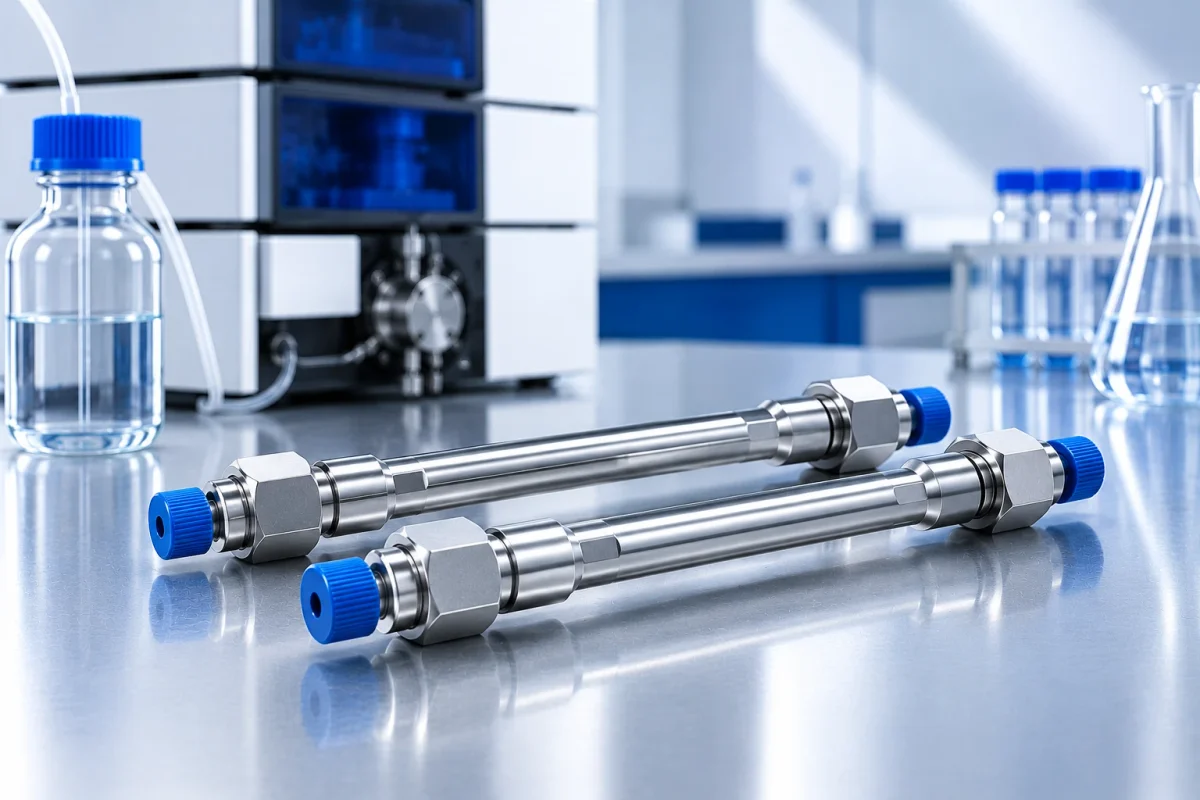
The base of the sorbent is silica gel with a specific pore diameter. Bonded groups are attached to its surface: for C18, it's an octadecyl chain; for C8, an octyl chain. The longer the chain, the more strongly the bonded layer interacts with nonpolar compounds. Bonding can be mono- or polyfunctional, with or without endcapping (blocking residual silanol groups): this affects the peaks of polar and basic compounds. A chromatographic column is more than just a tube packed with sorbent.
The hardware, fittings, frits, and bonding type determine how consistently retention holds from batch to batch. When a method is transferred between instruments, reproducibility of these parameters is what matters.
C18 and C8 Columns: Sorbent Chemistry and Phase Differences
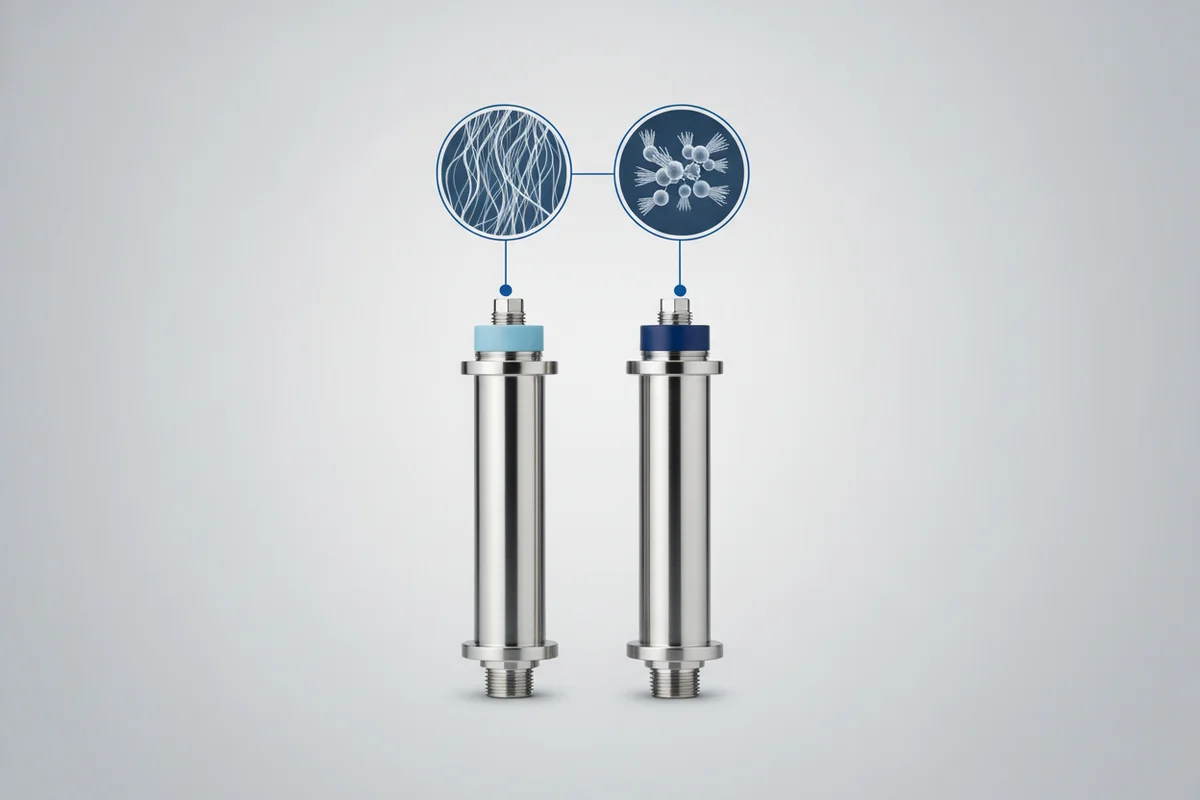
The difference between the phases is the alkyl chain length and bonding density. C18 is more hydrophobic, so nonpolar compounds are retained more strongly. C8 has a shorter chain: the surface is less 'oily', wets better with aqueous eluents, and polar and moderately polar substances elute faster. When deciding between a C18 or C8 column, look at the balance of retention and speed.
C18 octadecyl is the go-to phase for a wide range of RP-HPLC applications. C8 octyl is more often chosen for polar mixtures and short methods.
| Parameter | C18 (octadecyl) | C8 (octyl) |
|---|---|---|
| Hydrophobicity | High | Medium |
| Retention of nonpolar compounds | Stronger | Weaker |
| Polar/basic compounds | Possible peak distortion without endcapping | Often more symmetric |
| Analysis speed | Usually longer | Usually shorter |
| Typical use | Broad range of RP methods | Fast methods, polar mixtures |
Endcapping and the bonding type from a specific manufacturer affect selectivity as much as chain length. So compare columns from the same manufacturer and product line, otherwise your conclusion will be misleading.
Retention and Selectivity: Where C18 Wins and Where C8 Does
An HPLC column with C18 is the default choice when the mix contains nonpolar components, fat-soluble vitamins, steroids, pesticides, or PAHs. The long chain provides more interaction points: nonpolar peaks elute later with better resolution. If a method is already validated on C18, it's usually kept there.
C8 shines where components are retained too strongly on C18 and the run drags on, while reducing the organic fraction worsens peak shape. The short chain cuts retention and lets you fit the separation into a shorter time with the same eluent. The mobile phase stays the same; only the phase changes.
The phase is just one variable. Retention and selectivity also change with buffer pH, temperature, the type of organic modifier, and the nature of surface silanol groups. Two C18 sorbents from different manufacturers can give different elution orders for basic compounds. So before transferring a method, test it on the real mixture.
When C8 Is Preferred: Polar and Large Molecules, Speed of Analysis
If the mix has many polar components, they may be poorly retained on C18 and elute near the dead volume, interfering with each other. In such cases, a C8 sorbent gives more predictable retention and symmetric peaks.
The second reason to choose C8 is speed. Lower retention lets you fit the method into a short gradient or isocratic run without losing resolution. This is critical for high-throughput labs: shaving a few minutes off each sample adds up to significant savings in instrument and staff time over a month.
The third scenario is large molecules. For peptides and some protein mixtures, wide-pore sorbents are used: the molecule must penetrate the particle, so the pore size of the HPLC sorbent matters more than the length of the bonded chain. Dedicated sorbent lines are selected for such tasks, including Supelco sorbents.
Practical Selection: Length, Diameter, Particle Size, Pore Size
The formal column specifications affect efficiency and pressure as much as the phase:
- Length — longer column means more plates, but longer analysis and higher pressure.
- Internal diameter — narrow columns save eluent but require a well-maintained system and leave less room for error in injection volume.
- Particle size — 5 µm is the classic for routine methods; 3 µm and below give efficiency but sharply raise pressure.
- Pore size — typically 100–120 Å for small molecules; wide-pore sorbents are needed for large ones.
First match the pore size to the molecule size, then the particle to the instrument's pressure limit. Never put a column with 2–3 µm particles on a system designed for 5 µm: the pressure will exceed the operating range.
Chromatography consumables include more than the column: you need guard columns, eluent filters, and vial inserts. Without a guard column, sample contaminants reach the sorbent faster and degrade it.
Mobile Phase Compatibility and pH Limits
Standard silica-based C18 and C8 columns typically work in the pH range of about 2 to 8. In alkaline conditions, silica dissolves and column lifetime drops sharply. For pH above 8, use special hybrid-based phases or polymeric sorbents. Check the column's pH stability in the certificate before the first injection.
Organic modifiers: acetonitrile and methanol. Methanol is more viscous than acetonitrile, so pressure will be higher. Buffers are chosen per method: phosphate buffers are popular but can precipitate at high organic fractions. Triethylamine and other additives alter peak shape for basic compounds.
A C18 column dislikes abrupt switches from pure acetonitrile to aqueous buffer without intermediate flushing: you can get a 'sticking' gradient and pressure drift. Make the transition gradually through a miscible composition.
Common Mistakes and How to Extend Column Life
Most columns die not from old age but from simple mistakes. Here's a ready checklist for the lab:
| Mistake | Consequence | How to avoid |
|---|---|---|
| Eluent without filtration and degassing | Clogged frits, pressure spikes | 0.45 or 0.22 µm filters, degassing |
| Sample not prepared | Precipitate and sorbent contamination | Filtration and guard column |
| Storage without flushing | Salt plugs and pressure build-up | Flush with water to remove buffer, then organic |
| Abrupt eluent change | Pressure spike, gradient failure | Gradual transition through miscible composition |
| Operating outside pH range | Silica degradation | Follow the phase certificate |
Condition check: compare baseline pressure and peak shape with current values. Rising pressure and 'tailing' under the same method indicate contamination or sorbent degradation. Regular logging of parameters helps spot problems before the method fails.
What to Check When Receiving a New Column and How to Accept It
A column may arrive with a cracked body, dried-out sorbent, or a certificate listing the wrong phase. Inspect it on the day of receipt while a claim is easy to make.
| What to check | How to check | Acceptance criteria |
|---|---|---|
| Labeling and certificate | Match the label on the body with the certificate: phase, particle and column size | Exact match, including serial number |
| Body integrity | Inspect ends and fittings under bright light | No chips, cracks, or leaks |
| Sorbent | Connect the column and flush with 100% acetonitrile for 10–15 column volumes | Stable pressure, no pulsation or spikes |
| Efficiency | Run a test chromatogram per the certificate method | Plate count no more than 10–15% below certificate |
| Dead volume | Inject a non-retained marker (thiourea, uracil) | Elution time matches calculated value for the column dimensions |
Keep the certificate, invoice, and test chromatogram together: if you need a warranty replacement, these are the first documents requested. Mechanical damage and operation outside the pH range are usually not covered, so a pressure stabilizer and in-line filter are worth having.
Three checks you can do yourself:
- Flush 10–15 column volumes: pressure should plateau within 1–3 minutes, not creep up gradually.
- Inject the test mixture from the certificate: elution time deviations over 10% indicate a sorbent or system issue.
- Measure asymmetry of the first peak: a value above 1.8–2.0 points to voids at the column inlet or incorrect injection volume.
How to Transfer a Validated Method from C18 to C8 and Back
Method transfer in HPLC rarely goes without tweaks: C8 has lower retention, so elution times shift toward the dead volume. Expect a visible shift of 5 to 25% per zone, with the most polar components affected most. This is normal behavior, not a column defect.
Follow these steps to preserve selectivity and avoid redeveloping the method.
- Run a chromatogram on the current phase under working conditions and save it as a reference: elution time, resolution of the critical pair, asymmetry factor, water/acetonitrile ratio.
- Install the column with the new phase but keep the same eluent and flow rate. Note how much the peaks shifted.
- Adjust the organic fraction in 2–5% steps. For C8, you usually need to reduce it by 3–10% to restore retention to previous times.
- Recheck resolution of the critical pair: it should be at least 1.5. If it drops below 1.2, change not only the organic fraction but also column temperature (5 °C steps) or flow rate.
- Record the new conditions in the method log and update the SOP so the next shift doesn't start over.
Switching back from C8 to C18 is easier: retention increases, and some polar peaks can be 'pulled back' from the dead zone. But then check that late nonpolar components don't elute too late and exceed the run time. If the cycle is too long, increase the organic fraction or raise the temperature by 5–10 °C.
Frequently Asked Questions
Which column to choose for a mix of polar and nonpolar components—C18 or C8?
Start with C18 if nonpolar components need strong retention. If polar components elute too early on C18 and interfere, try C8. Make the final choice based on the actual chromatogram.
Why is analysis often faster on C8, and how does that affect separation?
The short chain retains compounds less, so peaks elute earlier. The shorter time is convenient for routine methods, but check resolution of close peaks: speeding up can bring components closer together.
How do particle and pore size affect efficiency and pressure?
Smaller particles give more plates and better separation but higher pressure. Pore size should match the molecule: wide-pore sorbents are needed for large compounds.
Can I switch from C18 to C8 without reworking the method?
Formally the eluent composition stays the same, but retention and elution order may change. Before swapping, test the method on a standard mixture and confirm resolution is acceptable.
How to properly flush and store a column to make it last longer?
After buffers, flush the column with water, then with an organic solvent, and store it in the same solvent. For long-term storage, use the solvent specified in the certificate and do not let the sorbent dry out.
What particle size to choose for regular HPLC without UHPLC?
For a standard instrument with pressure up to 400 bar, 5 µm particles are convenient and don't overload the pump. 3 µm particles give more plates but require a shorter column and higher pressure. If your pump handles 600 bar, 3 µm is justified.
How to flush a C8 column after working with a buffer?
First flush with water without buffer, then with a 50/50 water/acetonitrile mixture, and only then with pure acetonitrile. A direct switch from aqueous buffer to 100% organic causes salt precipitation in the pores and clogs the sorbent.
How often should you replace a column in a routine lab?
The lifespan depends on your samples and eluent, not on the calendar. As a rough guide: 500–2000 injections per column when samples are properly prepared. Keep an eye on rising pressure, falling plate counts, and peak asymmetry: when the resolution of the critical pair drops below 1.2, it's time to change the column.
What should you do if pressure rises after changing the eluent?
Give the system 10–15 column volumes to stabilize: part of the pressure increase is due to the viscosity of the new mix. If the pressure keeps climbing, check the eluent filter and degassing: more often than not, that's where the problem lies, not in the sorbent.
Conclusion
Choosing between C18 and C8 comes down to your actual mix: first assess the polarity of the components and the allowable pressure, then select the column dimensions and verify the method on a standard sample. At LPS UZ, we'll help you choose the right phase and consumables for your method: send a list of your samples and your instrument parameters to contacts to get a consultation and a quote.