 Chromatography
How to Choose a C18 HPLC Column

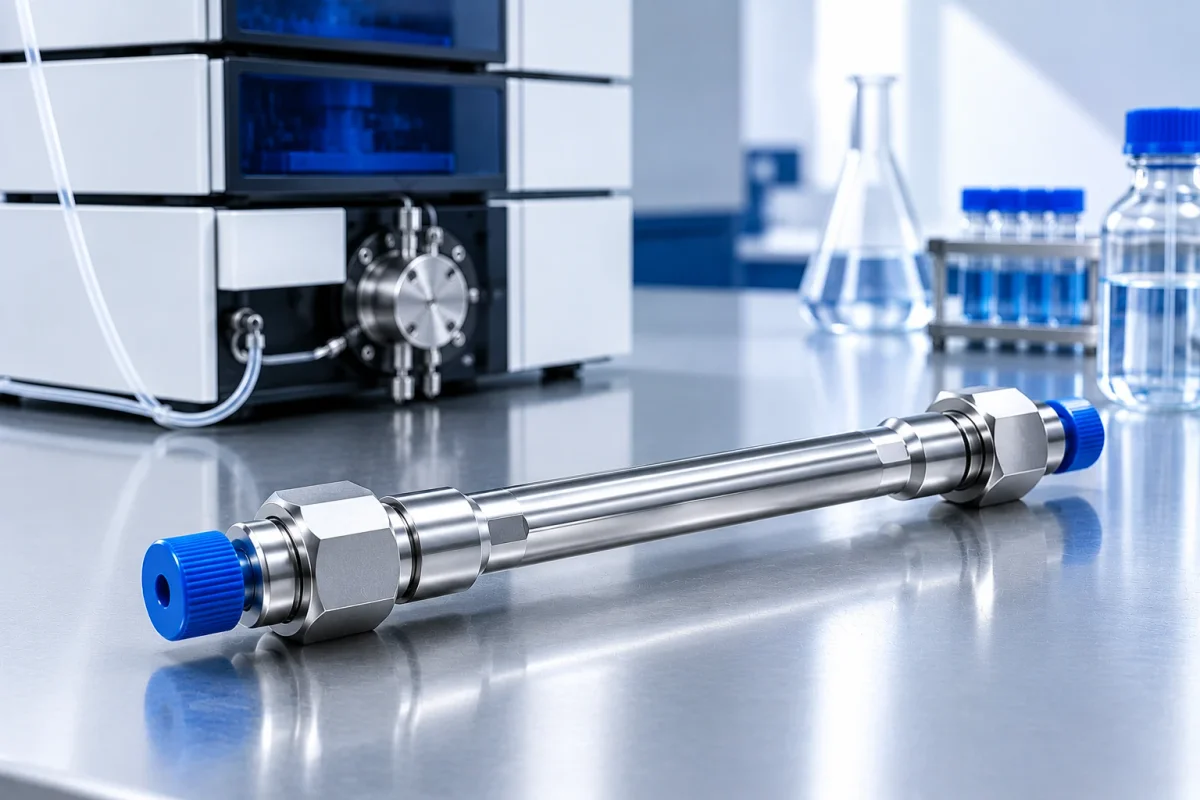
How to choose a C18 HPLC column? The short answer: start with your method and the type of chromatograph, and only then compare particle size, pore size, length, and diameter. A column with a C18 phase is versatile, but that's exactly why there are dozens of similar options on the market at different prices. Below is a step-by-step breakdown of the parameters, checks, and an ordering checklist to help you pick the right column for your analysis and avoid paying for features you don't need.
What Is a C18 Column and What Analyses Is It For?
C18 is octadecylsilane bonded to silica gel. This is a reversed phase: it retains nonpolar and weakly polar compounds, while polar compounds elute earlier. Hence its use in pharmaceuticals, quality control, food, and environmental analysis.
A C18 column is suitable for most routine methods: determination of active ingredients, impurities, preservatives, vitamins, pesticides, and dyes. If your method specifies a C18 reversed phase with a water/acetonitrile or water/methanol gradient, it's most likely this type.
When C18 won't work: highly polar compounds without a chromophore, isomer separation, or strict requirements for pH below 2 or above 8. In those cases, look at other phases (C8, phenyl, amino, HILIC).
Check: take your method and write down three things — the phase, the mobile phase composition, and the pH. If the phase isn't specified and the method is 'classic' (water/acetonitrile, UV detection), start with C18.
Key Parameters: Particle Size, Pores, Length, and Internal Diameter
These four parameters determine how your C18 chromatographic column performs in your system: resolution, pressure, analysis time, and solvent consumption. It's convenient to put the HPLC column parameters into a table before ordering.
Particle Size
The standard for most labs is 5 µm: acceptable pressure and sufficient resolution. An HPLC column particle size of 3–3.5 µm gives narrower peaks and faster run times but requires higher pressure. Sub-2 µm particles work on UHPLC systems, and UHPLC and sub-2 µm are incompatible with classic HPLC.
Pore Size
Column pore size is typically 100–120 Å for molecules up to 2000–3000 Da. For proteins and peptides, use 300 Å or larger, otherwise large molecules won't penetrate the pores. For small molecules, larger pores reduce retention capacity without any benefit.
Length and Diameter
Column length and diameter: 150 mm is a go-to choice for complex mixtures, 100 mm is a compromise on speed, 250 mm maximizes resolution. Diameter 4.6 mm is standard, 2.1 mm saves solvents and is compatible with mass detection, and 3.0 mm is an intermediate option.
Endcapping, pH Range, and Selecting a Phase for Your Method
Column endcapping blocks free silanol groups. Without it, basic compounds give tailing peaks. For analyzing bases, choose a C18 column for bases with stated endcapping and proven inertness.
The pH range of a C18 column is the main limitation on its service life. Classic C18 columns work at pH 2–8. For pH up to 1.5 or above 8, you need special phases (hybrid, hydrolysis-resistant). Working outside the stated range accelerates wear and changes retention.
Selecting a column for your method starts from the method, not the other way around. If the method requires a gradient with a high aqueous content, look for an aqueous-stable phase resistant to 'dewetting.' For fatty acids and lipids, you sometimes need a phase with different selectivity.
A C18 chromatographic column is a consumable with a limited lifespan. Compare options by the combination of: price + lifespan + batch reproducibility.
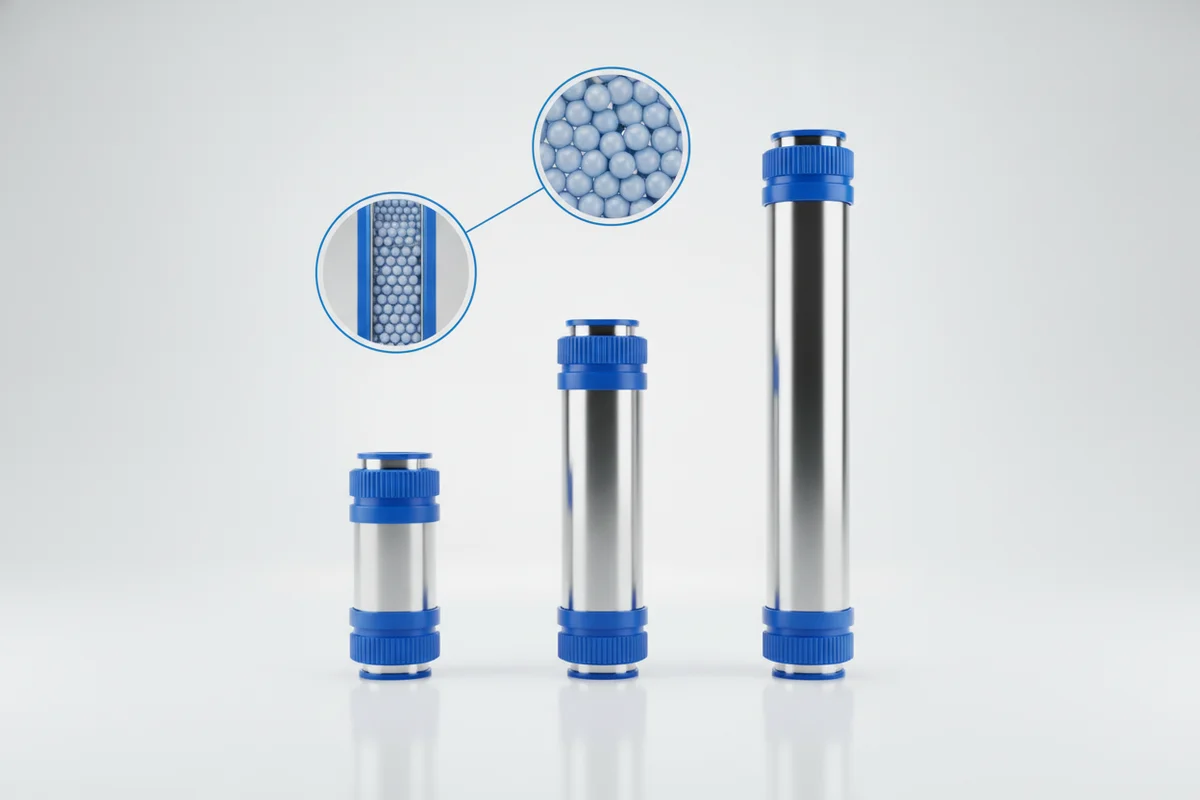
Chromatograph Compatibility: Pressure, Injection Volume, Flow Rate
Before ordering, check whether your system can handle the column. Calculate the expected pressure using the formula: pressure increases inversely with the square of the particle diameter and directly with length and viscosity.
Example: switching from 5 µm to 3 µm at the same length roughly doubles the pressure. If your pump maxes out at 400 bar and your method already runs at 300 bar, a 3 µm column could push the system over the limit.
| Parameter | Classic HPLC | UHPLC |
|---|---|---|
| Particle size | 5 µm | 1.7–2 µm |
| Operating pressure | up to 400 bar | up to 1000+ bar |
| Column diameter | 4.6 mm | 2.1 mm |
| Injection volume | 10–20 µL | 1–5 µL |
Flow rate for 4.6 mm is typically 1.0–1.5 mL/min, for 2.1 mm it's 0.2–0.4 mL/min. Keep the injection volume within 1–5% of the column volume, otherwise peaks broaden.
Consider the system's dead volume: when switching to a narrow column, old tubing and the flow cell can negate the gains.
When You Need a New Column: Signs of Wear and Analysis Errors
A column ages gradually, and at first everything gets blamed on a 'bad sample.' Here are the signs it's time to replace it:
- Pressure increases with the same method and mobile phase.
- Peak shape has worsened: tailing, splitting, loss of resolution.
- Retention time has shifted by more than 5–10% without changing conditions.
- Extra peaks or baseline noise have appeared.
| Mistake | What it leads to | How to avoid it |
|---|---|---|
| Running without a guard column | Rapid sorbent wear | Use a guard column or in-line filter |
| pH outside the range | Phase hydrolysis, loss of retention | Check mobile phase pH before running |
| Unprepared sample | Clogging of the column inlet | Filter samples through 0.22–0.45 µm |
Before retiring a column, flush it according to the manufacturer's instructions: backflushing with a strong solvent often restores some of its life.
How to Check and Validate a Column After Installation
Test a new column with a test mixture per the manufacturer's protocol: check the theoretical plate count, asymmetry factor, and resolution. Compare the results with the column's certificate.
Then run your working sample three times. Make sure retention time is reproducible, peak area is stable, and resolution of the critical pair meets the method's requirement.
For validated methods, log the parameters: column serial number, installation date, pressure, plate count. Compare after a month: this way, wear is visible before analysis problems start.
If you need to select chromatographic columns and related consumables for your method, check out [Restek columns]('/brands/119-restek') and the [Supelco brand]('/brands/130-supelco') range.
Practical Checklist for Ordering a Column and Consumables
Put together your request so the supplier gets it right the first time. Mistakes in the request are the main cause of returns and downtime. An HPLC column for routine analyses is often bought with a spare to avoid stopping the sample flow.
- Write down the phase, length, diameter, particle size, pH, and flow rate from the method.
- Specify the chromatograph model and maximum operating pressure.
- Check whether you have a guard column and whether it fits the new column.
- Add chromatography consumables: mobile phase filters, syringe filters, vials, caps, tubing, and fittings.
- Get a spare: one column in use, one for replacement.
| What to order | Why | How much to get |
|---|---|---|
| Analytical C18 column | Main analysis | 1 working + 1 spare |
| Guard column | Sorbent protection | 2–3 cartridges |
| 0.22 and 0.45 µm filters | Sample and eluent prep | Based on quarterly usage |
| Vials and caps | Autosampler | With 10–20% extra |
If you need [chromatography consumables]('/categories/115-zapasnye-casti') and a column for a specific method, write to us: [request a consultation and quote]('/contacts').
How to Select a Column for a Specific Method: A Calculation Example
Take your method and write down four numbers: length, internal diameter, particle size, and flow rate. Then check whether the chosen column fits within your pump and detector limits. Below is an example for a C18 reversed phase on gradient HPLC.
Method: column 150 × 4.6 mm, 5 µm, flow 1.0 mL/min, mobile phase acetonitrile/water. You have a system with a 400 bar limit and a column 100 × 2.1 mm, 1.8 µm. Calculate the expected pressure using the empirical formula: P₂ = P₁ × (L₂/L₁) × (d₁/d₂)² × (dp₁/dp₂)². Going from 5 to 1.8 µm at the same length increases pressure by about 7.7 times. Reducing the length to 100 mm gives 5.1×. Reducing the diameter from 4.6 to 2.1 mm keeps the plate count and allows you to lower the volumetric flow to 0.3–0.4 mL/min, which further reduces pressure by about 2 times. The result is 5.1 / 2 ≈ 2.6× the original pressure. If the method ran at 120 bar, you'll get about 310 bar, within 400.
Check the injection volume. On a 2.1 mm column, the allowable injection volume is about 4.8 times less than on 4.6 mm: 20 µL becomes 4 µL. Otherwise peaks broaden and resolution drops, even if pressure is fine.
How to Store and Maintain a C18 Column for Longer Life
Column lifespan is determined not only by the number of injections but also by how you treat it between analyses. A few habits significantly extend its life.
- Flush the column after a gradient: 10–15 column volumes of a composition in which the sample is soluble, then switch to the manufacturer-recommended storage solvent.
- Don't leave the column in buffer overnight without flushing: salts precipitate and clog pores. Flush with water for at least 10 column volumes, then switch to organic/water.
- Store at room temperature in a 60:40 acetonitrile/water mixture or the solvent specified in the column certificate. Put the caps on immediately.
- Install a filter at the mobile phase inlet (0.22 or 0.45 µm) and a guard column: this is cheaper than replacing the main column.
- Avoid freezing and drying out: if the column was stored dry, pump 20–30 column volumes of mobile phase at low flow before running to ensure uniform wetting of the silica.
The lifespan of a 4.6 × 150 mm, 5 µm column with careful use is about 500–1000 injections before a noticeable drop in resolution. With 'dirty' samples without filtration, lifespan is reduced by 2–3 times. Replacing the guard column every 100–200 injections costs far less than a new analytical column.
Common Mistakes When Choosing and Ordering a Column
| Mistake | What it leads to | How to avoid it |
|---|---|---|
| 'I'll get 1.8 µm for faster runs' | Pump can't handle the pressure, system errors out | Calculate pressure first, then order |
| Ordering without specifying method pH | Column quickly loses endcapping, base peaks tail | Note the pH from the method and check against the certificate |
| Skipping the guard column | Main column clogs, lifespan drops 2–3 times | Guard column and mobile phase filter are a must |
| New lot without test mixture verification | Dispute with supplier if specs deviate | Run a test chromatogram right after installation, before first samples |
| Hardware material not checked | Corrosion at high salt concentration and low pH | Check the certificate for hardware material and pH range |
One case study. A client says: 'Same column, but peaks split — must be a bad batch.' In most cases, the cause is different: a clogged guard column, a dirty mobile phase filter, or an unsuitable sample solvent. Before filing a claim, replace the guard column, run the test mixture, and compare with the certificate. If the specs are fine, the issue is in the system, not the column.
What Documents Come With a Column and What to Request From the Supplier
A C18 column is a support with reproducible characteristics, so it comes with a set of documents. Check they're included before paying.
- Certificate of quality with lot number and test mixture results: plate count, asymmetry factor, resolution.
- Test chromatogram for the current lot, not the batch as a whole.
- pH range, maximum pressure, recommended solvents, and storage conditions.
- Shelf life and shipping conditions, especially if the column ships chilled.
- Invoice and delivery note for the legal entity, if purchasing for a lab.
If your lab operates under a quality management system, attach document requirements and the method number to your request. Then the supplier will select an option with a certificate listing the required parameters, and you'll avoid the situation where a column arrives without a test report.
How to Choose a C18 HPLC Column for Your Method: A Short Algorithm
Five steps that settle the question: write down the phase, length, diameter, particle size, pH, and flow from the method; check the pump pressure limit with a calculation; verify pH against the phase certificate; select a guard column and filters; submit your request with a spare column. This algorithm works for both routine replacement and method transfer to a new system. For everyday work, 5 µm and 150 mm are often chosen because they're predictable in pressure and sufficient in resolution.
Frequently Asked Questions
Can I use a 3 µm column on a regular HPLC?
Yes, if the system pressure stays below the pump limit. First estimate the pressure increase: 5 → 3 µm roughly doubles it. If your pressure headroom is less than 30%, it's better to stick with 5 µm.
What's the difference between C18 and C8?
C8 is less hydrophobic and retains compounds less strongly, so polar compounds elute faster. For highly hydrophobic samples, C8 can sometimes be the better choice: there's less risk of "sticking" and the gradient is easier.
How long can a column be stored unused?
In a storage solvent (typically 60:40 acetonitrile/water without buffer), a column can be stored for years. The key is not to leave buffer salts in it: they must be flushed out before storage.
Can a column be washed and put back into service?
Often yes: backflushing with a strong solvent removes some of the contamination. If the plate count hasn't recovered after washing, the column has reached the end of its life and needs to be replaced.
Choosing a C18 column comes down to four steps: take the parameters from the method, check your system's pressure limit, select a phase with the right pH, and order consumables with some spare. [LPS UZ]('/') sources analytical equipment and consumables for the laboratory's needs and helps put together a request based on your method. Send us your analysis parameters and your chromatograph model, and we'll prepare a quote.