 Labware
What Are Erlenmeyer, Round-Bottom, and Flat-Bottom Flasks For?

Many people buy glassware "by eye": they grab flasks of one type and volume, then discover that they crack under vacuum and heat unevenly on a hotplate. The question of what Erlenmeyer, round-bottom, and flat-bottom flasks are for isn't about shape—it's about the task you're solving: titration, mixing, heating, or distillation.
Below you'll find the design of each type, compatibility with ground joints and equipment, common mistakes, and a practical selection checklist. At the end, we'll cover what to confirm when ordering in Tashkent so you don't overpay for extra volume or end up with a flask that won't fit your condenser.
Erlenmeyer Flask: Design and Why the Conical Shape Works
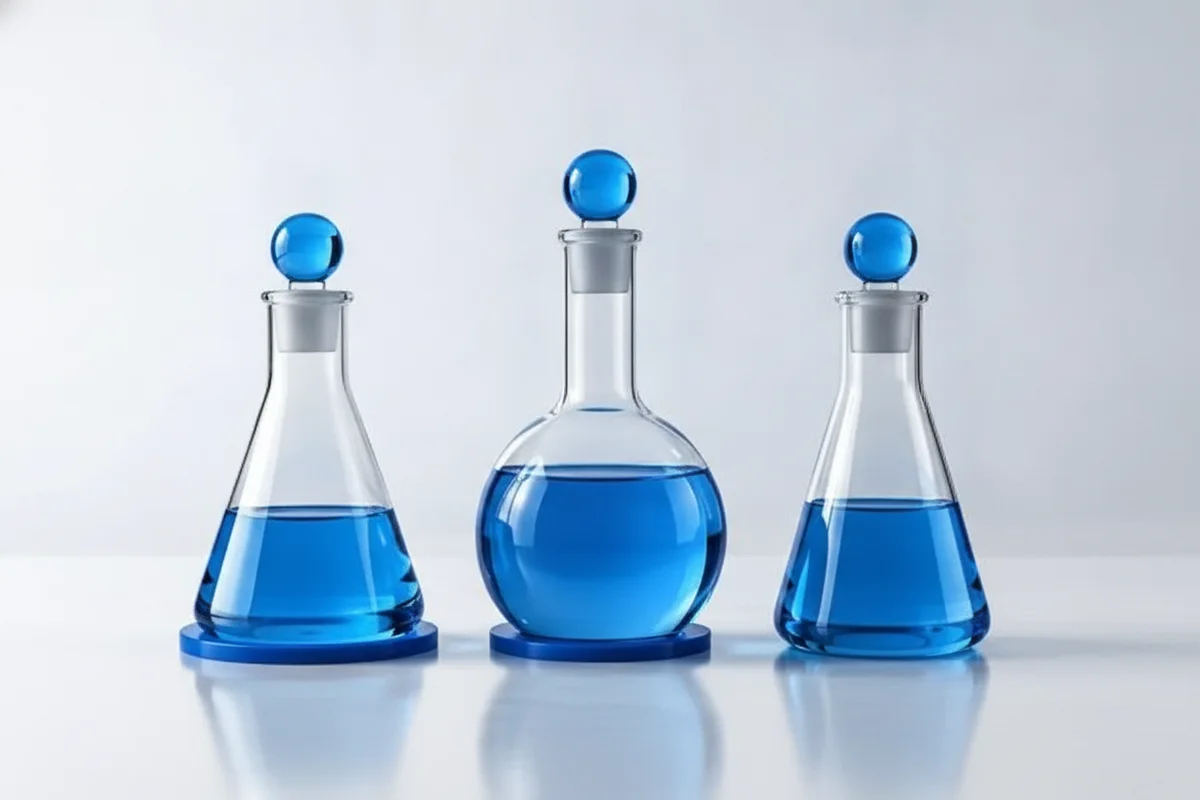
The conical flask, or Erlenmeyer flask, has a body that widens toward the top with a flat bottom and a narrow neck. This shape provides a wide mixing zone with a small neck opening: liquid mixes when swirled, and splashes don't fly onto the bench.
The conical geometry is handy when working with solutions by hand: during titration, color changes are easy to see, and the narrow neck reduces evaporation of volatile reagents. The flat bottom lets you place the flask on a magnetic stirrer or the bench without a stand.
Erlenmeyer flasks are used for:
- titration and preparing working solutions per protocol;
- growing cultures on a shaking incubator, where aeration matters;
- mixing on a magnetic stirrer with a stir bar;
- storing solutions under a ground-glass stopper or film.
Choose a volume with headroom: a 250 mL flask comfortably holds 100–150 mL of solution; otherwise, liquid will creep into the neck during mixing. If your protocol allows heating on a hotplate, pick a flask with a flat bottom free of cracks and chips on the rim.
Erlenmeyer flasks are also common in teaching labs: clear glass and graduation marks on the body help quickly estimate sample volume. Lab flask types differ in purpose, and it's best not to confuse a conical flask with a volumetric one.
Round-Bottom Flask: Even Heating, Distillation, and Vacuum Work
A round-bottom flask has a spherical bottom and one or more necks. The sphere distributes heat flow across the entire surface, so liquid boils without local overheating and bumping, and the thin wall transfers heat evenly in a heating mantle or bath.
Under vacuum, a sphere withstands external pressure better than flat faces. That's why round-bottom flasks are chosen for distillation, rotary evaporation, vacuum filtration, and reflux boiling. Vacuum distillation is the main scenario where skimping on glass thickness ruins the experiment.
What to consider when choosing:
- Fill volume—guideline: no more than half or two-thirds of the nominal volume, or foam will carry into the condenser during boiling;
- Number of necks: one for distillation; two or three for a thermometer, adapter, and stirrer;
- Heater: a round bottom needs a heating mantle with a matching well or an oil or water bath.
Placing a round-bottom flask directly on an open hotplate with a flat burner is risky: the contact area is small, and the glass heats unevenly. The standard replacement for a heating mantle is a bath with heat-transfer fluid and a ring stand that holds the flask upright. Heating a round-bottom flask on a hotplate without a stand is a common cause of cracks.
Flat-Bottom Flask: Stability on the Bench and Hotplates
The flat-bottom flask is a versatile type with a flat bottom and a single neck. It stands on the bench without a stand, is easy to carry, and sits well on a stirrer and hotplate. Thanks to the flat bottom, thermal contact with the burner is better than with a sphere—a plus for simple heating in a water bath.
The downside is uneven heating near the walls and lower vacuum resistance. If your protocol requires reflux boiling without stirring, a flat-bottom flask may bump: add boiling chips or a stir bar.
When a Flat-Bottom Flask Wins
The flat bottom is convenient for reactions with mixing on a magnetic stirrer-hotplate, for simple atmospheric distillation, and for storing prepared solutions. Another plus—it's easier to clean: wide bottom and access through the neck. A magnetic stirrer with a flat-bottom flask works more steadily; the stir bar doesn't "jump" around a sphere.
If you work with both heating and vacuum, keep both types on hand: flat-bottom for the hotplate and stirrer, round-bottom for distillation and vacuum. That's cheaper than replacing a broken flask mid-protocol.
Ground Joints and Necks: How the Flask Connects to the Condenser, Adapter, and Stirrer
A flask with a ground joint has a frosted conical neck that connects to a matching joint on a condenser, adapter, or transition piece without a stopper or rubber tubing. Apply a thin layer of grease so the connection doesn't seize after heating. Flask joints and necks are specified as a pair of numbers: nominal diameter and cone length.
Before ordering, measure the mating part of your condenser or adapter and check the marking on the glass. A flask without a joint will fit a drilled rubber stopper—cheaper but less airtight under vacuum.
| Flask type | Typical task | Equipment | Ground joint |
|---|---|---|---|
| Conical (Erlenmeyer) | Titration, mixing, culturing | Stirrer, shaker | Often without joint |
| Round-bottom | Distillation, boiling, vacuum | Heating mantle, bath | Single- and multi-neck |
| Flat-bottom | Hotplate heating, solution storage | Hotplate, stirrer | Single- and multi-neck |
| Volumetric | Preparing solutions of exact concentration | — | With stopper |
Assembling a setup also requires connecting fittings and connectors—choose them for your tubing diameter and joint type. Check that the adapter seats without skew: even a slight wobble under vacuum causes air in-leakage.
Material and Accuracy Class: Borosilicate Glass, Volumetric and Unclassified Flasks
Lab flasks are made of borosilicate glass: it withstands heating, temperature swings, and contact with most reagents. Ordinary household glass isn't suitable for heating and vacuum. If your protocol lists a solvent without specifying material, ask the supplier: borosilicate is marked on the body.
Accuracy class applies to volumetric glassware. A volumetric flask with a single mark on the neck delivers an exact volume at a given temperature and is used to prepare titrant and standard solutions. Conical and flat-bottom flasks aren't assigned volumetric accuracy: their job is handling reaction mixtures.
Rule of thumb:
- Preparing a solution of exact concentration—use a volumetric flask of the required class;
- Titrating and mixing—use a conical flask;
- Heating, boiling, or working under vacuum—use a round-bottom flask.
If the protocol says "volume of solvent" without "exactly," a volumetric flask isn't required: a graduated conical flask will do, and measure the volume with a cylinder. Exact concentration is set only with volumetric glassware.
Flask volume selection ties to your working solution dose: for 50 mL of titrant, choose 100–250 mL; for 200 mL of distillation, choose 500 mL. An oversized flask makes color changes harder to see and takes longer to heat.
Common Mistakes: Heating Without a Mantle, Stirring Without a Bar, Wrong Volume
Mistakes in glassware selection cost more than the difference between flask types. Below are three common cases with risks and solutions.
| Mistake | Risk | How to avoid |
|---|---|---|
| Heating a round-bottom flask on a flat hotplate | Uneven heating, crack, sample loss | Heating mantle or bath with stand |
| Stirring without a bar and without volume headroom | Liquid enters the neck, splashing | Bar sized to bottom diameter, fill to half |
| Choosing an oversized flask "for growth" | Poor visibility of color change during titration | Volume matched to working solution volume |
| Using a flask without a joint under vacuum | Air in-leakage, distillation failure | Flask with joint and adapter |
A note on cleaning: don't dry flasks over an open flame and don't pour cold water into glassware just removed from a hotplate. A sharp temperature change is a common cause of cracks that go unnoticed until vacuum. Titration in a flask with a cracked bottom ends with a lost sample.
What Are Erlenmeyer, Round-Bottom, and Flat-Bottom Flasks For: Matching to the Task
Gather the basics from your protocol: what you're doing (titration, mixing, heating, distillation), working solution volume, whether vacuum is required, and whether adjacent equipment has a ground joint. Then select by type and volume, not the other way around.
Checklist before ordering:
- Define the task in one phrase: "titration of 50 mL" or "vacuum distillation."
- Choose a volume with headroom: working volume about half the nominal.
- Measure the ground joint of the mating part on your condenser or adapter.
- Confirm whether ground joints are needed and what equipment you already have.
- Check that a heating mantle is available for the round bottom of the required diameter.
Browse available lab glassware brands in the brands section, and the range of volumetric and chemical glassware in the general lab equipment category. Technical requirements for glassware and flask classification are given in current standards and lab practice references: use them to verify temperature and operating conditions.
What to confirm with the supplier: glass material, joint size, presence of graduations, and batch. Prices, lead times, and delivery terms in Tashkent—check on the website and with a manager: they depend on volume and model.
Lab glassware in Tashkent is the query that starts a supplier search: in the catalog, check type, volume, joint, and material on one card; otherwise, it's easy to pick an incompatible flask. Lab glassware in Tashkent in stock at local dealers cuts waiting from weeks to days.
Frequently Asked Questions
How does an Erlenmeyer flask differ from flat-bottom and round-bottom flasks?
The conical shape and narrow neck reduce splashing during swirling and titration. Round-bottom gives even heating and better vacuum resistance; flat-bottom is more stable on the bench and hotplate. What they share is that all three are reaction vessels, not volumetric glassware.
Which flask should I use for titration and which for distillation?
For titration, use a conical flask of suitable volume without a joint or with a stopper. For distillation, use a round-bottom flask with a joint for the condenser and adapter. A flat-bottom flask works for simple atmospheric distillation.
Can I heat a round-bottom flask on a hotplate, and what can replace a heating mantle?
Direct heating on a flat burner gives uneven heating and risks cracks. Alternatives: a water or oil bath with a ring stand, or a heating mantle with a well for the round bottom. Choose heat-transfer fluid temperature per your protocol.
What does a ground joint on a flask mean, and how do I match the size to my condenser?
A ground joint is a frosted conical neck for connecting to a matching joint without a stopper. The size is read from the marking on the glass and must match the mating part. Measure the diameter and cone length; if in doubt, use an adapter.
Do I need a volumetric flask if the protocol just says "volume of solvent"?
No, if concentration isn't specified exactly: a conical flask and a cylinder for measuring will suffice. Volumetric is needed where you prepare a solution of exact concentration with a single mark on the neck. The difference in price and accuracy between these types is significant.
Cleaning, Drying, and Storing Flasks: What Extends Service Life
A borosilicate flask lasts for years, but cracks and cloudy film appear more from care than from use. Three habits save the lab budget: wash right after the experiment, dry without sharp temperature changes, and store with the neck open.
- Wash with warm detergent solution and a brush sized to the flask diameter. For round-bottom, use a brush with a flexible handle: a stiff scourer without lint is worse at removing bottom sediment.
- Rinse with tap water, then distilled water. Three portions of 20–30 mL for a 250 mL flask are enough to remove detergent residues.
- Dry upside down on pegs or in a drying oven at 60–80 °C. Don't place a wet round-bottom flask on a hotplate: uneven heating on wet glass causes cracks.
- Store only dry glassware with a stopper inserted. Cover wet glassware with paper or leave open; otherwise, odors and mold develop inside.
Ground joints need special attention. Clean frosted surfaces without abrasives, and after drying, store with a thin layer of grease or a paper gasket. A joint clogged with residue seizes, and separating it without chipping isn't always possible.
| Symptom | Cause | What to do |
|---|---|---|
| White cloudy film on the bottom | Hard water, dried salts | Rinse with 5–10% acid solution, then distilled water |
| Joint seized | Alkali or reagent in the gap | Soak in solvent for 1–2 hours, don't tap |
| Crack at the neck | Overtightened holder or sudden cooling | Retire the flask, use only at atmospheric pressure |
| Odor inside a closed flask | Storing wet with a stopper | Dry, store open |
Receiving a batch of flasks: five checks before you sign the delivery note
Glassware arrives in shipping packaging, and some defects only become visible once you unpack it. Inspect the batch on the day it arrives: suppliers accept claims for breakage and chips based on a report, and after a week it's much harder to prove where a chip came from.
- Hold each flask up to the light. Chips on the neck, star cracks and hairline cracks on the bottom are grounds for setting it aside.
- Fit the flask to the ground joint of a condenser or adapter. The joint should go on with light pressure and seat evenly, with no wobble or misalignment.
- Check the volume of a volumetric flask: filling to the mark at 20 °C should match the nominal value. The tolerance for Class A is ±0.1–0.2%, depending on volume.
- Check the markings: the material (borosilicate glass 3.3), accuracy class, nominal volume and joint size should all be legible on the body.
- Heat one flask from the batch to the working temperature of your method. Even heating with no crackling confirms the glass has been properly annealed.
If your method requires a vacuum, add a pressure test: assemble the system and hold it for 10–15 minutes. The gauge needle shouldn't drift downward. For a batch of 20–30 flasks, this inspection takes 40–60 minutes and heads off most disputes with the supplier.
Choosing a flask comes down to the task, the volume and joint compatibility: conical → for titration and mixing, round-bottom → for heating and distillation, flat-bottom → for hotplates and storing solutions. Make a list from your method, measure the joints and compare it with what you already have in the lab. At LPS UZ they'll help you pick the type, volume and joint for your task and confirm availability and delivery terms — send them your list or ask a manager.